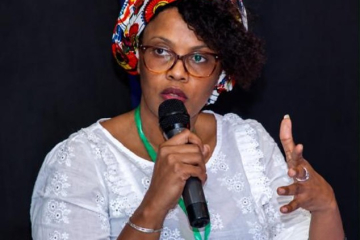
In a profession traditionally dominated by men, her journey from a Fibre-Optic Transmission Technician to Senior Manager of Transmission at Gamtel/Gamcel stands as an example of determination, professional excellence and the power of challenging gender stereotypes.
When Kodou Jeng joined Gamtel in January 2002, following her telecommunications training at the Gambia Technical Training Institute (GTTI), she was entering a field where women were significantly underrepresented. Among the 20 students admitted into her telecommunications programme, she was one of only three women.
More than two decades later, she has risen through the ranks to become one of the women occupying a senior technical leadership position in the country’s telecommunications sector.
Her journey, she explains, has been characterised by determination, continuous learning, resilience and a refusal to allow gender stereotypes to define her professional ambitions.
Starting as a technician, she worked directly with fibre-optic infrastructure, installations, maintenance and network operations. Through commitment and professional development, she progressed to Senior Engineer, first in Fibre Transmission and later in Radio Transmission.
In 2012, she became Manager of Transmission Radio, taking responsibility for leading a team of male engineers. Her career reached another milestone in 2023 when she was appointed Senior Manager of Transmission.
One of the defining moments of her professional journey was being entrusted with leadership responsibilities in a technical department where women were rarely represented in senior positions.
She also received an opportunity to pursue a Bachelor’s degree in Telecommunications Engineering in Ghana between 2017 and 2019, sponsored by Gamcel. She graduated with honours and was the only woman in her cohort.
Looking back, she believes her experience demonstrates that one’s starting point should never determine one’s destination.
“I started as a technician, but I never allowed my position to limit my ambition. I believe in growing through experience, proving myself through results and remaining open to learning,” she said.
Breaking barriers in a male-dominated profession

Working in telecommunications engineering as a woman has not always been easy. She recalls entering technical environments where men overwhelmingly occupied engineering and field operations positions, sometimes raising questions about women’s ability to handle demanding technical responsibilities.
One experience that remains particularly memorable occurred during the former Jammeh administration when she was working in Kanilai.
She recalled that some soldiers followed her to the equipment room and questioned whether women were capable of undertaking engineering work.
Rather than becoming discouraged, she invited them to observe what she was doing.
“When the problem was resolved and the site came up, they were so happy. Sometimes the best way to answer doubts is to prove yourself,” she recalled.
That experience reinforced her determination to demonstrate her capabilities through competence, practical knowledge and results.
Today, she leads a team of engineers and believes women should not be judged by stereotypes about what they can or cannot accomplish.
Her message to young women is that no profession should be considered beyond their reach simply because it is traditionally dominated by men.
Leadership beyond professional titles
For her, professional success is not measured by appointments and positions alone. It is also about the opportunity to contribute to national development and create opportunities for others.
Throughout her career, she has contributed to the development, maintenance and expansion of critical telecommunications infrastructure in The Gambia.
Among the initiatives she is particularly proud of is the expansion of 3G infrastructure, through which 50 new 3G sites were delivered under a network expansion project. She served as the transmission resource person on the project team.
However, her ambitions extend beyond the corporate environment.
Recognising the limited participation of women and girls in science, technology, engineering and mathematics, she founded Women in STEM Gambia in October 2022.
The initiative was inspired by her personal experience as a woman navigating a male-dominated technical profession and her observations of talented girls who lacked access to educational opportunities, mentorship and resources.
She realised that encouraging girls to pursue STEM subjects was not enough. There was a need to establish practical pathways through which they could acquire skills, access scholarships, receive mentorship and eventually participate in the technology workforce.
In 2024, she expanded this vision by establishing Wi-STEM Africa, with the ambition of connecting girls and women across African countries and strengthening their participation in emerging technologies.
Through these initiatives, she hopes to address the barriers that prevent girls from accessing opportunities in the rapidly changing technology sector.
The organisations focus on areas including artificial intelligence, cybersecurity, computer networking, data science and other emerging technologies.
She explained that their work goes beyond motivational activities, with an emphasis on providing practical technology training, mentorship, scholarships and professional development opportunities.
Women in STEM Gambia has supported girls through free Cisco courses and expanded training opportunities in cybersecurity, artificial intelligence and computer networking.
The programmes have also extended to students from nursing and public health institutions as well as Quranic memorisation schools.
For her, the ultimate objective is to ensure that girls from different educational and socioeconomic backgrounds are not excluded from opportunities in technology.
Addressing the gender gap in STEM

Despite growing conversations about gender equality, women and girls remain underrepresented in STEM fields in The Gambia.
She identifies social perceptions, inadequate learning resources, limited mentorship and financial constraints as some of the major barriers.
In many communities, engineering, computing and technology are still perceived as professions more suitable for boys.
This perception, she argues, can discourage girls from developing an interest in mathematics, science and technology from an early age.
She also points to the shortage of adequately equipped science laboratories, computers, internet connectivity and practical learning opportunities in some schools.
The absence of visible female role models further contributes to the problem.
According to her, girls are more likely to imagine themselves becoming engineers and technology professionals when they can interact with women already working in those fields.
She believes addressing the gender gap requires more than encouraging girls to believe in themselves.
“We cannot solve the gender gap in STEM through motivational speeches alone. We must provide computers, connectivity, training, scholarships, mentors and real opportunities for employment,” she emphasised.
She is also calling on Gambian institutions to create more opportunities for women to access technical training, professional development and senior leadership positions.
She believes women’s participation in leadership should not be treated as a favour or a gender-related obligation but as an investment in institutional development and national progress.
For her, institutions must establish transparent promotion systems, equal opportunities for career advancement and policies that support women’s professional growth.
She particularly wants to see more women occupying senior positions in telecommunications, energy, engineering, information and communications technology, cybersecurity and emerging technology sectors.
She also stresses that institutions must move beyond celebrating women during International Women’s Day and create working environments where women’s competence and leadership are recognised throughout the year.
Artificial intelligence: An opportunity The Gambia cannot afford to miss
As artificial intelligence continues to transform economies globally, she believes The Gambia has considerable potential to benefit from the technology, although important gaps remain.
She identifies infrastructure, digital literacy, research capacity, institutional readiness and access to computing resources as areas requiring urgent attention.
Nevertheless, she believes artificial intelligence could create opportunities across agriculture, healthcare, education, banking and other sectors of the Gambian economy.
In agriculture, AI could help farmers detect crop diseases, improve productivity and anticipate weather-related risks.
In healthcare, it could support disease detection, medical research and access to health information, while in education it could improve learning experiences and access to educational resources.
She is particularly interested in using artificial intelligence to address challenges affecting ordinary Gambians.
One area she is exploring is the application of machine learning for the early detection of groundnut diseases in The Gambia.
She believes such initiatives demonstrate that artificial intelligence should not be viewed only as an advanced technological concept but as a practical tool for addressing local development challenges.
However, she argues that the country needs a national AI strategy, investment in digital infrastructure, AI education in schools and universities, research partnerships and stronger collaboration between government, academia and the private sector.
Her involvement also extends to the continental level as a member of the Africa AI Council Secretariat’s Thematic Working Group on AI Talent and Skills.
Through this engagement, she is contributing to conversations about developing Africa’s human capacity and ensuring that the continent plays a meaningful role in shaping the future of artificial intelligence.
She warns that Africa risks becoming merely a consumer of technologies developed elsewhere if governments fail to invest in local expertise, research, computing infrastructure and innovation.
She believes African countries must strengthen regional partnerships, establish shared research infrastructure and promote collaboration between governments, universities and the private sector.
More importantly, she insists that women and young people must be central to Africa’s AI development agenda.
“We cannot build an inclusive AI economy while excluding half of our population from its development,” she said.

Opening doors for the next generation
Beyond her professional achievements, her greatest ambition is to create opportunities for girls who may otherwise struggle to enter technology-related professions.
Her message to young Gambian girls is rooted in the lessons of her own journey: circumstances should never become the boundaries of their dreams.
Having started as a technician and worked her way into senior technical leadership, she wants girls to understand that determination, education, continuous learning and access to opportunities can transform their lives.
She encourages them to pursue engineering, artificial intelligence, cybersecurity, robotics and other fields that interest them without allowing societal expectations to determine their future.
She also urges successful women to support others by sharing knowledge, providing mentorship and opening doors for the next generation.
“We do not just need more women using technology. We need more women designing it, developing it, owning it and leading the institutions that shape its future,” she said.
Her journey from a young telecommunications trainee, one of only three women in her class, to a senior technical manager and advocate for women in STEM reflects the importance of representation, perseverance and opportunity.
Through her work at Gamtel/Gamcel and the organisations she founded, she is not only challenging the traditional perception of women in technology but also helping to create pathways for more Gambian and African girls to become the engineers, innovators and technology leaders of tomorrow.