On a Tuesday afternoon, returning from a routine assignment at a hotel in Bijilo, my attention is drawn to a familiar yet deeply unsettling sight: children on the streets.
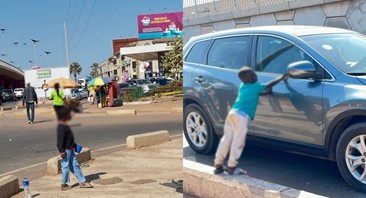
At the busy traffic lights along Kairaba Avenue, the midday heat shimmers over a crowded intersection as vehicles slow to a halt. Within seconds, small figures emerge from the roadside, weaving between cars with quiet urgency.
Among them is Lamin, aged seven not his real name.
He moves quickly from one vehicle to another, gently tapping on windows, his voice barely rising above the hum of engines.
“Please help me,” he murmurs, stretching out his small hand.
Some drivers avoid eye contact. Others offer a few coins or leftover food. And then, engines roar back to life and the cars speed away, leaving Lamin standing silently at the roadside.
Scenes like this are no longer rare. Across The Gambia’s urban centres from Farafenni to Banjul, Serrekunda to Brikama, and along the bustling Kairaba Avenue children carrying bowls, tins and plastic containers roam streets, markets and traffic junctions, asking for money or food.
For many passers‑by, it has become routine.
But beneath these fleeting encounters lies a deeper, more troubling reality one shaped by poverty, systemic neglect, and the quiet normalisation of child exploitation.
A Childhood on the Streets
In Latrikunda Sabiji, nine‑year‑old Awa, also a pseudonym, walks slowly along a dusty roadside. She approaches strangers one after another, her voice soft but persistent.
“Sister, give me 10 dalasis. I want to buy bread.”
Some people respond. Others walk past without a word.
Awa does not complain. She simply moves on.
She has been on the streets since morning. Her clothes are worn, her face tired from hours under the sun. When asked if she attends school, she shakes her head.
“No.”
There is no parent nearby. No school bag. No place to rest. Just the road, the noise of passing vehicles, and the long, uncertain hours.
For Awa, this is not unusual. It is her daily life.
At another traffic point along Kairaba Avenue, Modou, also a pseudonym, stands between lanes of traffic holding a blue cup. His voice trembles as he calls out for help.
A passer‑by asks where his mother is. He points to a distance she is seated nearby, watching.
Moments later, as the sun intensifies, he runs back towards her, darting between moving vehicles.
A Growing Presence
Children begging in public spaces have become an increasingly visible feature of daily life in The Gambia. Markets, bus stops, tourist areas and major intersections are now common sites where children spend long hours soliciting alms.
Officials from the Department of Social Welfare acknowledge that the number of children on the streets appears to be rising, particularly in densely populated urban centres.
While comprehensive national data remains limited, regional trends paint a concerning picture.
According to UNICEF, millions of children across West Africa are engaged in street‑based activities including begging, informal labour and street vending driven by poverty, displacement and lack of access to education.
Globally, the International Labour Organization estimates that 160 million children are involved in child labour, with Sub‑Saharan Africa recording the highest prevalence.
When Survival Becomes Exploitation
What appears to be an act of compassion giving a coin to a child can mask a far more dangerous reality.
“Street life is extremely dangerous for children,” says Mariama Cham, a social worker.
“These children are exposed to exploitation, trafficking and psychological trauma. In many cases, it amounts to child abuse.”
She notes that children navigating traffic risk road accidents daily. Others face hunger, illness, verbal abuse and, in some cases, criminal exploitation.
Cham adds that the Children’s Act 2005 explicitly prohibits child exploitation and recognises children engaged in begging as being in need of care and protection. Yet, enforcement remains inconsistent.
Njundu Drammeh, Commissioner at the National Human Rights Commission, describes the trend as “worrying and worrisome.”
“The presence of children at traffic lights and public spaces shows that our child protection system is either weak or ineffective. These children should be in school and under the care of their families,” he states.
He adds that existing laws — including the Children’s Act 2005 and the Tourism Offences Act 2003 — clearly prohibit child begging, but gaps in implementation persist.
Poverty, Tradition and Systemic Gaps
Experts agree that poverty remains a key driver of child begging.
Many families, struggling to survive, send their children to Quranic schools (daaras) with the hope of receiving religious education. However, in some cases, children are forced to beg to support themselves or their teachers.
Marie Njie Adams, Human Rights Officer with the OHCHR PAPEV Project, explains that many of these children are either runaways from such centres or are tasked to beg as part of their daily routine.
“Family disintegration, poverty and lack of support systems push children into these situations,” she says.
While religious education is an important part of Gambian society, Islamic scholar Ousman Keita is clear:
“There is nowhere in the Quran that says children must beg to sustain their teachers. This practice is not only unfair it is un‑Islamic.”
Historically, child begging has existed in The Gambia, particularly in rural and provincial towns. During the second republic under former President Yahya Jammeh, a crackdown significantly reduced its visibility in urban areas.
However, recent years have seen a resurgence this time with a notable shift. Increasingly, children are accompanied by parents or guardians, raising further concerns about normalisation and intergenerational cycles of poverty.
A Public Health Emergency
Beyond the visible hardship lies a hidden health crisis.
Hamadi Sowe, a public health expert, outlines the severe risks faced by children on the streets.
“These children are exposed to malaria, respiratory infections, diarrhoeal diseases and skin infections. Many suffer from malnutrition due to irregular and inadequate food intake,” he explains.
He adds that prolonged exposure to harsh weather, unsafe environments and traffic increases the risk of injury, dehydration and chronic illness.
“Many of these children show signs of untreated illnesses, which can lead to long‑term disability. The psychological impact stress, anxiety and trauma is equally severe.”
Law, Policy and the Struggle for Enforcement
Isatou Sarr, a resident of Farafenni, says it is deeply distressing to witness children particularly those in daara (Qur’anic schools) being sent out by their teachers to beg from morning until evening and return with money. According to her, many of these children end up spending nights on the streets within neighbourhoods, too afraid to return if they fail to meet the required amount, fearing punishment. She notes that this is especially common among children who come from Senegal.
She describes the situation as alarming and worsening, adding that many of the children appear visibly ill and malnourished.
“It is really becoming too much,” she says, urging parents to take greater responsibility for their children’s wellbeing and ensure they are given a better and safer life.
From a legislative standpoint, the issue is well recognised.
Modou Lamin Bah, National Assembly Member for Banjul North, notes that while laws exist, enforcement remains the greatest challenge.
“The Children’s Act has strong provisions, but gaps in implementation and resources hinder effectiveness,” he says.
He points to ongoing efforts by the National Assembly to strengthen legal frameworks, raise awareness and collaborate with NGOs and international partners.
He calls for reform to include stronger law enforcement, expanded social protection, improved education access and greater community awareness.
Government Response
Authorities have begun to acknowledge the urgency of the crisis.
Minister of Women, Children and Social Welfare, Fatou Kinteh, recently described child begging as “child abuse” during an appearance on Gambia Radio and Television Services.
“Children have two places home and school. You should not use a child to beg,” she stated.
The Ministry is currently developing strategies to address the issue, including financial support and livelihood programmes for vulnerable families.
“We know it is not going to be easy,” she admitted. “But we are very concerned, and we are coming up with solutions.”
A System Under Strain
ChildFund The Gambia Country Director, Musu Kuta Komma, frames the issue as a systemic failure rather than an individual one.
“Child begging is not just a parental failure it is a child protection system failure,” she says.
She emphasises the need for prevention, protection and partnership across government, civil society, religious leaders and communities.
According to ChildFund and international reports, forced child begging is recognised as one of the worst forms of child labour and is increasingly linked to trafficking networks in the region.
The Human Cost
As the sun sets over Westfield, Modou remains by the roadside, clutching his small tin cup.
Another line of cars slows under the traffic light.
He steps forward once again, scanning faces behind windshields hoping, waiting.
For children like Lamin, Awa and Modou, the streets have become more than a place of passage.
They are classrooms of survival.
Yet this should never be normal.
Conclusion: A Nation at a Crossroads
Child begging in The Gambia is not merely a social inconvenience it is a profound human rights crisis unfolding in plain sight.
Behind every outstretched hand is a story of deprivation, of systems that have failed, and of a society gradually becoming desensitised to the suffering of its most vulnerable.
The laws exist. The policies are known. The voices from government officials to human rights advocates, from health experts to community members are clear and consistent.
What remains is action.
Ending child begging will require more than periodic crackdowns or policy statements. It demands sustained political will, stronger enforcement of existing laws, meaningful investment in social protection, and a collective shift in societal attitudes.
It requires confronting uncomfortable truths about poverty, tradition and accountability.
Above all, it requires recognising that every child on the street is a child denied their basic rights to education, to protection, to dignity, and to a future.
Until that recognition is matched with decisive action, the traffic lights will continue to change, the cars will continue to pass, and the children will remain waiting, hoping, and slowly losing what should never be taken from them: their childhood.
However, efforts to obtain comments from the Department of Child Welfare at the Police Headquarters in Banjul were unsuccessful, as no responses were received at the time of publication.