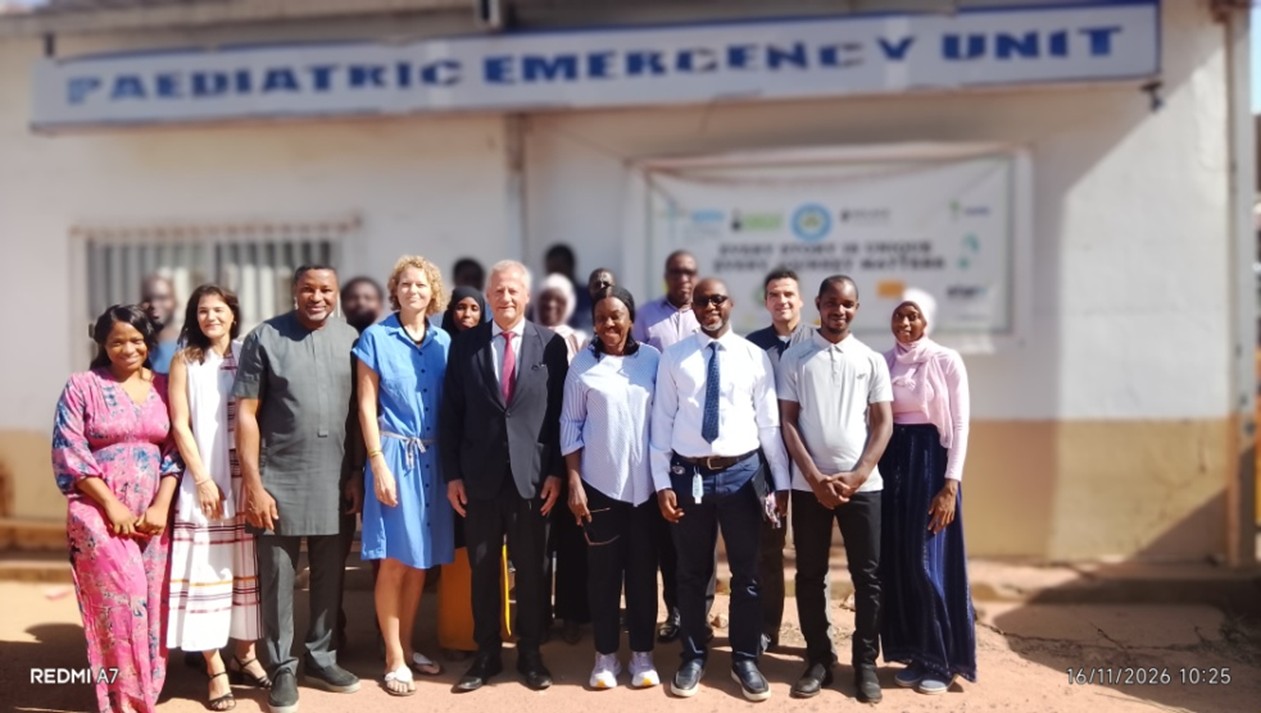
The Embassy of the Federal Republic of Germany to The Gambia has extended support to the Emergency Paediatric Unit (PEU) of the Edward Francis Small Teaching Hospital (EFSTH) with the donation of an Echography machine to help timely diagnosis of congenital heart defects.
The Embassy also facilitated a five-day echocardiography training for selected resident doctors at the hospital to operate the machine and enable them to address emerging cases related to heart failure.
At the start of the training sponsored by the German Embassy, Dr. Sara Loetz, Head of the Emergency Paediatric Unit at EFSTH, reminded that children make up about 40% of The Gambia's population.
She said they see severely sick children daily, noting that at the Neonatal Unit alone last week, they had more than 135 babies in far too little space.
"Many of them are born too early and premature. Others suffer complications around birth and others have severe infections," Dr. Loetz said.
She revealed that globally, about 1% of all babies are born with congenital cardiac conditions, ranging from relatively minor to very severe.
"As of two years ago, we were struggling a lot to diagnose these children overall," she said.
She lauded the training as crucial in equipping Gambian resident doctors with basic skills in paediatric echocardiography.
"So I thank the German Embassy that you enabled us to get this machine," she added.
Professor Augusta Eneh, Head of Department, Paediatric Unit at EFSTH, described the machine as a big boost and said the five-day course comes at a critical time for child health in The Gambia.
"Every day in our department, paediatric department, we care for children born with congenital heart defects," she said.
She revealed that for too long, the country's ability to diagnose these defects quickly and accurately has been limited, not by the dedication of staff, but by lack of appropriate diagnostic tools and specialised training.
"Today, that narrative is about to change," she said, thanking the German Embassy for sponsoring the training.
"This is not just a machine. It is a lifeline and it is the opportunity for every child in Banjul, Brikama, Basse and across this country," Prof. Eneh said.
The machine, she added, would enable children to receive an accurate diagnosis without delay, and give mothers the opportunity to be told early what is wrong with their child's heart and what can be done.
She urged participants to make the most of the five days and be ready to share with colleagues, expressing optimism that the partnership will be the beginning of a long and fruitful collaboration in strengthening paediatric care.
Dr. Cherno Jallow, Deputy Chief Medical Director at EFSTH, commended the German Embassy for its foresight, noting that the Embassy could have just given a machine, but went further to build capacity of staff to use it.
"So I think that is the best way of partnership. You give us a machine, and then we are also helping to build capacity," Dr. Jallow said.
In his keynote address, Klaus Botzet, German Envoy to The Gambia, said capacity building is not about only machines because machines gather dust and do not do anything by themselves.
"It is the people who can work with the machines, and that is why this training is so important," he said.
He commended Dr. Loetz for her investment in time and energy at the hospital, noting that she has contributed to changing the atmosphere and moving the section forward.
He observed that support in training, management and technology is critical and that they all go together, expressing optimism that staff would be able to use the equipment well and do all examinations.
"We put our trust in you all that it will be a sustainable success," he said.