The meeting, which forms part of RFLD’s growing mandate within regional governance frameworks, particularly its co-chair role of the SEA-T Programme Advisory Council, brought continental strategy into direct conversation with the lived realities of women defenders operating in fragile and conflict-affected contexts across West Africa.
Held at RFLD’s Dakar office in Résidence “AW 06”, Cité Keur Gorgui, the consultation, themed “Solidarity, Protection and Lineage of Resistance,” gathered around thirty participants. These included WHRDs from Mali, Burkina Faso, Niger and Guinea, alongside Senegalese feminist civil society organisations. The discussions underscored growing concerns over shrinking civic space, security threats, and the urgent need for stronger protection systems for women defenders.
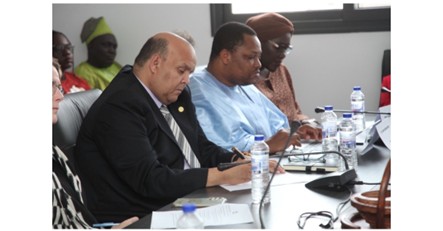
The consultation also convened a strong mix of institutional and expert actors shaping the human rights protection landscape in Africa. Among them was Hon. Prof. Rémy Ngoy Lumbu, Special Rapporteur on Human Rights Defenders and Focal Point on Reprisals in Africa at the African Commission on Human and Peoples’Rights (ACHPR). His participation highlighted the need for stronger alignment between continental mechanisms and grassroots realities.
Also contributing was Mr. Naji Moulay Lahsen, Director for the Sahel and North Africa at the International Federation for Human Rights (FIDH), who offered a cross-regional perspective on evolving risks defenders face across the Sahel.
Senior African human rights expertise was further represented by Mme Hannah Forster, former Executive Director of the African Centre for Democracy and Human Rights Studies (ACDHRS) in Banjul; Prof. Mabassa Fall, jurist and expert of the African human rights system; and Mr. Sadikh Niass, a veteran Senegalese human rights advocate. Diplomatic missions’ active in Senegal also took part, alongside development partners GIZ and Sida.
From Germany’s GIZ, Senegal Country Director Mme Katja Roeckel and Programme Director Mr. Mathias Muehlhans attended the consultation. Sweden was represented by Ambassador H.E. Catharina Cappelin and Programme and Political Officer Mme Khady Touré.
RFLD, described as an African feminist intermediary institution led and governed by African women, emphasised that its work is rooted in African feminist analysis and political thought. The organisation stressed that its partnerships with European donors should be understood as accompaniment to African feminist leadership rather than its origin.
Through flexible, multi-year support from partners such as GIZ and Sida, RFLD has developed a continental infrastructure supporting women’s rights organisations. These includes offices in Porto-Novo, Accra, Banjul and Dakar; a network of 670 member organisations across more than 35 African countries; and re-granting mechanisms such as the WAFFF Fund and Africa Portfolio Grant, which channel resources directly to grassroots feminist groups.
Other key initiatives include the DƆNÙESÈ Data Centre, which provides bilingual policy tools for civil society; rapid response mechanisms for WHRDs under threat; and continental research outputs such as the State of African Francophone Feminist Movements report. RFLD also holds strategic governance roles, including its co-chairmanship of the SEA-T Programme Advisory Council.
The SEA-T programme Strengthening Empowerment of African Women through Transformative Approaches is funded by Germany’s BMZ and implemented by GIZ. It integrates civil society participation into its governance structure, a model RFLD says is critical for ensuring alignment with feminist priorities across the continent.
At the Dakar consultation, stakeholders reflected on how continental strategies can be more effectively translated into concrete protection measures at national and community levels. The presence of GIZ Senegal Country Director Mme Katja Roeckel was highlighted as a sign of efforts to bridge policy design with local realities.
Prof. Rémy Ngoy Lumbu stressed that continental human rights frameworks and country-level implementation must be more tightly integrated to ensure effective protection for defenders, particularly women operating in high-risk environments.
Beyond its formal proceedings, the consultation was described as a space of solidarity and affirmation for women defenders whose work often goes unrecognised. Participants noted that such convening’s strengthen trust, reinforce protection networks, and create pathways for collective response in times of crisis.
As discussions concluded, the central message emerging from Dakar was clear: safeguarding women human rights defenders in West Africa requires not only policy commitments, but sustained collaboration between continental institutions, feminist movements, and development partners grounded in accountability and shared responsibility.