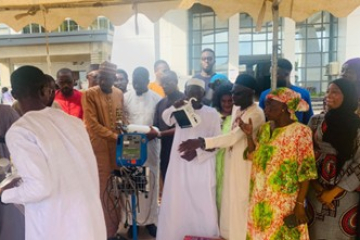
The resolutions were passed during the Association’s ordinary Congress held on Thursday at the Faculty of Law Auditorium, Kanifing Campus, where faculty and staff debated issues ranging from salaries and promotions to postgraduate programmes and governance reforms.
Opening the Congress, UTGFSA President Yorro Njie described the gathering as the Association’s highest decision‑making body, where members hold the Executive accountable, debate key issues and adopt resolutions in the collective interest of staff and the University.
He reaffirmed the Association’s independence, rejecting claims of alignment with either University Management or the Ministry of Higher Education, Research, Science and Technology (MoHERST).
“I am neither an agent of Management nor an agent of MoHERST. I am an agent of the staff of the University of The Gambia,” Njie said, stressing that the Association’s sole mandate is to protect the welfare, rights and professional interests of its more than 600 members.
Njie emphasised that UTGFSA remains an autonomous body guided solely by the interests of its members and the University, noting that it has consistently resisted external influence. He argued that stronger governance rooted in justice, accountability, transparency and respect for institutional laws is urgently required, and restoring confidence will demand visionary and inclusive leadership.
In his activity report, UTGFSA Secretary Alieu Jarju highlighted key issues discussed during the period under review, including staff salaries, delayed promotions, non‑implementation of approved policies, postgraduate programmes, the review of Conditions of Service and compliance with governance frameworks.
Following extensive deliberations, delegates adopted resolutions calling for the expedited processing of staff promotions, describing prolonged delays as detrimental to morale, motivation and career progression. Members also urged a comprehensive review of salaries to reflect the rising cost of living and ensure remuneration remains competitive.
The Congress further resolved that the University should develop new Conditions of Service to address emerging human resource and governance issues, including acting appointments, succession planning and career progression.
On postgraduate programmes, the Association recommended that selected courses remain at the Kanifing Campus, warning that relocating all graduate programmes to Faraba Banta would create accessibility challenges for working professionals, reduce enrolment and affect revenue.
Delegates also called for a high‑level consultative meeting involving MoHERST, the Governing Council, University Management and UTGFSA to discuss the University’s future, including the sustainability of the Faraba Banta Campus, operational funding and measures to strengthen collaboration.
The Association proposed the establishment of a structured staff recognition and awards programme to honour excellence in teaching, research, innovation, community service and administration.
While reaffirming dialogue as the preferred means of resolving institutional challenges, Njie cautioned that resolutions adopted by the Congress would be accompanied by implementation timelines ending in September 2026.
He warned that members may be compelled to consider industrial action that could affect the commencement or continuation of the 2026/2027 academic year if agreed measures are not implemented.