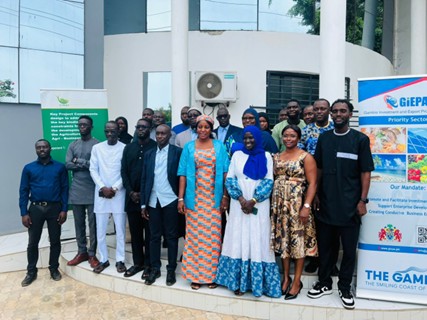
Held at the GCCPC Central Hall, the workshop brought together government officials, development partners and agricultural stakeholders to review and validate data collected across six priority agricultural value chains: rice, horticulture, maize, cashew, poultry and groundnuts.
The platform, developed with support from the World Bank through the GIRAFE Project, profiles farmers, cooperatives, processors and exporters across all regions of The Gambia. It is expected to provide reliable, real-time data to improve planning, coordination and investment decisions within the sector.
Speaking at the event, Aja Ramatoulie Hydara Sanyang, Director of Operations at GIRAFE, highlighted the transformative role of digital technology in modernising agriculture.
“Digitalising agriculture has taken us to e-extension services. The farmer-to-extension-worker ratio remains very high, but technology now allows us to reach farmers in remote communities while extension officers provide support from elsewhere,”she said.
She stressed that the platform is intended to be a practical tool rather than another policy document left unused.
“This will not be one of those documents that sit on shelves collecting dust. We want it to become an active, operational and user-friendly tool that supports decision-making and service delivery,”she added.
GIEPA Chief Executive Officer Ousainou Senghore said the initiative addresses a longstanding information gap that has hindered agricultural growth and investment.
“For years, The Gambia’s agribusiness sector has lacked a single credible and geo-referenced database of actors operating within key value chains. This has constrained planning, weakened coordination and made it difficult to attract serious domestic and foreign investment,” he noted.
According to him, the new platform combines an integrated digital mapping system, a secure database, an interactive online portal and physical value-chain maps, providing a comprehensive picture of agricultural actors and activities nationwide.
Senghore urged participants to thoroughly review the information gathered during the validation process.
“This workshop is not a formality. It is a critical step to ensure that the data accurately reflects realities on the ground. We need your expertise, local knowledge and honest feedback,” he said.
He further disclosed plans to expand the initiative beyond agriculture to include other priority sectors such as tourism, fisheries, manufacturing and energy in line with the National Export Strategy.
Participants are expected to assess the accuracy of the data, review actor classifications and evaluate the platform’s usability before its official rollout.
The initiative is widely seen as a major step toward building a data-driven agricultural sector capable of attracting investment, increasing productivity and supporting The Gambia’s broader economic development agenda.