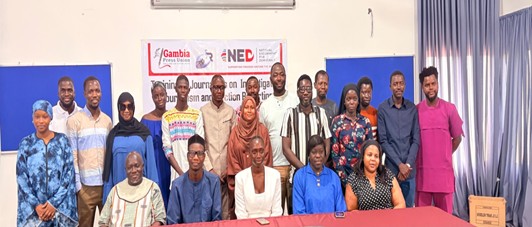
The Gambia Press Union (GPU) has launched a six-day capacity-building training on investigative journalism, election reporting and fact-checking to strengthen media accountability ahead of the 2026 presidential and 2027 parliamentary elections.
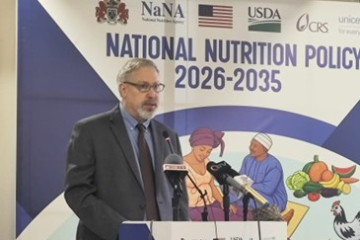
The training, held on Monday at the National Nutrition Agency (NaNA), forms part of the newly approved Strengthening Electoral Integrity and Accountability project, funded by the National Endowment for Democracy (NED) and implemented by the GPU and The Republic.
Speaking at the opening ceremony, The Gambia Press Union Vice President Sheriff Saidykhan described the initiative as timely and significant, noting that investigative journalism plays a crucial role in exposing corruption, countering misinformation and providing citizens with credible information to make informed decisions.
He urged journalists to prioritise accuracy over speed and ensure their reporting is supported by verifiable evidence.
“Journalists must prioritise accuracy over speed and provide evidence-based reporting. This training will enhance their ability to report ethically, identify hate speech, and promote conflict-sensitive coverage,” Saidykhan stated.
The programme is designed to equip participating journalists with practical skills to investigate public procurement, analyse asset declarations and uncover corruption. It will also address journalists’ safety, including secure communication and the protection of confidential sources.
Delivering the keynote address, Madi Jobarteh, Chief Executive Officer of the Edward Francis Small Centre for Rights and Justice, warned that The Gambia’s democratic transition remains fragile and requires an informed citizenry and a media capable of holding public officials accountable.
“Democracy is not sustained by elections alone. It is strengthened when citizens have access to accurate, verifiable, and independent information,” he said.
Jobarteh identified a culture of impunity, weaknesses in public financial controls and the rapid spread of misinformation online as challenges that could undermine democratic processes, particularly during elections.
He challenged journalists to move beyond reactive reporting and undertake deeper investigations into campaign financing, public expenditure and allegations of corruption.
According to him, journalists must also strengthen their capacity to verify digital content and investigate claims circulating on social media, where misleading information can influence public opinion and heighten political tensions.
The training comprises three interconnected components. Investigative journalism will focus on following financial transactions, examining procurement processes and analysing asset declarations. Election reporting will cover ethical, inclusive and conflict-sensitive journalism throughout the electoral cycle, while fact-checking will equip participants with techniques for verifying claims, authenticating digital content and using open-source intelligence.
Jobarteh described the participants as “the vanguard of a more informed and accountable Gambia,” emphasising that their professionalism and integrity are essential to protecting democratic values.
He further reminded journalists that their responsibility to hold power accountable is grounded in constitutional guarantees of freedom.
“Freedom is not a privilege granted by those in power. It is a right enshrined in our constitution. Your professionalism is your shield, and your integrity is your sword,” he said.
The initiative will also produce a media handbook on audit reporting in collaboration with the National Audit Office, providing journalists with additional guidance on examining public accounts and strengthening financial accountability.
As the country approaches another electoral cycle, the GPU maintains that an independent, professional and responsible media remains essential to promoting transparency, accountability and good governance.