Senior government ministers have unveiled sweeping initiatives aimed at tackling unemployment, strengthening education, and empowering Gambian youth, with a strong emphasis on migration management and regional integration.
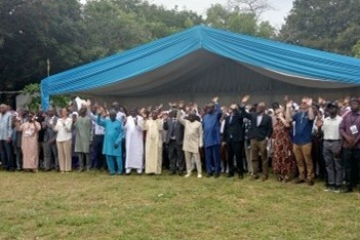
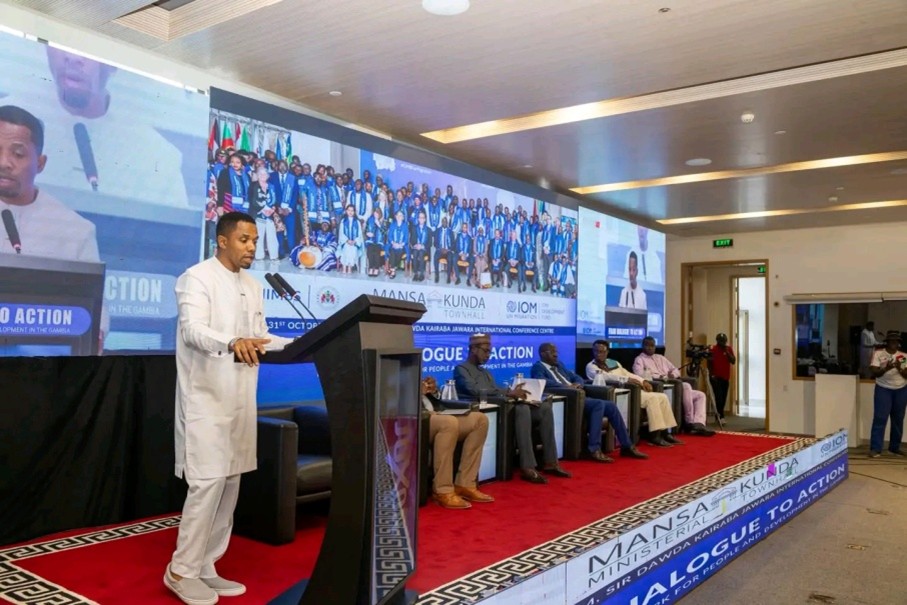
These remarks were made during the special Mansakunda on Saturday at Sir Dawda Kairaba Jawara International Conference Centre organised by the Ministry of Information, Media and Broadcasting Service with the support from International Organisations for Migration (IOM).
Trade and Employment Minister Mod K. Ceesay announced the establishment of new job centres in the West Coast and North Bank Regions, complementing existing centres in KMC and Upper River Region He highlighted the GAM Jobs online recruitment platform as a key tool for connecting job seekers with opportunities.
Trade Minister Ceesay stressed that labour mobility should not be seen solely in the context of migration outside Africa, but also as a chance to harness opportunities within the ECOWAS region. “Labour migration must complement national job creation efforts and contribute to sustainable economic growth,” he said.
Higher Education Minister Professor Pierre Gomez emphasised the urgent need to align education with labour market demands. He warned against producing graduates whose qualifications fail to translate into employment. “You cannot build a nation without skilled labourers,” Gomez noted, underscoring reforms that bring industry leaders directly into curriculum design.
Major investments are underway at the University of The Gambia’s Faraba campus, including a $37 million School of Medicine and Allied Health Sciences with 16 state-of-the-art laboratories. New degree programmes in engineering, computer science, cybersecurity, and AI are also planned. The government has launched the Skills and Innovation Fund to support TVET centres, subsidise student tuition, and provide start-up capital for young entrepreneurs.
Youth and Sports Minister Bakary Y. Badjie highlighted the role of sports in fostering leadership, unity, and discouraging irregular migration. He pointed to new football fields across the country and the recently approved National Sports Policy (2024–2034), which dedicates a section to using sports as a tool against migration pressures. “Sports is one of the largest exporters of Gambian talent,” Badjie said, citing the success of young footballers signing professional contracts abroad.
Beyond sports, youth-focused institutions such as the National Youth Council, NYSS, and NEDI are providing training, scholarships, and grants to equip young Gambians with skills and entrepreneurial opportunities.
Together, these initiatives reflect a coordinated government effort to ensure that Gambian youth can access decent employment, thrive in education, and find opportunities at home and abroad without resorting to irregular migration.