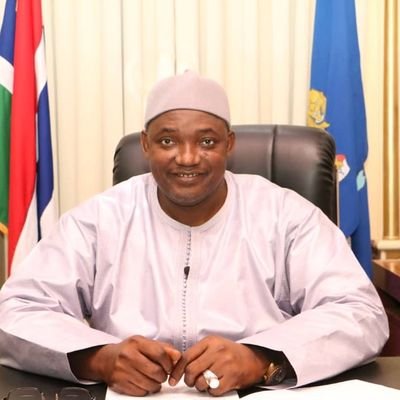
His Excellency Adama Barrow, the third President of the Republic of The Gambia, is a businessman-turned-politician whose rise to the country’s highest political office marked a significant turning point in the nation’s political history.
From his early beginnings in Mankamang Kunda, a village in the Jimara District of the Upper River Region, to becoming the country’s president in January 2017, Barrow’s journey has been shaped by business, political participation and his emergence as the consensus candidate of an opposition coalition that ended 22 years of rule under former President Yahya Jammeh.
Born in February 1965, shortly before The Gambia attained independence from Britain, Barrow grew up in a rural community where access to formal education and other opportunities was limited.
He attended Koba Kunda Primary School before proceeding to Crab Island Secondary School in Banjul. He subsequently obtained a scholarship to attend Muslim High School, also in Banjul, where he completed his secondary education in 1988.
His educational journey took him beyond The Gambia when he moved to the United Kingdom in the early 2000s to pursue further studies in real estate. While in London, he reportedly worked as a security guard at an Argos retail store to support himself and finance his studies.
From business to politics
Before entering the political arena, Barrow built his professional career in the private sector.
After completing secondary school, he joined Musa Njie and Sons Limited, a Gambian business involved in the energy sector. He started as a salesman and eventually rose to become sales manager.
His experience in business provided the foundation for his subsequent involvement in real estate.
In 2006, after returning from the United Kingdom, he established Majum Real Estate, a property development and real estate agency. He served as its chief executive officer until his entry into national politics in 2016.
Although his professional background was primarily in business, Barrow had developed an interest in politics and was associated with the United Democratic Party (UDP), which was among the main opposition parties during the Jammeh administration.
He held positions within the party, including serving in its Upper River Region structures and as deputy treasurer.
His political journey included an unsuccessful attempt to contest for the Jimara parliamentary seat. However, his involvement in opposition politics continued, eventually placing him among the leading figures in the political developments that preceded the 2016 presidential election.
The 2016 political turning point
Barrow’s political fortunes changed significantly in October 2016 when he emerged as the consensus presidential candidate of Coalition 2016, an alliance of seven opposition parties formed to challenge the 22-year rule of former President Yahya Jammeh.
The coalition brought together different opposition political parties around a common objective of securing a change of government through the ballot box.
Barrow resigned from the UDP and contested the December 1, 2016 presidential election as an independent candidate representing the coalition.
The election produced a historic outcome, with Barrow defeating incumbent Yahya Jammeh and third candidate Mama Kandeh.
The result marked the first electoral change of presidency in The Gambia since independence in 1965.
However, the transition was not immediate. Although Jammeh initially conceded defeat, he later rejected the election results, triggering a constitutional and political crisis.
The situation attracted regional and international attention, with the Economic Community of West African States (ECOWAS), the African Union and the United Nations becoming involved in efforts to resolve the impasse.
On January 19, 2017, Barrow was sworn in as President at The Gambia’s embassy in Dakar, Senegal, while Jammeh remained in the country.
Jammeh subsequently left The Gambia on January 21, 2017, following regional diplomatic and military intervention. Barrow returned to Banjul on January 27, 2017, formally beginning his administration on Gambian soil.
His presidency and national reforms
Barrow assumed office at a time when The Gambia was emerging from more than two decades of authoritarian rule.
His administration inherited significant challenges involving public institutions, the economy, national debt, human rights, infrastructure and access to essential services.
One of the early priorities of his government was to restore the country’s international relationships.
In February 2018, The Gambia formally rejoined the Commonwealth of Nations after withdrawing from the organisation in 2013 under the previous administration.
His government also pursued engagement with international institutions and development partners, while introducing processes aimed at strengthening democratic governance and accountability.
A major development during his first term was the establishment of the Truth, Reconciliation and Reparations Commission (TRRC), which investigated human rights violations committed during the Jammeh era.
The commission’s work provided a platform for victims and survivors to recount their experiences and contributed to national discussions on transitional justice, accountability and reparations.
His administration also oversaw the establishment of the National Human Rights Commission and other institutional reform initiatives.
The government further pursued constitutional reform, although the proposed 2020 draft Constitution failed to secure the required parliamentary approval.
Infrastructure development has also featured prominently in his administration.
Among the notable projects is the Senegambia Bridge, officially opened in January 2019, which connects communities on both sides of the Gambia River and facilitates movement between the northern and southern parts of the country.
His government has also pursued road construction, electricity expansion, healthcare infrastructure and improvements in educational facilities.
In the social sectors, the administration has continued to work with development partners on programmes targeting women, young people, children, agriculture and poverty reduction.
Nevertheless, challenges relating to unemployment, the cost of living, public services, electricity supply and economic opportunities have remained important issues in national discussions.
Re-election and the second term
On December 4, 2021, Barrow contested the presidential election under the ticket of his newly established National People’s Party (NPP).
He secured 457,519 votes, representing 53.23 per cent of the valid votes, according to the electoral results, defeating five other candidates, including his former political ally and opposition leader Ousainou Darboe of the UDP.
His re-election gave him a second presidential mandate.
He was sworn in for his second term on January 19, 2022, at the Independence Stadium in Bakau.
The second term has continued to focus on infrastructure, agriculture, education, healthcare, energy, youth empowerment and economic development.
However, questions surrounding constitutional reform, presidential term limits, governance, accountability and the pace of economic transformation have continued to feature in the country’s political discourse.
The constitutional reform process remains an important part of the broader national conversation about the country’s democratic future.
Political leadership and the road ahead
Beyond the presidency, Barrow is the founder and leader of the National People’s Party, which he established in December 2019 after the breakdown of the Coalition 2016 arrangement.
The party has since become a major force in Gambian politics, with Barrow continuing to lead its political activities while serving as head of state.
His political journey reflects a transition from the private business sector to opposition politics and eventually to the presidency through a coalition arrangement.
As The Gambia approaches another presidential election cycle, his administration’s record, particularly on economic management, institutional reforms, infrastructure, public service delivery and democratic governance, remains central to discussions about the country’s development.
From his beginnings in Mankamang Kunda to his emergence as the country’s third president, Adama Barrow’s political journey has become an important chapter in contemporary Gambian history.
His presidency continues to shape national debates about democracy, leadership, development and the future direction of The Gambia.