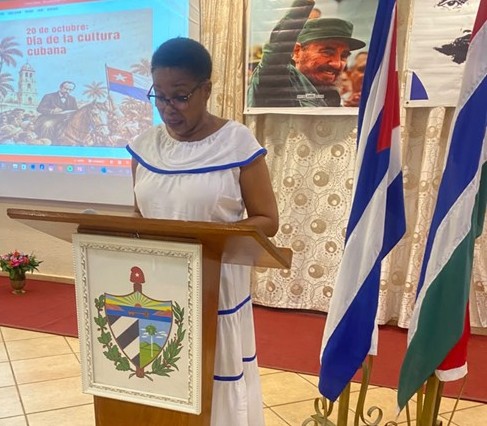
Cuban National Culture Day highlights the important role culture plays in preserving national identity, strengthening social cohesion and sustaining the resilience of the Cuban people, Cuba’s Ambassador to The Gambia, Carmelina Ramirez Rodriguez, has said.
She made the remarks on Tuesday, October 20, 2026, during the commemoration of Cuban National Culture Day held at Senegambia Beach, where she also highlighted the historical and cultural ties between Cuba and Africa, particularly The Gambia.
Ambassador Rodriguez explained that October 20 marks the anniversary of an important moment in Cuba’s history when patriot and musician Perucho Figueredo unveiled La Bayamesa in 1868. On that day, the people of Bayamo sang the notes of what later became Cuba’s national anthem for the first time.
She said the anthem called on Cubans to rise against colonial oppression, adding that 158 years later, the occasion continues to serve as a reminder of the country’s struggle for freedom and national identity.
Cuban National Culture Day is observed annually on October 20 to commemorate the creation of the national anthem and celebrate the country’s cultural heritage.
According to the ambassador, Cuban culture reflects a rich mixture of influences, evident in its music, dance, literature, theatre, fine arts and visual arts.
She said these cultural expressions tell the story of the Cuban people, preserve their history and resilience, and contribute to social cohesion and a shared sense of belonging.
This year’s celebration also takes place during the centenary year of Fidel Castro, the historic leader of the Cuban Revolution, whom she said regarded culture as a cornerstone of the emancipation of the people.
She recalled his belief that “culture is the first thing that must be saved,” describing the principle as a reflection of the importance Cuba attaches to preserving its cultural identity.
“Being here in Banjul today gives us the opportunity to honour our African roots,” she said.
Ambassador Rodriguez noted that Cuba and The Gambia share historical connections dating back to the transatlantic slave trade, during which more than a million enslaved Africans were forcibly taken to Cuba.
She said Africans played a decisive role in shaping Cuban national identity, leaving lasting influences on the country’s heritage, traditions and cultural expressions.
“Over the centuries, we have forged a strong, reciprocal relationship; we have inherited everything from our African ancestors from our very genes to their spirit of resistance while fraternity, joy and optimism remain ever-present in our bonds,” she said.
The ambassador described culture as a living legacy that connects people across generations and borders, adding that it continues to nurture creativity and strengthen Cuba’s determination to defend its national sovereignty.
She acknowledged the economic difficulties facing Cuba but said these challenges had not diminished the people’s joy, hospitality or connection to their roots.
“No matter where we are, the Cuban essence
la cubanía—is never lost; it runs in our blood,” she concluded.