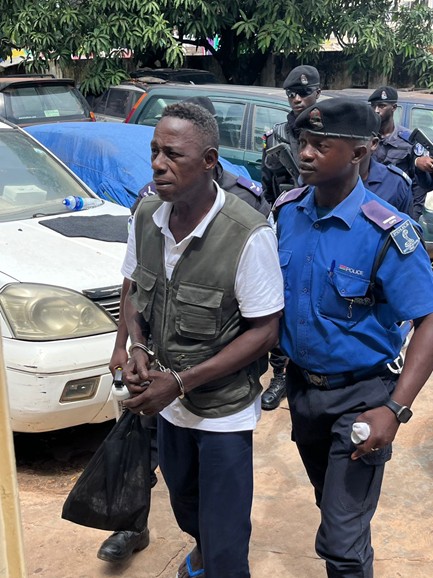
The courtroom fell silent as Sanyang struggled to compose himself, pausing several times while recounting events linked to the allegations. The trial continues before Justice Jaiteh, with the prosecution pressing its case and the defence seeking to challenge the evidence presented.
Sanyang was repeatedly seen wiping away tears as he recounted his interview with veteran journalist Peter Gomez of the West Coast Region. He described how he was arrested and insisted that he does not deserve the ordeal he is currently facing, given the sacrifices he made for the country during the former regime of Yahya Jammeh. Not only Sanyang, but several people in the courtroom were also seen wiping away tears as they watched tears roll down his face.
Emotional Testimony
In his testimony, led by Defence Counsel Bondi on behalf of Senior Counsel Lamin Darboe, Sanyang told the court that he had been detained at Mile Two Prison since August. He recalled events leading to 14 August, beginning with an interview he granted veteran journalist Peter Gomez of West Coast Radio.
He explained that the interview was conducted in his capacity as a citizen, but shortly afterwards he was invited by police for questioning. He said he was interrogated about remarks he made during the interview, and later arrested at the airport by plain-clothed security officers before being transferred to Brusubi Police Station.
“I was seriously interrogated with many questions. I told them I did not know what I had done,” he said, adding that he spent the night at Brusubi Police Station before being moved to police headquarters, where he remained for almost a week.
Sanyang stated that his health deteriorated while being detained on a mat at the police headquarters. He further claimed he was denied access to a lawyer until he was eventually transferred to Mile Two Prison.
Denial of Charges
Asked whether he was aware of the charges, Sanyang confirmed but insisted they were linked to the APRC and judicial proceedings. He denied any involvement in the burning of the APRC bureau, stressing: “I have never financed anything. I was only explaining what Gambians went through during the former regime, but I was not part of burning the bureau.”
He told the court that he was not in the Gambia in 2016, only returning in 2018. On the video evidence played in court, Sanyang said he had been misinterpreted or misquoted, and denied ever sending money to anyone to commit arson.
“I was just explaining the evidence before the court when I used the word ‘clandestine’, as most of the evidence brought before the court was thrown out,” he added.
Sanyang recounted that a panel of nine people, including some of his former military colleagues, questioned him extensively about his interview with Peter Gomez. He said they asked whether he had a hidden agenda or financed any activities, which he denied. “They never brought any paper or identified anyone to whom I allegedly sent money,” he said.
Expressing disappointment, Sanyang told the court: “I have faced difficulties for the past 23 years fighting the former regime.” I don’t think I should pay such a price. I am disappointed to be asked about things I know nothing about.”
Sanyang revealed that he had previously been diagnosed with depression in Switzerland and had undergone psychiatric examination in the Gambia. He said he struggled to sleep properly and was in tears as he recounted his condition.
“As someone who served the country, I will not do anything bad for the country,” he said emotionally.
During cross-examination by State Counsel Jobarteh, Sanyang admitted that the video played in court was the interview he had with Peter Gomez, but insisted it could have been tampered with. “Yes, the image was me, but it can be tampered,” he said.
Asked whether he stood by the statements he made in the interview, Sanyang replied: “I have never been part of the burning of the APRC bureau.”
He confirmed that the interview led to his arrest, but maintained that “a lot of things have been said” and reiterated his denial of any involvement in arson or financing criminal activity.
Denial of Involvement
Under cross-examination, Sanyang was asked whether he still stood by the words expressed in his interview with journalist Peter Gomez. He replied that the charges against him were not based on what he said, but rather on misinterpretations of his remarks. “I only referenced the burning of the APRC bureau. Yes, the building was indeed burnt down in 2016, and I saw it on the media. But I never said I took part in it,” he told the court.
He rejected claims that he mobilised people to burn the bureau, swearing on the Quran: “I have never mobilised anyone, nor financed anything. What I meant was that the change in 2016 was carried out by Gambians. I was not in the country at that time.”
The prosecution argued that his statement was tendered without objection and with an independent witness present. Sanyang disagreed, insisting the police had wrongly implicated him. “That is not my statement. The police wrote their own version. They can write anything they want,” he said.
He maintained that he never contributed to funding the burning of the bureau, despite suggestions in the police record. He acknowledged that some people believed voter cards belonging to former president Yahya Jammeh were kept at the bureau, but denied any role in the incident.
Video Evidence
The court played video footage of his interview with Peter Gomez, which Sanyang identified as himself. However, he insisted he was misquoted. Even after the video was replayed, showing him apparently admitting participation in the burning, he maintained: “I was never part of the burning of the APRC bureau. Maybe it was misunderstood, but I meant that the change in 2016 was done by Gambians. I never financed it, nor participated in it.”
Remarks on the Judiciary
Sanyang was questioned about comments he made regarding the judiciary. He clarified that his remarks were directed at how investigations were handled, not at the courts themselves. “I was referring to how material evidence was brought before the judge. Most of the evidence in this case was thrown out,” he explained.
When asked if he was in a position to evaluate what evidence prosecutors should present, he disagreed: “I was just expressing myself as a citizen, not dictating what goes on in court.”
Allegations of Executive Interference
The prosecution pressed him on statements suggesting the international community had already proven the case and was waiting for President Adama Barrow’s strategy. Sanyang denied implying executive interference in the judiciary.“I did not say that. I only meant that as head of state, he is part of the process. I was speaking as a citizen,” he said.
He rejected claims that his comments discredited the court or suggested executive control, insisting: “As a citizen and former security officer, I was only expressing concern, nothing more.”
He admitted using the word “clandestine” to describe how evidence was handled, but clarified: “I was not referring to the court itself, but to the evidence brought before it.”
He also confirmed making comments that those statements by the National Security Adviser and government spokesperson did not align with evidence in the Ousainou Bojang case.