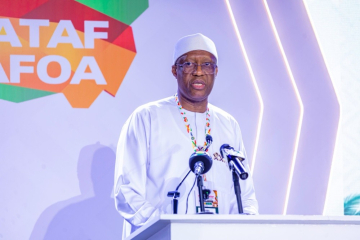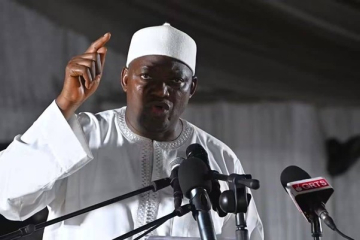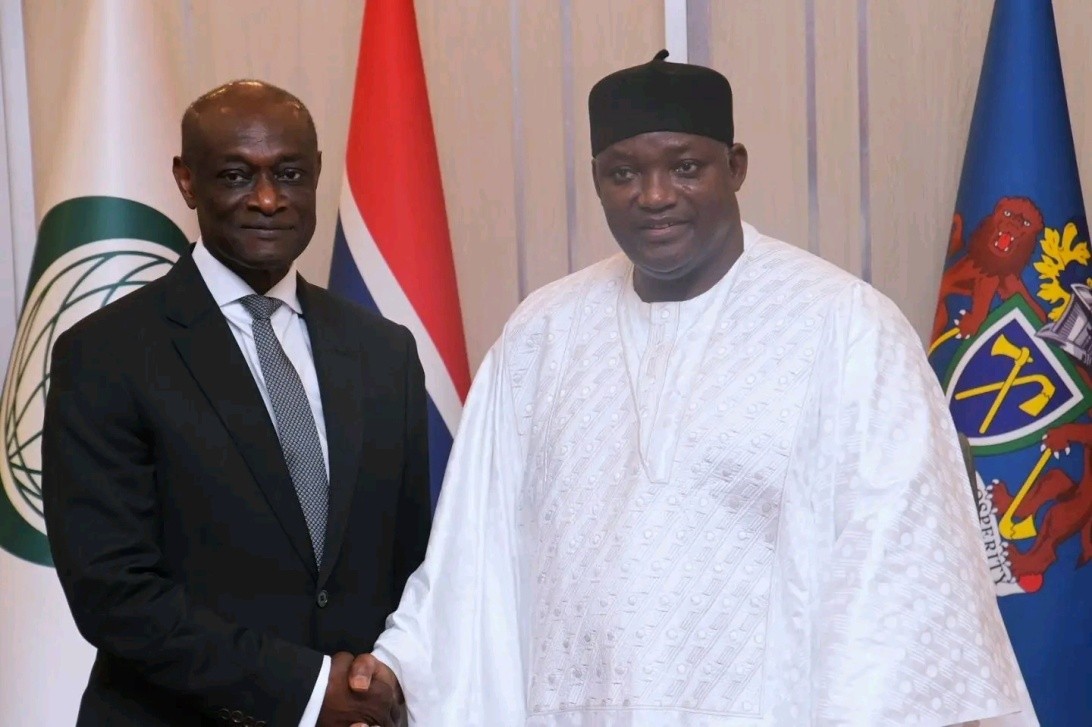
The swearing-in went ahead despite the GBA passing a unanimous resolution in July stating that Mr. Faal does not meet the constitutional requirements under Section 139(2) for appointment as Chief Justice.
Speaking at the ceremony, President Barrow said the appointment reaffirms his government’s commitment to “an independent, impartial, and effective judiciary” as the cornerstone of the constitutional order.
He said Mr. Faal was selected after a “well-thought-through process” based on his intellectual standing, academic and professional qualifications, track record, and character.
“For over four decades, Mr. Faal has practised law at the highest levels of the Common Law World,” Barrow said. He noted that Faal has appeared in state and federal courts in the United States, including the US Supreme Court.
“His practice cuts across the most demanding fields of the law. These range from capital criminal trials in the Superior Courts of California, such as his celebrated advocacy in the 1992 Los Angeles civil unrest proceedings, to very complicated international cases in which he represented sovereign states. Incidentally, they include The Gambia, at the International Centre for Settlement of Investment Disputes,” the President added.
Barrow also highlighted Faal’s contribution to legal education, noting that he has lectured at The Gambia Law School and sponsored a prize for outstanding students in Company Law and Commercial Practice.
The President paid tribute to outgoing Chief Justice Hassan B. Jallow, who served for over nine years. “Chief Justice Jallow’s reforms have transformed the Gambian Judiciary into a much stronger, much more modern, and much more credible sector,” Barrow said.
He cited data showing the Judiciary handled over 9,000 new cases in 2025 and disposed of more than 6,500 lawsuits, a 19% increase from the previous year.
In his first remarks as Chief Justice, Mr. Faal said he accepted the appointment “with humility, fully cognizant of the immense responsibilities that accompany the office.”
He described the office as “a public trust, entrusted to its holder to administer justice independently and impartially, and always in fidelity to the rule of law.”
“As I assume the office of Chief Justice, I am keenly aware that no institution entrusted with such vital public responsibility can ever regard its work as complete. The pursuit of higher professional standards, efficient and timely delivery of justice, and steadfast adherence to best practices, is a continuing institutional responsibility,” Faal said.
He stressed that an independent judiciary is “indispensable in all democratic societies” and that “justice must be administered according to law, and not according to public opinion, public sentiment, or the preferences of any interest group.”
Faal also acknowledged his predecessor, saying Jallow made “significant strides in re-establishing the independence of the judiciary, promoting alternative dispute resolution, and improving access to the courts.”
Following confirmation of the appointment, the Gambia Bar Association said it has filed an action at the Supreme Court challenging the constitutional validity of Mr. Faal’s appointment.
The Association said the suit follows its 6th July 2026 Emergency General Meeting resolution and prior engagements with the President, the Judicial Service Commission, and the Attorney General.
The GBA is seeking declarations that Mr. Faal does not satisfy the qualifications under Section 139 of the Constitution, and that his appointment and swearing-in before the retirement of the incumbent on 1st August 2026 are “unconstitutional, null and void.” It is also asking the Court to set aside the appointment for non-compliance with Section 139.
The legal challenge means the tenure of the new Chief Justice will be tested in court even as he begins work to lead the Judiciary.