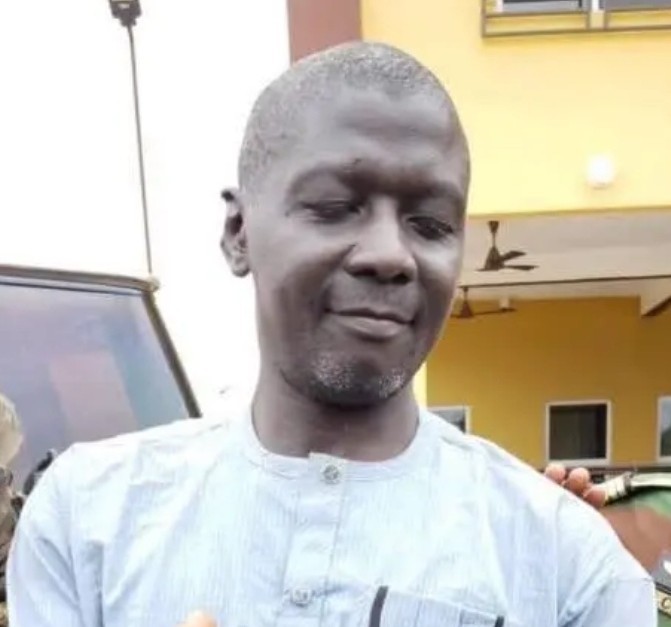
The defense of former Lieutenant Colonel Sanna Manjang has mounted a jurisdictional challenge before the General Court-Martial, arguing that the military tribunal lacks the competence to try him because he ceased to be a serving member of the Gambia Armed Forces (GAF) nearly a decade ago.
The State, however, has strongly opposed the application, insisting that Manjang remained subject to military law throughout his prolonged absence.
Manjang is represented by Counsel SK Jobe, while the State is represented by Director of Public Prosecutions (DPP) A.M. Yusuf.
The proceedings began with the introduction of the members of the General Court-Martial and the reading of the charge against Manjang. He was arraigned on one count of desertion, contrary to Section 53(1)(a) of the Gambia Armed Forces Act.
Asked whether he understood the charge, Manjang answered in the affirmative before pleading not guilty.
Following the plea, defence counsel immediately raised a preliminary objection challenging the jurisdiction and competence of the Court-Martial. Counsel Jobe argued that Manjang had quit the Gambia Armed Forces on 19 January 2017, returned military items in his possession and left the country amid the political crisis that followed the 2016 presidential election.
According to the defence, Manjang remained outside the country for approximately nine years and during that period had no relationship with the GAF.
Counsel argued that the military did not pay him his salary or allowances and that this conduct, coupled with his prolonged absence, amounted to a termination of his military service.
The defense therefore submitted that Manjang had become a civilian and was no longer a person subject to service law when the alleged desertion occurred.
Counsel maintained that a civilian cannot be subjected to a court-martial, urging the tribunal to dismiss or strike out the charge, convening order and other proceedings for want of jurisdiction.
The defence further relied on an affidavit sworn by Manjang, in which he stated that he left the Army because he feared arrest during the political and military uncertainty surrounding the departure of former President Yahya Jammeh. He maintained that he never deserted the Army but instead ended his military career.
The State has rejected that account.
In its affidavit in opposition, the GAF, through Major Saikou Kuyateh, Staff Officer 1 of GAF Records, argued that Manjang’s departure did not amount to a lawful discharge, retirement, dismissal or resignation.
The State maintains that Manjang left the country without leave or permission and remained absent from military service for approximately nine years. It disputes his claim that he returned military equipment before leaving.
Crucially, the State produced military records which it says demonstrate that Manjang continued to be regarded as a serving member of the GAF.
According to the opposition affidavit, a 7 February 2017 military signal classified Manjang as Absent Without Leave (AWOL), while a subsequent list dated 28 September 2021 identified him among officers declared to have deserted the Armed Forces.
The State argues that the non-payment of salary or allowances did not automatically terminate Manjang’s military service. Instead, it says the military’s records remained open and continued to classify him as AWOL and later as a deserter.
The prosecution also rejected the defence allegation that the proceedings were brought in bad faith to frustrate Manjang’s liberty, arguing that the Court-Martial case arises from distinct allegations governed by a different legal regime from his separate High Court proceedings.
The Court subsequently adjourned the matter till Monday, 12 October, for the defence to reply to the State’s opposition.