Global merchandise trade is showing continued resilience in 2026, with trade in AI-enabling goods emerging as a major driver of growth despite disruptions in key commodity markets, according to the latest analysis of global trade trends.
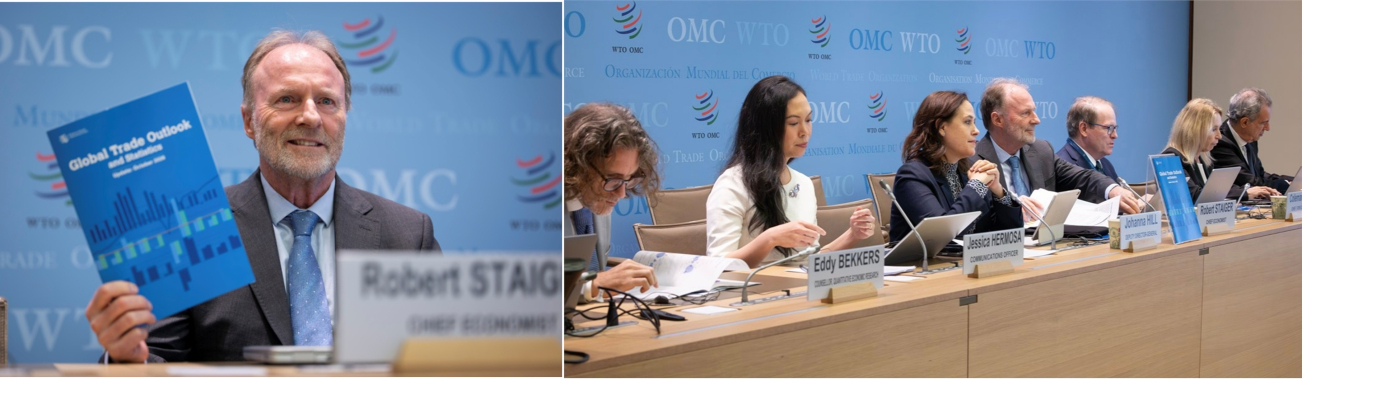
This disclosure was made by Robert Staiger, Chief Economist of the World Trade Organization (WTO), at a press conference held on Thursday 8 October 2026, at the WTO headquarters, Geneva, Switzerland. Conversation focused on the WTO Trade Outlook.
Mr Staiger disclosed that trade in AI-enabling goods including semiconductors - electronic components and machinery - used in advanced chip production grew by an astonishing 67 per cent in value terms during the first half of 2026, accounting for 47 per cent of the increase in global merchandise trade, even though these products represent less than 15 per cent of total merchandise trade.
The WTO Chief Economist revealed that the analysis also shows that global trade has been supported by shifts in production and supply chains, with countries outside the Middle East helping to offset declines in the region’s exports of crude oil, liquefied natural gas and fertilizers.
Meanwhile, he said, Asia has emerged as the dominant contributor to merchandise trade growth, while Europe is expected to lead growth in global services exports.
Highlighting further on the latest Trade Outlook and Statistics, Johanna Hill, WTO Deputy Director General announced that in the face of a major geopolitical shock, supply chains adapted and strong investment in artificial intelligence provided a powerful boost, saying this has led to updated WTO trade forecasts.
She said that when the previous trade outlook was issued last March, the world economy faced two powerful but opposing forces highlighting the conflict in the Middle East, which was expected to weigh on trade growth by disrupting shipments of energy products and fertilizers through the Strait of Hormuz. This would, in turn, lead to higher prices and weaker global GDP growth, she estimated.
At the same time, she said investments in AI and digital infrastructure were expected to provide a boost to merchandise trade by lifting demand for AI‑enabling goods, including electronic components and production inputs, but it was still unclear how the situation would unfold and affect trade.
On the first half in value terms
With the updated outlook reflecting on trade performance in the first half of the year, she said, the US dollar value of world merchandise trade was up 15% year-on-year in the first half of 2026 and, by comparison, trade grew by 7% in 2025 as a whole.
“And although they are strongly influenced by prices and exchange rates, trade statistics in value terms provide a more detailed picture of developments across products and across sectors. They show that growth in the first half of 2026 was led by electronic components, with trade in those products rising by 51% year-to-date, compared with 15% growth in 2025 as a whole,” she explained.
She advanced that least-developed countries also recorded particularly strong export growth, both in volume and value terms, with exports increasing by 25% year-on-year in value terms, driven in large part by a higher demand and prices for commodities, as buyers turned to alternative sources of supply.