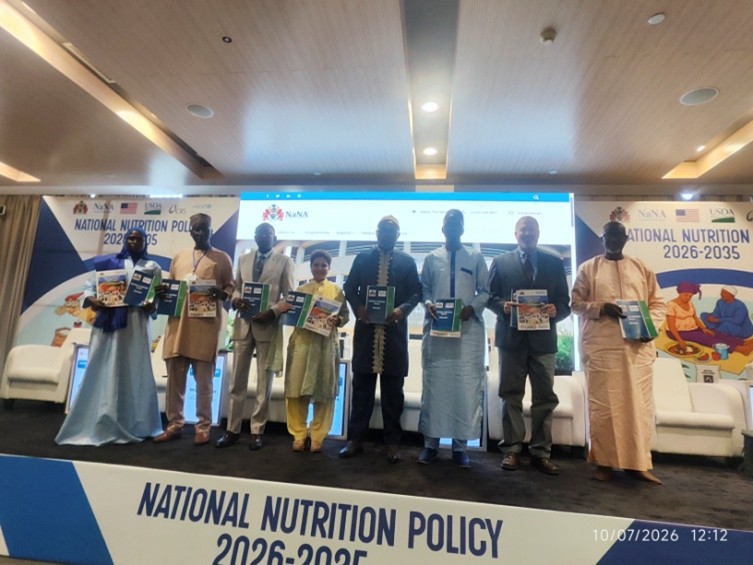
The government of The Gambia has reaffirmed its commitment to ending all forms of malnutrition with the launch of the National Nutrition Policy 2026-2035 and its accompanying Strategic Plan 2027-2031.
The policy was unveiled by Vice President Muhammed B.S. Jallow on Wednesday, 7th October at the Banjul International Conference Center.
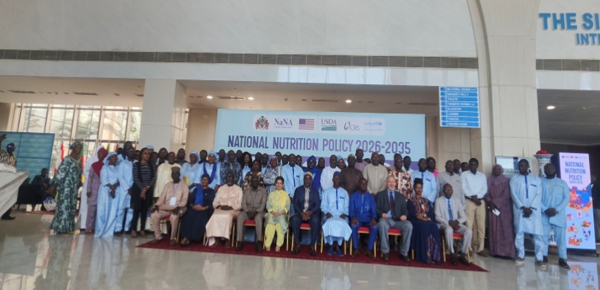
The event brought together government officials, ambassadors, bilateral and multilateral partners, NGOs, the private sector and civil society organizations to highlight policy priorities, targets and implementation strategies, and to galvanize partnership and accountability.
The launch was funded by Catholic Relief Services, with UNICEF providing technical and financial support for the review and development of the policy and strategic plan.
Vice President Jallow said the policy provides the strategic framework to guide multi-sectoral action to address malnutrition, improve food security and advance nutrition and health outcomes in line with the National Development Plan and SDGs 2 and 3.
He described it as a landmark framework embodying a collective vision for a healthier, stronger and more resilient Gambia, anchored on principles of equity, inclusivity, resilience, accountability and sustainability.
Its key priorities include improving the nutritional status of adolescents, women, infants and young children, ensuring equitable access to safe, diverse and nutritious foods, promoting healthy diets and lifestyles to prevent diet-related non-communicable diseases, and strengthening governance and partnerships for effective nutrition service delivery.
"The real measure of the policy will not be the document just launched, but the difference it makes in the lives of Gambians, particularly children, women and other vulnerable groups," Jallow said.
He challenged stakeholders to move from policy to implementation, from commitment to action, and from action to measurable results.
He emphasized that nutrition is not merely about food, but about human capital, dignity, productivity and national development.
"Good nutrition is the foundation upon which healthy lives, educational attainment, economic productivity and national prosperity are built," he said.
He noted that undernutrition continues to deprive many children of their full potential and contributes to preventable illness and deaths, while micronutrient deficiencies including anaemia and vitamin A deficiency continue to affect vulnerable populations.
Jallow said the policy provides a coordinated multi-sectoral response aligned with the Recovery-Focused National Development Plan (YIRIWA) 2023-2027, the Nutrition Act 2024, the Sustainable Development Goals, and Agenda 2063.
Speaking on behalf of UN Resident Coordinator Karl Frédérick Paul, UNICEF Representative in The Gambia, Nafisa Binte Shafique said with 2030 fast approaching, progress towards SDG 2 – ending hunger and all forms of malnutrition – must be accelerated.
"The Policy demonstrates the Government's commitment to placing nutrition at the heart of national development. The challenges are significant. We must address stunting, wasting and micronutrient deficiencies, alongside the growing burden of overweight, obesity and diet-related non-communicable diseases. Critically, we must confront child food poverty," she said.
She reaffirmed the UN system's commitment to supporting government to translate the policy into measurable results by strengthening food and nutrition security, maternal and child nutrition, resilient food systems, social protection and national monitoring systems.