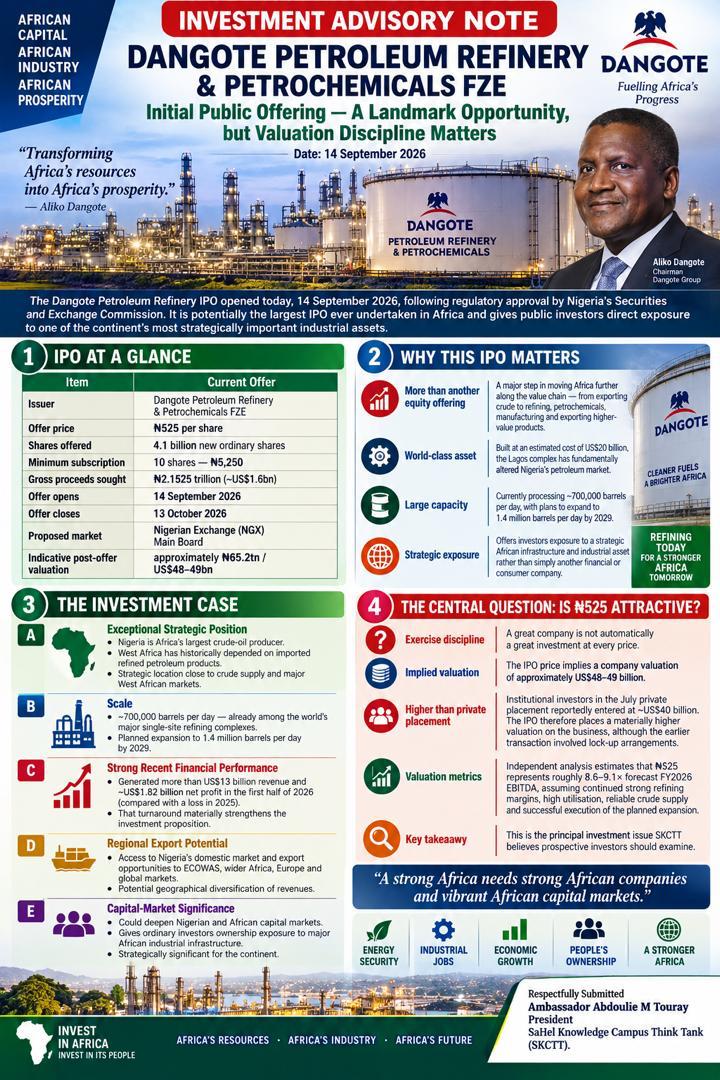
The significance of the Dangote Refinery IPO extends beyond Nigeria. For The Gambia, it provides a practical case study in democratising ownership, mobilising domestic and diaspora savings, and financing large African enterprises through capital markets rather than relying exclusively on bank debt, government borrowing or foreign investors.
Dangote is deliberately presenting the transaction as a broad-based public offer. The IPO is priced at ₦525 per share with a minimum application of only 10 shares (₦5,250), illustrating how ownership of a major industrial asset can be opened to relatively small retail investors.
Implications for Gambian Investors
For Gambians, the IPO demonstrates that participation in major African businesses need not be restricted to governments, banks, sovereign wealth funds and wealthy institutional investors.
Subject to the IPO’s eligibility requirements and applicable Gambian and Nigerian regulations, Gambian investors could potentially obtain exposure to one of West Africa’s largest industrial assets. The official offer requires investors to meet the prospectus eligibility criteria and subscribe through approved channels.
However, Gambian investors should distinguish between strategic enthusiasm for African industrialisation and investment discipline. Investment returns will ultimately depend upon refinery profitability, dividends, share-price performance and currency movements. A Gambian investing through naira-denominated securities assumes both equity risk and NGN/GMD foreign-exchange risk.
Opportunity for the Gambian Diaspora
The Gambian diaspora represents an important but insufficiently mobilised source of national investment capital.
Rather than diaspora resources flowing predominantly into:
remittances → consumption → housing → family support,
The Gambia should progressively create credible channels through which part of those savings can also flow into:
shares → bonds → infrastructure → productive enterprises → national wealth creation.
The Dangote IPO illustrates the possibilities of digital distribution. Its official subscription framework includes banks, fintech platforms, mobile-money operators and NGX Invest, dramatically lowering traditional barriers to retail capital-market participation.
For Gambians living in the United Kingdom, United States, Europe and elsewhere, this is particularly relevant. A future Gambian capital market should be designed from inception to accommodate diaspora investors through digital KYC, electronic brokerage accounts, transparent custody arrangements and efficient mechanisms for dividends and repatriation of investment proceeds.
LESSONS FOR THE PROPOSED GAMBIA STOCK EXCHANGE
The Dangote IPO strengthens the case for accelerating development of a properly regulated Gambia Stock Exchange (GSE).
The Gambia historically has lacked its own stock exchange and a developed secondary capital market. That has limited opportunities for ordinary Gambians to acquire tradable ownership stakes in major domestic businesses.
The objective should therefore be bigger than simply establishing another institution.
The GSE should become an instrument of national capital formation and people’s ownership.
It could eventually provide a platform for carefully selected listings involving commercially viable assets in:
Banking & Insurance • Telecommunications • Energy • Ports & Logistics • Tourism • Housing • Agro-processing • Infrastructure • Successful SOEs
The government could also consider partial listings rather than wholesale privatisation of suitable State-Owned Enterprises.
For example, where commercially and legally appropriate:
Government retains strategic control — citizens and institutions acquire minority ownership — companies become subject to stronger disclosure and governance requirements — domestic capital is mobilised for expansion.
This could create a genuine People’s Capitalisation Programme.
FROM REMITTANCES TO OWNERSHIP
The larger strategic lesson from Dangote is therefore not simply:
“Should Gambians buy Dangote shares?”
The more consequential question is:
“When will Gambians be able to invest their savings in well-governed Gambian companies and national assets through their own regulated capital market?”
The Dangote Refinery IPO provides a powerful African demonstration that large strategic enterprises can progressively broaden ownership while mobilising capital for expansion.
For The Gambia, the opportunity is to move from a predominantly savings-and-remittances economy toward an investment-and-ownership economy.
THE SKCTT PROPOSITION
From Remittances to Investment.
From Savings to Shares.
From State Ownership to People’s Capitalisation.
From Foreign Dependence to Domestic Capital Formation.
From Consumers of Wealth to Owners of Productive Assets.
That could become one of the foundational principles of the proposed Gambia Stock Exchange and a new national asset-ownership strategy.
Respectfully Submitted
Ambassador Abdoulie M Touray
President
SaHel Knowledge Campus Think Tank
(SKCTT)