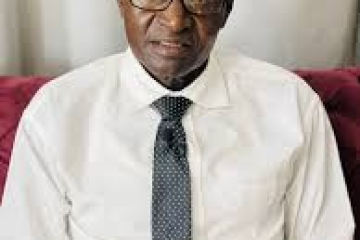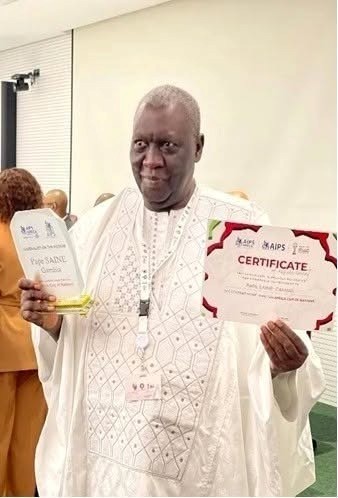
The doyen of Gambian journalism and a pillar of press freedom, Pap Saine: The survivor – over fifty years of journalism, perseverance, and the pursuit of truth in The Gambia
Fatoumatta: For half a century, Gambian journalist Pap Saine has stood at the forefront of African press freedom. From Radio Syd to Reuters, from CAF press boxes to the founding of The Point, and through the assassination of his colleague Deyda Hydara to his own arrests, trials, and eventual vindication, Saine's journey exemplifies courage and resilience. Alagi Yorro Jallow writes that Saine's life transcends Gambian borders, positioning him among Africa's foremost defenders of truth.
In every region of Africa, there are journalists whose lives become symbols of resistance: Dele Giwa in Nigeria, Carlos Cardoso in Mozambique, Norbert Zongo in Burkina Faso. Their stories are marked by courage, persecution, and sacrifice. But unlike them, Pap Saine survived. His survival is not accidental; it is a testament to endurance, resilience, and an unwavering belief in the power of truth. For more than fifty years, Saine has been one of the most important journalistic voices in West Africa. His story is not merely Gambian; it is African. It is global. It is the story of a man who refused to break.
Before he became a doyen of the Gambian press and a continental figure, Pap Saine was a young man with rhythm, a music lover, a dancer, a charismatic presence in the social life of Banjul. Those who knew him in his youth remember a man full of joy, elegance, and sociability. He carried that charisma into journalism, where his voice first emerged on Radio Syd, The Gambia's pioneering private radio station.
Radio Syd was a radical experiment in a young republic. Saine's early broadcasts helped shape the country's first independent media culture. He was not simply reporting; he was helping define what journalism could be in a post‑colonial state. Saine's transition to Reuters marked the beginning of his international relevance. For decades, he served as Reuters' correspondent for The Gambia and West Africa, covering coups, elections, constitutional crises, and regional political shifts. His reporting on the 1981 attempted coup and the subsequent Senegalese intervention became essential reading for international observers.
He was the journalist foreign correspondents called when they needed clarity. His dispatches were read in London, Paris, New York, Johannesburg, and Nairobi. He became the bridge between a small West African nation and the global press.
Fatouatta: From 1988 to 2004, Saine served as Alagi Media Officer for the Confederation of African Football (CAF). He attended nearly every major FIFA and CAF tournament for two decades. His reporting from Cairo, Johannesburg, Lagos, Dakar, and Zurich made him one of Africa's most respected sports journalists. He was a fixture in press boxes across the continent, a Gambian journalist whose presence signaled professionalism, credibility, and continental reach.
In 1991, Saine co‑founded The Point with his childhood friend Deyda Hydara and colleague Baboucarr Gaye. Hydara and Saine ran the paper together for a decade, building one of West Africa's most respected independent newspapers. The Point was not merely a publication; it was a declaration of independence in a country where truth often carried consequences. It became a symbol of resistance, a platform for accountability, and a beacon for press freedom.
On 14 December 2004, The Gambia passed two draconian media laws that criminalized defamation and imposed overwhelming financial burdens on newspapers. Hydara publicly announced his intention to challenge the laws. Two days later, on 16 December 2004, he was assassinated by an unknown gunman. His murder remains unsolved. Saine refused to let The Point die. In 2006, he made it a daily newspaper. It soon became the only independent newspaper in the country.
Under the Jammeh dictatorship, Saine became one of the most persecuted journalists in West Africa. His newsroom was raided. His staff was detained. He was arrested multiple times.
In February 2009, police stormed The Point's offices three times in one day, demanding that reporters reveal their sources. Saine was later arrested for "publishing false information" after reporting that a Gambian diplomat had been sent to Mile II Prison. He refused to reveal his source. Days later, he was arrested again, this time accused of being Senegalese.
On 24 February 2009, Saine was charged with "obtaining Gambian citizenship by pretense" and "obtaining a Gambian passport by false declaration." The charges were absurd, but the humiliation was real. In court, he produced his father's birth certificate and the compound lease, documents that should never have been necessary for a man whose entire life had been lived in service to his country. His lawyers, Antouman Gaye, Hassan B. Jallow, and the late Lawyer Abdoulie Drammeh defended him with dignity. On 15 June 2009, the court declared him a bona fide Gambian. It was one of the most emotional moments in Gambian journalism, a man forced to prove his own identity simply because he dared to tell the truth.
Fatoumatta: Saine's courage earned him global recognition. In 2006, he received the Johann Philipp Palm Award for defending freedom of opinion. In 2010, the International Press Institute named him a World Press Freedom Hero, the third West African to receive the honor. In 2019, the Black American Journalists Association named him Foreign Journalist of the Year. In 2021, he received Africa's Most Respected CEO Award in Dubai. He described the IPI award as "an inspiration for journalists fighting for justice, democracy, and human rights."
Martyrs mark Africa's press freedom history. A parcel bomb killed Dele Giwa in Lagos. Carlos Cardoso was assassinated in Maputo. Norbert Zongo was murdered in Ouagadougou. Pap Saine belongs in this pantheon, but with one difference. He survived. He lived to continue the fight. He lived to keep The Point alive. He lived to carry Hydara's legacy. He lived to mentor younger journalists. He lived to see the dawn of a new republic. He is the survivor among martyrs.
Fatoumatta: I must speak personally here. Pap Saine was not my rival in journalism. We competed fiercely. We challenged each other. We sharpened each other. But rivalry in journalism is not enmity; it is respect. It is recognition of talent. It is acknowledgment of excellence. He later became (Goro), my in‑law, married to my niece. Life has a way of weaving stories together. Our rivalry became kinship. Our kinship became brotherhood. The same regime persecuted us. The same machinery arrested us. We had our citizenship questioned by the same state. We fought the same draconian laws. We survived the same darkness. We are brothers forged in fire.
Those who know Saine describe him as kind, sociable, charismatic, debonair, principled, and unwavering. He brightens every space he occupies. He never accepts being second best. He believes in diversity, unity, and national harmony. He never wavers in his belief in a better world. He never modulates his principles for professional gain. Even though the world has not always treated him kindly, he carries no self‑pity. He carries dignity.
In the long and painful chronicle of African journalism, Pap Saine stands as a pillar, unbent, unbroken, unbowed. He is the journalist who refused to be silenced, the elder who refused to retire from truth, the survivor who refused to surrender his pen. His life is a lesson. His courage is a legacy. His endurance is a monument. And his story must be told, loudly, proudly, and while he is still here to hear it.
Fatoumatta: Pap Saine has given The Gambia everything: his youth, his voice, his pen, his freedom, his health. He has carried the burden of journalism for half a century. He has mentored generations. He has preserved Hydara's legacy. He has kept The Point alive when it would have been easier to let it die. The world must celebrate him now. The world must honor him now. The world must tell his story now. The world must give him his flowers now because men like Pap Saine do not come twice in a continent's history.