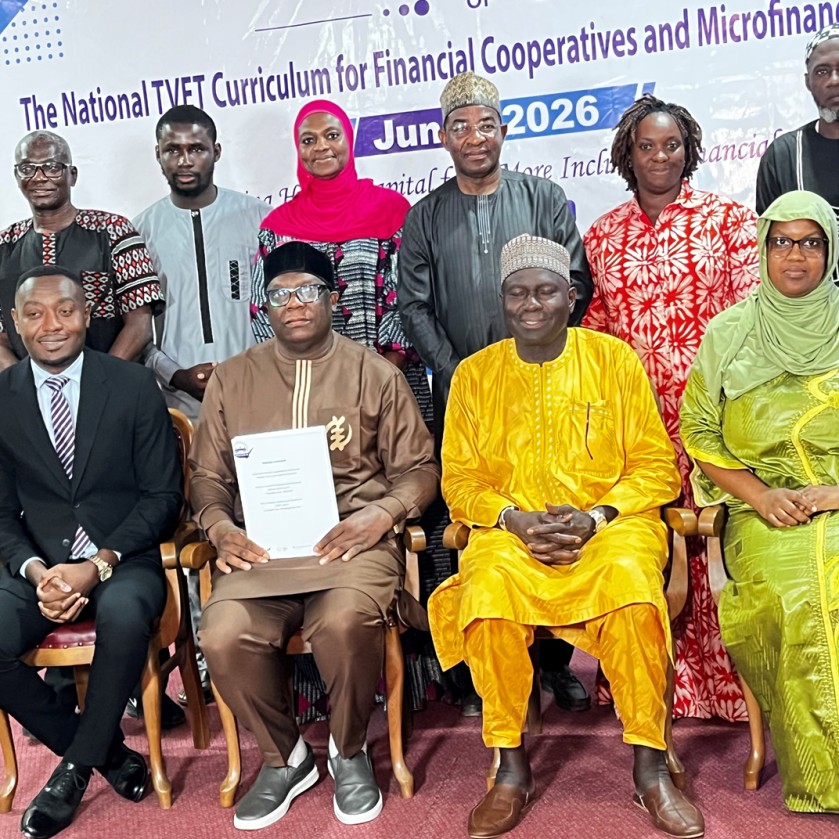
The curriculum was developed with financial and technical support from the German Sparkassenstiftung for International Cooperation (DSIK) in West Africa, under the auspices of Germany’s Federal Ministry for Economic Cooperation and Development (BMZ).
Speaking at the launch, NACCUG Chief Executive Officer, Foday Sanyang, described the curriculum as a nationally recognised and standardised framework designed to strengthen the competence of practitioners, managers, directors, and leaders within the financial cooperative and microfinance sectors.
He explained that the initiative would create a structured professional development pathway for both current and future practitioners, helping to build a workforce that is competent, ethical, and responsive to the evolving needs of the financial services industry.
“The institutions we represent are more than financial service providers. They empower farmers, support entrepreneurs, create opportunities for young people, strengthen households, and contribute significantly to local economic development,” Mr Sanyang said.
He noted that for financial cooperatives and microfinance institutions to continue fulfilling their mandate effectively, they must be supported by skilled and knowledgeable professionals equipped with the right values and expertise.
Mr Sanyang commended NAQAA for its leadership in promoting quality and nationally recognised skills development programmes, while also expressing appreciation to DSIK and the German Government for their support.
“If we invest in skills today, we will build stronger institutions tomorrow. And when cooperatives become stronger, communities become stronger,” he added.
Felix Amoako Boampong, DSIK Country Representative, said the new curriculum responds to the growing need for competent professionals capable of driving financial inclusion across The Gambia.
He observed that while much attention is often placed on expanding access to financial services, genuine financial inclusion cannot be achieved without adequately trained personnel.
“We cannot talk about financial inclusion without competent staff. People are at the centre of this journey,” Mr Boampong stated.
He explained that the initiative emerged from discussions between DSIK and NACCUG following the success of previous capacity-building programmes. Bringing together financial cooperatives and microfinance institutions under a common training framework, he said, was a significant achievement that demonstrated a shared commitment to strengthening the sector.
German Ambassador to The Gambia, Klaus Botzet, underscored the importance of vocational training in strengthening financial institutions and promoting economic opportunities.
He stressed that financial inclusion goes beyond opening bank accounts and must focus on expanding real economic opportunities for women, youth, farmers, and small business owners.
“Stronger financial cooperatives and microfinance institutions require investment not only in capital but also in human capability,” Ambassador Botzet said.
He emphasised that TVET should be recognised as a strategic platform for building financial literacy, digital competence, entrepreneurship, customer service, business planning, and governance skills.
Representing the Minister for Higher Education, Research, Science and Technology, Dr Momodou Lamin Tarro described the launch as a major milestone in aligning education and training programmes with labour market demands and national development priorities.
He reaffirmed government’s commitment to competency-based education and skills development, noting that a nation’s greatest resource lies in the skills, creativity, and productivity of its people.
“The curriculum will equip professionals in the financial cooperatives and microfinance sector with technical expertise, governance knowledge, ethical standards, and financial management skills required to support sustainable economic growth,” Dr Tarro said.