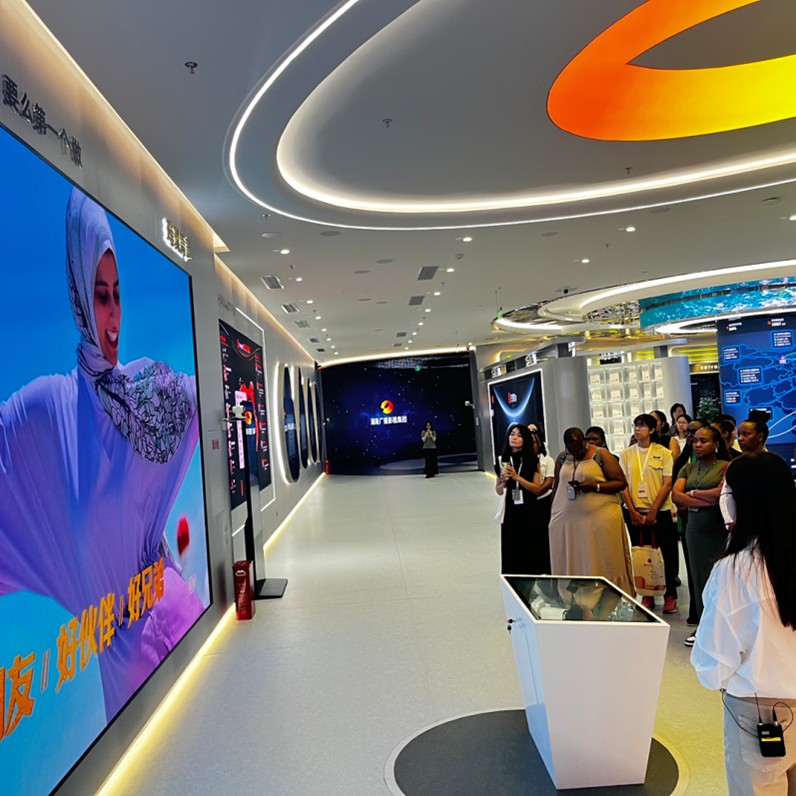
Delegates attending the Ministerial Seminar on New Media Capacity Building for Women Officials from Belt and Road Countries visited HBS headquarters in Changsha, where they learned how one of China’s most influential broadcasters is embracing AI to revolutionise content production and international broadcasting.
During a presentation, Nan Hui, a senior staff member at HBS, highlighted the organisation’s three-decade journey in building a reputation for award-winning dramas, documentaries, reality shows and digital content now enjoyed worldwide.
Widely recognised through its streaming platform Mango TV, HBS has grown into one of China’s largest media groups, blending traditional television with cutting-edge digital innovation. Mango TV distributes content in multiple languages and has expanded its global footprint through entertainment, documentaries and cultural programming.
Nan Hui revealed that one of the broadcaster’s documentaries focusing on Africa has become highly popular among viewers, reflecting China’s growing interest in telling stories that connect cultures. She also noted that HBS has pioneered reality programmes that promote traditional Chinese culture and local products. Some items featured on these shows reportedly sold out within 48 hours, underscoring the powerful influence of media on consumer behaviour.
“Our mission is not only to entertain but also to preserve and promote traditional Chinese culture through creative storytelling,” she told the international delegates.
HBS dramas have won numerous international awards, while Chinese productions continue to gain traction on overseas digital platforms. One of the most striking presentations focused on the explosive growth of short dramas, a rapidly expanding format attracting millions of viewers worldwide. According to Nan Hui, HBS has produced around 5,000 short dramas, including some created with the assistance of artificial intelligence.
She explained that AI is increasingly integrated into script development, production workflows and visual creation, enabling faster and more efficient content production without compromising quality.
“Artificial intelligence is becoming an important tool in modern broadcasting,” she said, adding that many of the broadcaster’s latest productions now incorporate AI technologies to enhance creativity and speed.
Delegates also learned that Mango TV serves audiences in more than 190 countries and regions, offers multilingual subtitles, and has accumulated billions of online views, making it one of China’s fastest-growing international media platforms.
For many participants, the visit highlighted how rapidly AI is transforming the global media landscape. From automated production systems to AI-assisted storytelling and digital distribution, China’s media industry is increasingly blending technology with creative content to reach international audiences.
The visit formed part of the ongoing seminar aimed at strengthening media capacity among women officials from Belt and Road countries, exposing participants to China’s latest innovations in journalism, broadcasting and digital communication.
As the seminar continues in Changsha, delegates are gaining first-hand insight into how Chinese media organisations are positioning themselves at the forefront of the digital era, where artificial intelligence, innovation and cultural storytelling are becoming the new language of global communication.