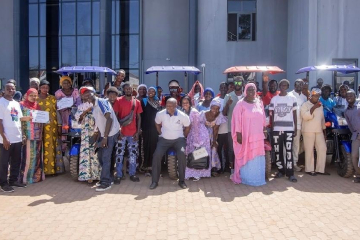
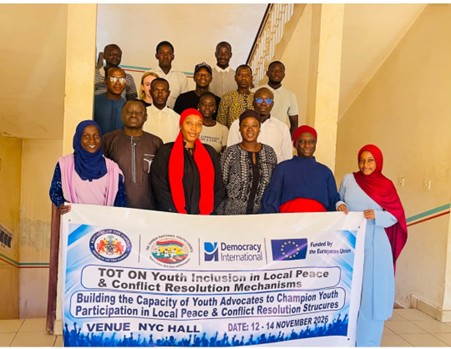
The National Youth Council (NYC) has launched a three-day training of trainers (ToT) programme aimed at equipping young people with the skills to promote peacebuilding and strengthen youth participation in community conflict resolution mechanisms.
The training, implemented under the EU-funded Next Generation Peacemakers project in partnership with Democracy International (DI), brings together selected youth representatives from the West Coast, North Bank and Central River Regions.
At the opening ceremony, Alhagie Jarjue, Executive Director of the National Youth Council, said meaningful conflict resolution and sustainable peace could not be achieved without the active involvement of young people in local decision-making structures.
He reminded that young people are often at the forefront of conflicts and frequently bear the consequences, particularly young women, making their inclusion in peacebuilding structures essential.
"You cannot talk about managing conflicts without the participation of young people," he said, outlining that the capacity building exercise would enable participants to return to their communities and conduct step-down sessions to encourage greater youth involvement in conflict resolution mechanisms.
The programme, he added, would also promote continuous advocacy, ensuring that community stakeholders understand the importance of youth participation in decision-making processes beyond periods of conflict.
Also speaking, Ndey Ngoneh Jeng, Project Manager, Democracy International, disclosed that the organisation was pleased to support the initiative, which seeks to address barriers preventing young people from accessing decision-making spaces.
The project, she went on, was being implemented across other African countries notably, Liberia and Sierra Leone and The Gambia with the support of the European Union.
She reminded that those to be trained had an important responsibility to take the knowledge gained into their respective communities, particularly underserved and rural areas.
She said the initiative was also intended to ensure that young people, who constitute a significant proportion of the population, have opportunities to influence decisions affecting their lives.
The participants are expected to conduct community-level training and facilitate the integration of youth focal points into local peace and conflict resolution structures in selected districts.