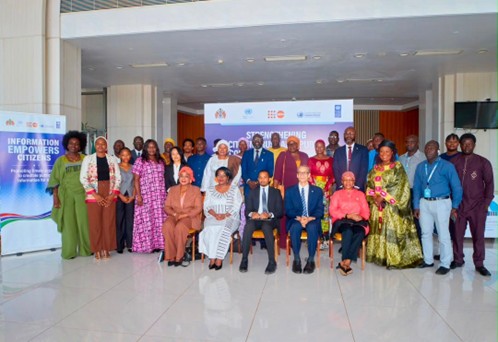
UNDP Resident Representative Mandisa Mashologu said the project, “Strengthening Citizen Trust and Public Accountability for Peaceful Coexistence in The Gambia”, was developed and will be implemented by UNDP in coordination with UNFPA and OHCHR.
The launch coincides with the first-ever global Peacebuilding Week and the 20th anniversary of the UN Peacebuilding Fund. Mashologu noted it follows a series of UN projects in The Gambia focused on conflict prevention, transitional justice, security sector reform, and peace infrastructure.
She said the project comes at a critical moment in The Gambia’s democratic journey. Since 2017, the country has made progress in strengthening democratic institutions, advancing transitional justice and human rights, expanding civic space, and deepening citizen participation.
“Yet, as in many societies undergoing democratic transformation, one challenge remains central: sustaining and strengthening trust between citizens and the state,” Mashologu stated. “Trust is the foundation upon which peaceful and resilient societies are built.”
She explained that citizens are more likely to engage constructively in governance when they believe their voices matter, institutions are transparent and responsive, and information is accessible.
“Public accountability is therefore not simply a governance objective. It is a peacebuilding imperative. When citizens are informed, engaged, and able to hold institutions accountable, grievances are more likely to be addressed through dialogue rather than mistrust or conflict,” she added.
Mashologu said the project is fully aligned with The Gambia’s Yiriwaa – Recovery Focused National Development Plan 2023-2027, which prioritizes accountable governance and citizen participation. It also supports SDG 16 on Peace, Justice and Strong Institutions, and the principles of inclusion under the 2030 Agenda.
At its core, she said, the project will strengthen citizen-institution relations through support for access to information, civic participation, protection of civic space, institutional accountability, and evidence-based dialogue.
Inclusion is central to the design. “Women, young people, persons with disabilities, civil society organizations, media practitioners, and marginalized communities must be recognized not only as beneficiaries but as active agents of change and indispensable partners,” Mashologu stressed.
She thanked the Ministry of Information for leadership and partnership in advancing transparency and citizen engagement, describing it as a “strong and trusted partnership” that produced a nationally owned project.
Mashologu also expressed appreciation to the UN Peacebuilding Fund for its confidence in The Gambia’s democratic consolidation. UNDP, UNFPA and OHCHR reaffirmed commitment to supporting stronger institutions and inclusive governance.
“As I conclude, let us seize this opportunity to strengthen public trust, deepen democratic accountability, and build a future where every Gambian can participate meaningfully in shaping the country’s development and prosperity,” she concluded.