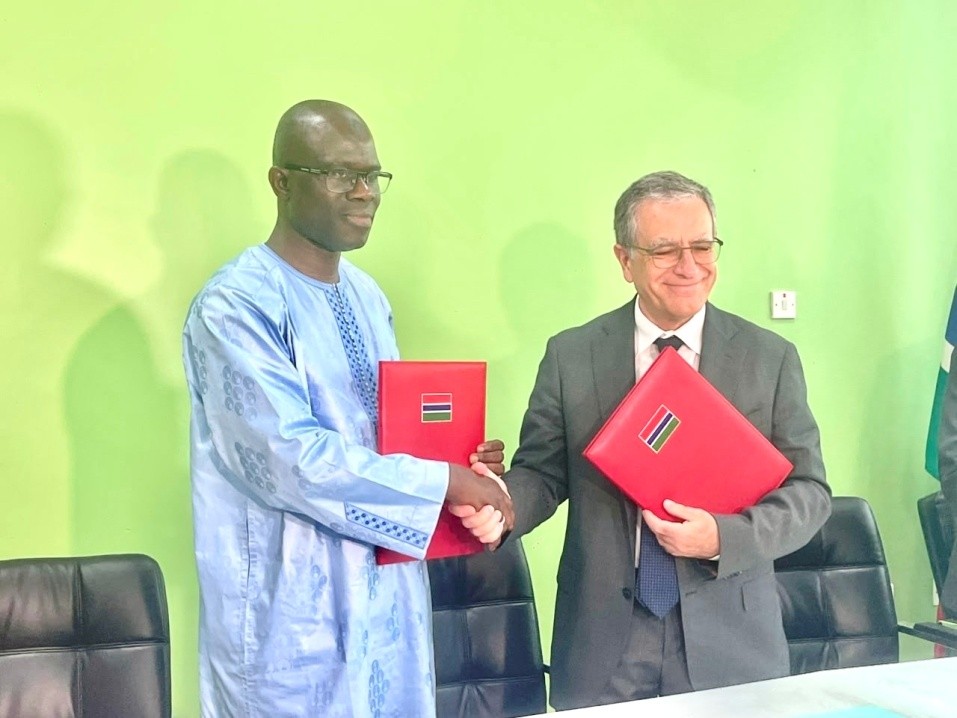
The deal marks the most significant upstream petroleum investment commitment in the country since the departure of BP and signals renewed international confidence in The Gambia’s hydrocarbon prospects.
Government officials described the agreement as a milestone in efforts to responsibly develop the country’s petroleum resources while attracting credible foreign investment to the upstream sector.
Speaking at the signing ceremony, Petroleum, Energy and Mines Minister Nani Juwara said the agreement extends beyond exploration activities and has been structured to deliver substantial benefits to Gambians through a carefully negotiated fiscal and commercial framework.
He disclosed that government will transfer its 10 percent carried participating interest in Block A1 to the Gambia National Petroleum Corporation through a Deed of Assignment. The stake will be managed by GNPC on behalf of the state and gives The Gambia direct participation in the project, with an option to acquire an additional five percent interest should a commercial discovery be made.
According to the minister, the agreement also secures a range of financial and developmental benefits, including royalties, taxes, signature and production bonuses, training contributions, data sales revenue, local content obligations, capacity-building initiatives and other contractual commitments designed to maximise national value.
He said the provisions were negotiated to ensure that any future petroleum development contributes meaningfully to economic growth, institutional strengthening and sustainable development for future generations.
Minister Juwara praised the Petroleum Commission, GNPC, members of the National Petroleum Negotiation Committee and other stakeholders for their role in concluding the agreement, while thanking Eni for placing confidence in The Gambia’s petroleum prospects.
He expressed optimism that through strategic partnerships and strong governance, The Gambia could eventually emerge as a responsible energy-producing nation on the African continent.
Director General of the Petroleum Commission of The Gambia, Cany Jobe, stressed that the signing should not be interpreted as an oil discovery but rather as the beginning of a serious new phase in assessing the country’s offshore petroleum potential.
She described the agreement as the first upstream petroleum licence signed under the Commission’s regulatory oversight and emphasized that its significance lies in securing a credible international operator to undertake further scientific exploration in Block A1.
According to her, petroleum exploration in frontier countries requires patience, significant investment, advanced technology and rigorous scientific analysis. While The Gambia is located within the wider MSGBC Basinan area that has attracted increasing global attention following major discoveries in neighbouring countriesthe country has yet to establish commercially viable oil or gas reserves.
“What The Gambia currently possesses,” she explained, “is encouraging geological data, a strategic offshore location and a structured framework that allows for further exploration.”
She outlined the extensive process leading to the agreement, noting that Eni first expressed interest in Block A1 in May 2025. The company subsequently underwent a comprehensive assessment covering its technical capabilities, financial strength, operational experience, local content commitments and corporate credentials.
The process included a Request for Information, technical reviews, consultations, exclusivity arrangements and detailed negotiations involving multiple government institutions through the National Petroleum Negotiation Committee.
Jobe said the negotiations covered legal, fiscal, operational, environmental and local content issues, underscoring that petroleum licences are not simply awarded but are built through careful evaluation, institutional coordination and negotiations designed to protect the national interest while maintaining international competitiveness.
She commended the Ministry of Petroleum, Energy and Mines, the Commission’s staff and members of the negotiating committee for their professionalism throughout the process.
Exploration Director, Eni SPA Aldo Napolitano welcomed the conclusion of what he described as a rigorous first phase of collaboration between the company and The Gambia.
He noted that the real work now begins with detailed geological and geophysical studies aimed at assessing the hydrocarbon potential of Block A1.
Napolitano acknowledged that petroleum exploration remains a high-risk undertaking that requires substantial financial investment and advanced technologies, with no guarantee of success. However, he assured government officials that Eni would deploy industry-leading expertise, methodologies and technologies in carrying out its exploration programme.
The Eni representative highlighted the company’s century-long history in the energy industry and its more than seven decades of operations across Africa, noting that the company places great importance on building long-term relationships with host countries.
He expressed hope that the signing would be remembered as the beginning of a successful partnership and a lasting friendship between Eni and The Gambia.