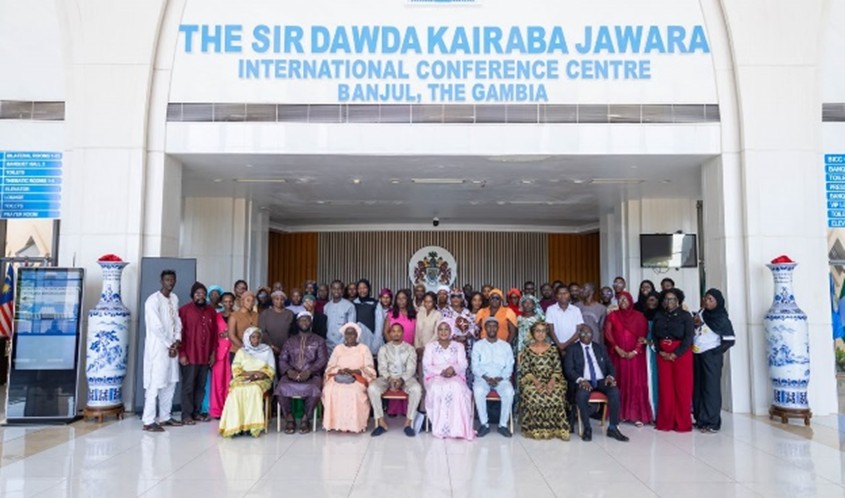
The Gambia took a decisive step today towards ending fragmented, late and one-way government communication, as stakeholders met at the Sir Dawda Kairaba Jawara Conference Center to validate the country's first National Communication Policy, covering 2027–2036.
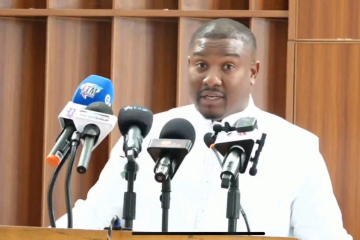
"This policy is designed to change that," said Dr Ismaila Ceesay, Minister of Information, Media and Broadcasting Services.
Organised by the Ministry of Information, Media and Broadcasting Services (MoIMBS) with support from the West Africa Coastal Areas Resilience Project (WACA), the National Validation workshop brought together government officials, media practitioners, civil society and community representatives. Their task was to review the draft policy and its annexes, resolve outstanding issues and agree the road to Cabinet submission.
Delivering the welcoming remarks, the Permanent Secretary of MoIMBS, Ms Cordu L. Jabang, traced the history of government communication in The Gambia since 1965. She noted that English has remained the master language for official government statements, even as citizens speak and understand the country's many other languages. The validation exercise, she said, offers a timely opportunity to examine current communication practices and establish a policy framework to guide government communication going forward. She urged participants to review the draft critically and help make it a document the whole country can own.
That call was taken up by the Minister of Information, Media and Broadcasting Services, Dr Ismaila Ceesay, who delivered the keynote address and officially opened the workshop. He said the validation marks an important step towards redefining the relationship between government communication and citizens.
"For far too long, government communication has been fragmented," the Minister said. Information has sometimes reached citizens late, and people have sometimes felt the government speaks at them rather than with them. "This policy is designed to change that," he declared, describing it as a fundamental shift in how government communication is understood, organised and delivered, and a commitment to communication that is credible, inclusive, accountable and responsive to the needs of every Gambian.
The Minister was firm on the principle behind the policy. Government communication is not propaganda, he stressed. It is a public service, and every Gambian has a right to know and to access information.
Speakers from across government and partner institutions backed the policy and linked it to their own work. The Director of Press and Public Relations underlined the need to strengthen the flow of information between government and its institutions, a theme the policy addresses through its institutional arrangements.
The Project Coordinator of the WACA Project Implementation Unit said the message of the moment is to stay alert and stay prepared, noting that resilience depends on communication strategies that get the right information to the right people at the right time. That, he said, is why a national communication policy is necessary rather than optional. The Minister of Environment, Climate Change and Natural Resources made the same link between credible communication and preparedness for climate-related risks and emergencies through her Deputy Permanent Secretary.
After the opening session, the Lead Consultant presented the draft policy, tracing the journey behind it and setting out its key findings, vision, goals and focus areas. The presentation also covered the annexes, institutional arrangements and outstanding issues, before participants raised questions and sought clarification in plenary.
Participants then split into four groups, each combining government, media, civil society and community voices with a facilitator and a rapporteur, and reviewed the policy section by section. One group examined coordination and credibility, covering leadership, clearance, integrity, media relations and governance. Another focused on inclusion and citizen voice, including languages, accessibility, community radio and feedback. A third looked at capacity and delivery, from staffing and budget to shared services, implementation and monitoring. The fourth took on resilience and the future, including crisis communication, climate, misinformation, elections, AI and legal reforms.
The groups agreed changes and priorities, then reported back in plenary, where outstanding issues were discussed and resolved under the moderation of the Director at the Department of Information Service. The day closed with a validation statement and an agreed route to Cabinet, the next step before the policy can guide government communication across the public sector.
For the ministry and its partners, the aim goes beyond a document. They want government information to reach citizens early and clearly, to reflect the languages and realities of communities, and to earn public trust through openness rather than persuasion.