I’ve
always prided myself on my ability to teach myself things. Whenever I don’t
know a lot about something, I’ll read a textbook or watch an online course
until I do.
I
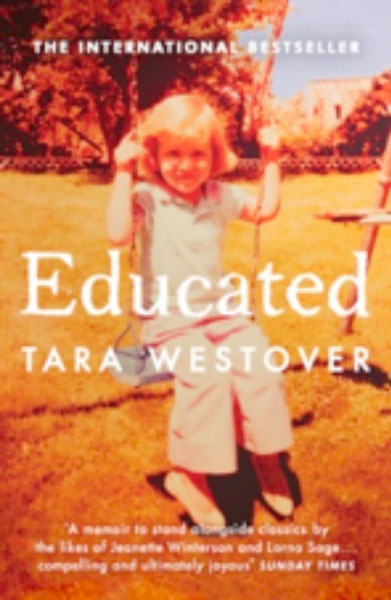
thought I was pretty good at teaching myself-until I read Tara Westover’s
memoir Educated. Her ability to learn on her own blows mine right out of the
water. I was thrilled to sit down with her recently to talk about the book.
Tara
was raised in a Mormon survivalist home in rural Idaho. Her dad had very
non-mainstream views about the government. He believed doomsday was coming, and
that the family should interact with the health and education systems as little
as possible. As a result, she didn’t step foot in a classroom until she was 17,
and major medical crises went untreated (her mother suffered a brain injury in
a car accident and never fully recovered).
Because
Tara and her six siblings worked at their father’s junkyard from a young age,
none of them received any kind of proper home-schooling. She had to teach
herself algebra and trigonometry and self-studied for the ACT, which she did
well enough on to gain admission to Brigham Young University. Eventually, she
earned her doctorate in intellectual history from Cambridge University. (Full
disclosure: she was a Gates Scholar, which I didn’t even know until I reached
that part of the book.)
Educated
is an amazing story, and I get why it’s spent so much time on the top of the
New York Times bestseller list. It reminded me in some ways of the Netflix
documentary Wild, Wild Country, which I recently watched. Both explore people
who remove themselves from society because they have these beliefs and
knowledge that they think make them more enlightened. Their belief systems
benefit from their separateness, and you’re forced to be either in or out.
But
unlike Wild, Wild Country-which revels in the strangeness of its subjects-Educated
doesn’t feel voyeuristic. Tara is never cruel, even when she’s writing about
some of her father’s most fringe beliefs. It’s clear that her whole family,
including her mom and dad, is energetic and talented. Whatever their ideas are,
they pursue them.
Of
the seven Westover siblings, three of them-including Tara-left home, and all
three have earned Ph.Ds. Three doctorates in one family would be remarkable
even for a more “conventional” household. I think there must’ve been something
about their childhood that gave them a degree of toughness and helped them
persevere. Her dad taught the kids that they could teach themselves anything,
and Tara’s success is a testament to that.
I
found it fascinating how it took studying philosophy and history in school for
Tara to trust her own perception of the world. Because she never went to
school, her worldview was entirely shaped by her dad. He believed in conspiracy
theories, and so she did, too. It wasn’t until she went to BYU that she
realized there were other perspectives on things her dad had presented as fact.
For example, she had never heard of the Holocaust until her art history
professor mentioned it. She had to research the subject to form her own opinion
that was separate from her dad’s.
Her
experience is an extreme version of something everyone goes through with their
parents. At some point in your childhood, you go from thinking they know
everything to seeing them as adults with limitations. I’m sad that Tara is
estranged from a lot of her family because of this process, but the path she’s
taken and the life she’s built for herself are truly inspiring.
When
you meet her, you don’t have any impression of all the turmoil she’s gone
through. She’s so articulate about the traumas of her childhood, including the
physical abuse she suffered at the hands of one brother. I was impressed by how
she talks so candidly about how naïve she once was-most of us find it difficult
to talk about our own ignorance.
I
was especially interested to hear her take on polarization in America. Although
it’s not a political book, Educated touches on a number of the divides in our
country: red states versus blue states, rural versus urban, college-educated
versus not. Since she’s spent her whole life moving between these worlds, I
asked Tara what she thought. She told me she was disappointed in what she called
the “breaking of charity”-an idea that comes from the Salem witch trials and
refers to the moment when two members of the same group break apart and become
different tribes.
“I
worry that education is becoming a stick that some people use to beat other
people into submission or becoming something that people feel arrogant about,”
she said. “I think education is really just a process of self-discovery-of
developing a sense of self and what you think. I think of [it] as this great
mechanism of connecting and equalizing.”
Tara’s
process of self-discovery is beautifully captured in Educated. It’s the kind of
book that I think everyone will enjoy, no matter what genre you usually pick
up. She’s a talented writer, and I suspect this book isn’t the last we’ll hear
from her. I can’t wait to see what she does next.
Available
at Timbooktoo Tel:4494345