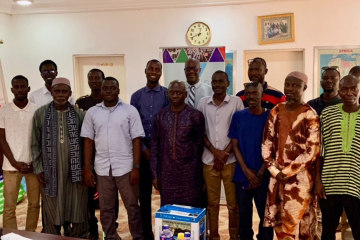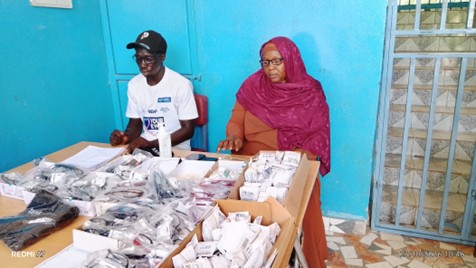
As part of an initiative aimed at tackling rising refractive error among school-going children in The Gambia, the National Eye Health Programme (NEHP) of the Ministry of Health in collaboration with OneSight Gambia and the Ministry of Basic and Secondary Education last Friday conducted a free eye screening at Sambuya Lower Basic School in Kombo South.
The outreach campaign, introduced in The Gambia with technical support from the University of Vermont Medical Center, is set to benefit hundreds of students and teachers in several schools within Kanifing Municipality and West Coast Region.
Eye health specialists were on the ground for the screenings and those who needed eyeglasses were given them free of charge.
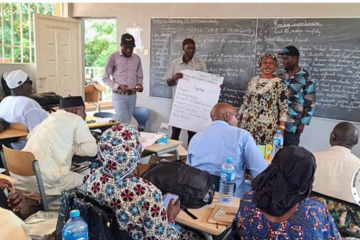
Giving an overview of the initiative, Pa Sarja Jatta, Senior Teacher from the ECIED Unit at the Ministry of Basic and Secondary Education, explained that the initiative targets children with special needs under Early Childhood Education.
The main objective of the Ministry partnering with OneSight to support children in their lower grades, he said, is to enhance and ease learning, as they have realized that children in their lower grades suffer conditions that impede their education.
“When we don’t even realise it, some of them struggle to figure out a letter from the blackboard. And sometimes you can see it in their exercise books,” he said.
He indicated that some do not write properly while some do not sit where their teachers ask them to sit.
“Sometimes teachers say they are stubborn or have bad behaviour when actually they are struggling to pick information that will make them somebody tomorrow,” Jatta observed.
With this growing problem, he said, they deemed it necessary to support these children, adding that teachers sometimes do not know that these behaviours are as a result of a child struggling to see a letter so that he can write it properly.
“So the objective of this initiative is to train these teachers to have a primary skill on how to do screening based on the behaviours they notice in these children,” he said.
Jeffery Young, Ophthalmologist at the University of Vermont, United States, revealed that they have been coming to The Gambia since 2018. During that time, they noticed a significant need to extend support especially in the area of eye care for children.
Fast forward to 2022, he said, they started the programme with visual screening in schools, free for children, targeting those under 10. This, he said, is to try and identify children who might have vision problems that are not visible.
Muhammed Kinteh, Operations Coordinator of OneSight Gambia, revealed that what prompted the outreach is research conducted over the years which shows refractive error is on the rise.
“In every three people, at least one would need glasses or eye health services. We know that some schools are so far away, and some people want to have access to good eye health, but due to their geographical location, they cannot,” he said.
“With this, we partnered with the Ministry of Health, under the National Eye Health Programme, who pioneered this whole programme to make sure that we not only stay at the health centres or hospitals, but we also go out and meet students at their own schools,” Kinteh added.
He also observed that some of the cases found were staggering, noting that in some instances they have seen patients with almost minus 18, which is alarming.
“I think if you have such high myopia, you could easily go blind, or have complications,” he said.
This, he said, is one of the reasons why these outreaches are very important — catching them while they are young, so that before their condition worsens, they are able to get treatment.
He noted that the concept of the programme is to pilot it in the West Coast Region, which is the biggest region in the country, and then expand it to other regions across the country.
He also shared some of the challenges, including referral issues and parents not following up on their children’s health.
“Sometimes we give glasses to people and medication, but when we do follow-up to make sure they use these glasses, we always face a challenge,” he said.
This, he said, is why they partnered with the Ministry of Basic and Secondary Education, because without them, they would not be able to succeed.
He also spoke about their system where IT teachers and students help ensure follow-up with the children to receive the right treatment, especially those who failed the initial screening.