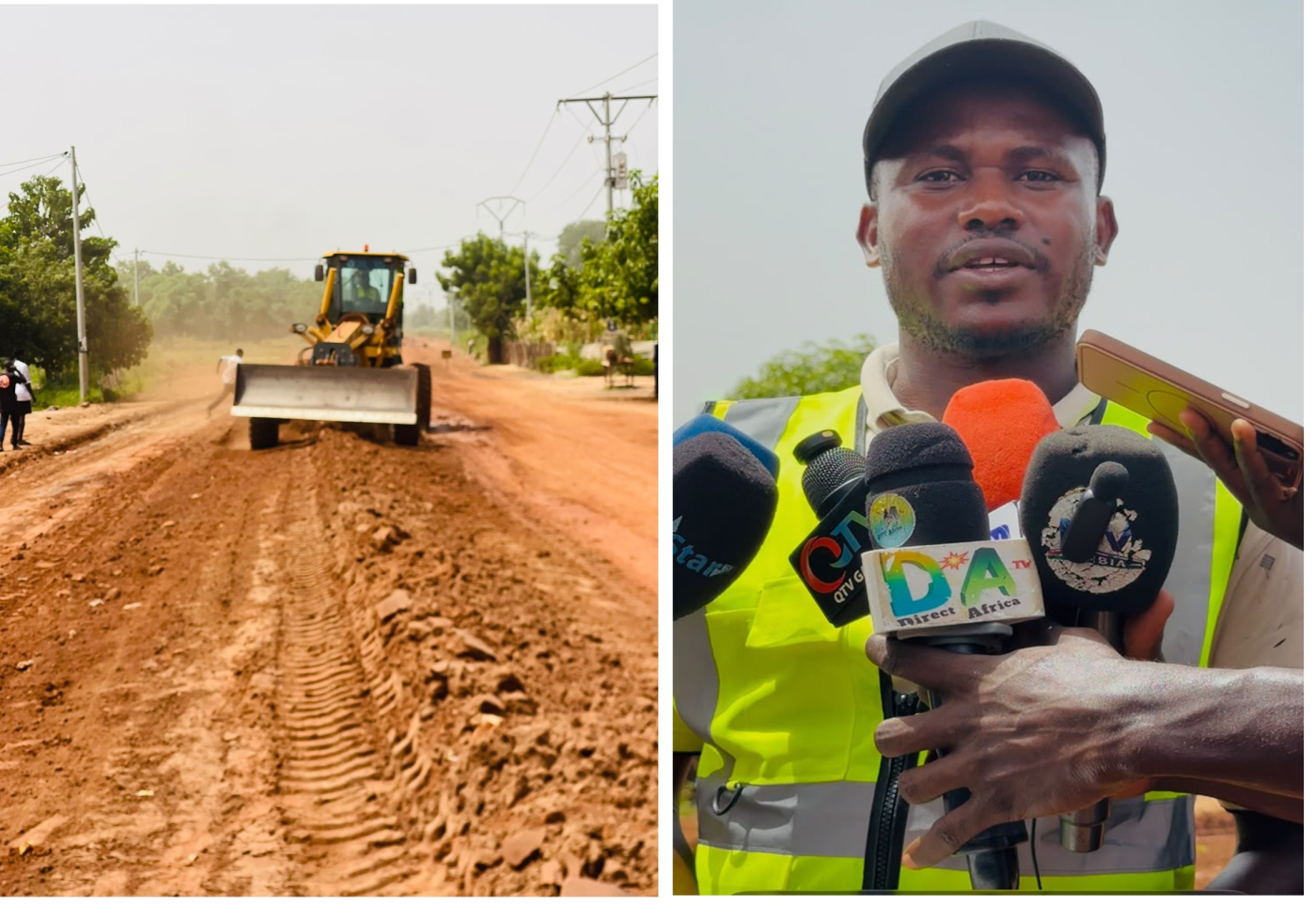
Construction has officially commenced on the long-awaited Choya-Dankunku road, bringing renewed hope to dozens of communities that have endured decades of poor transport infrastructure in the Central River Region.
Heavy machinery and construction equipment belonging to Bologel Company, the contractor tasked with executing the project, have already been deployed to the area, marking what residents have described as a historic milestone.
The 20.5-kilometre road, which will connect several communities across the region, is expected to be completed within three years.
Officials of Bologel have assured residents that the project will be executed in strict accordance with approved engineering designs and specifications.
For years, the road has been one of the most pressing demands of communities in the area, with residents repeatedly calling on successive governments to address the challenges posed by its poor condition.
The commencement of construction has therefore been widely welcomed as the fulfilment of a long-standing promise by the Government of The Gambia under President Adama Barrow.
Residents say the project represents a turning point for communities that have struggled with limited access to essential services due to the deplorable state of the road.
Upon completion, it is expected to strengthen connectivity between CRR South and CRR North, improving access to trade, education and healthcare while easing transportation challenges that have affected residents for generations.
Fully funded by the Government of The Gambia, the road is part of a wider programme of infrastructure projects designed to reconnect communities that have been cut off for decades.
Speaking to this reporter, the Alkalo of Choya, Ello Jamanka, described the start of construction as one of the proudest moments of his life.
"Witnessing this unprecedented development is something I am immensely proud of as the Alkalo of Choya," he said.
"I never imagined that I would live long enough to see this road being constructed.
Both the Jawara and Jammeh administrations promised to build this road, but those promises were never realised."
Alkalo Jamanka recounted the numerous difficulties endured by residents over the years, expressing confidence that many of those challenges would soon be history.
According to him, the poor state of the road has often hindered access to healthcare, with some pregnant women forced to travel to nearby health facilities in horse carts, sometimes giving birth before reaching medical assistance.
He further explained that commercial motorcycle operators serving the area charge between D150 and D400 depending on the destination, largely due to the poor road conditions.
"All these hardships will soon be history," he said, while commending President Barrow's administration for initiating the project.
He also urged communities to continue supporting government development initiatives.
The Project Manager of Bologel Company, Babacarr Cham, underscored the significance of the project and assured residents that the contractor remains committed to delivering the road within the stipulated timeframe.
Mr. Cham revealed that Bologel is currently implementing approximately 125 kilometres of road projects across Niamina and surrounding areas, with the Choya-Dankunku road forming part of that broader programme.
"Work has started and is progressing as planned. Our equipment has been mobilised and operations are ongoing on site," he said.
While noting that the contractual duration is three years, Mr. Cham indicated that the company is aiming to complete the works within two and a half years without compromising quality.
"We want the support and cooperation of the communities because this project is ultimately for their benefit," he said.
The project manager disclosed that the road will be constructed to modern standards, featuring an asphalt surface, proper drainage systems and other engineering components designed to ensure durability.
"The road will be strong, wide and built to last. Because it passes through several communities, special attention will be given to drainage infrastructure to prevent flooding and ensure the smooth flow of water," he explained.
Mr. Cham highlighted Bologel's experience in road construction, citing the company's track record in delivering infrastructure projects across different parts of the country, including the Greater Banjul Area.
"You cannot construct a durable road without an effective drainage system. The roads we are building in Niamina and elsewhere will all have proper drainage structures to enhance their lifespan and protect surrounding communities," he added.
The commencement of the project has been greeted with optimism across the region, with many residents hopeful that the new road will unlock economic opportunities, improve social services and bring long-awaited relief to communities that have endured decades of isolation.
For many residents, it is more than a road project; it is the fulfilment of a promise and the beginning of a new chapter in the development of the region.