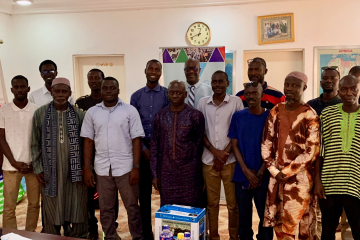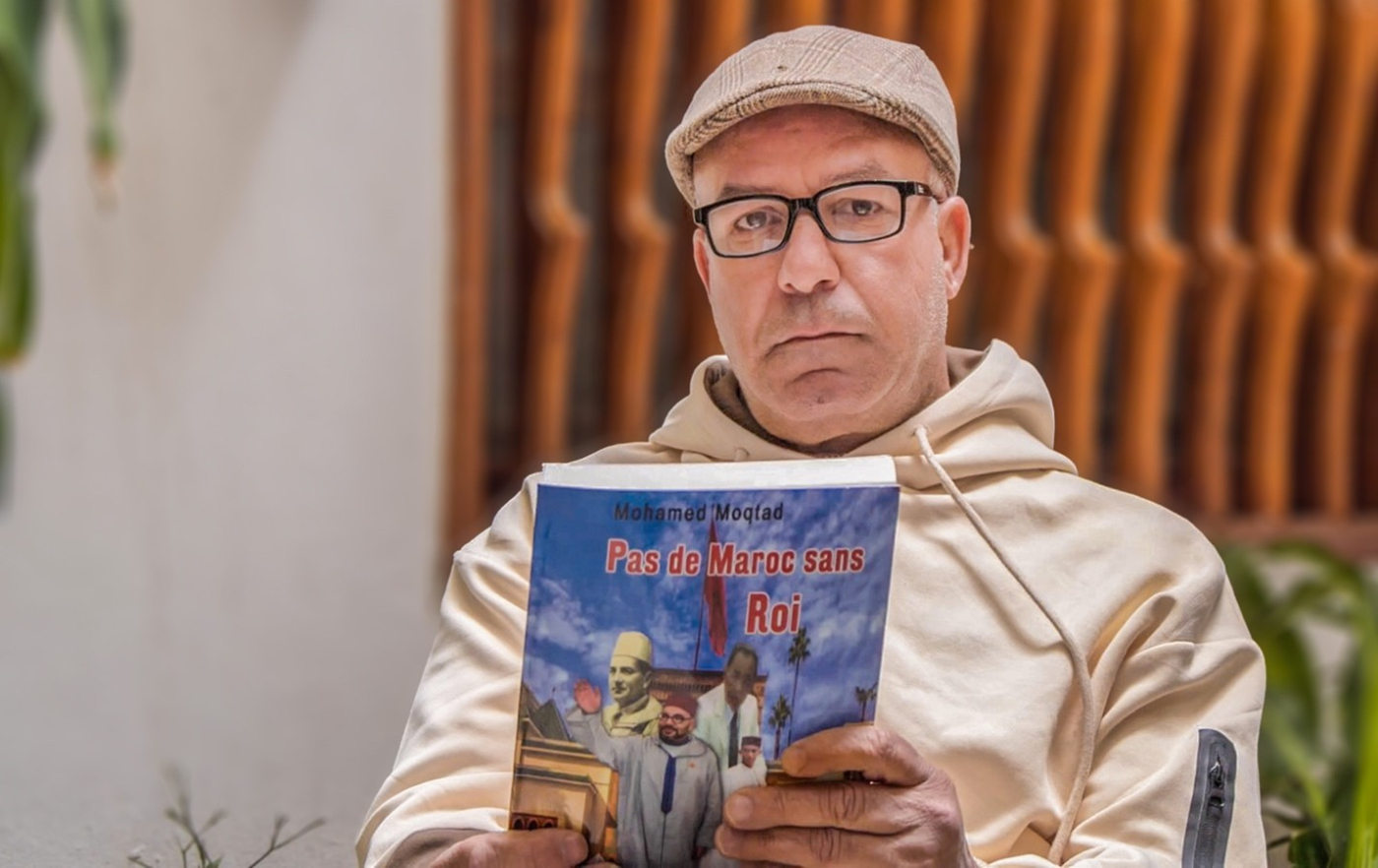
At the end of the research trip to Goree Island and Cheikh Anta Diop University by the UTG Socio-historical Fact-finedrs, Associate Professor Ensa Touray, caught up with Mr. Mohamed Moqtad, a 56-year-old Moroccan writer, journalist, and editor residing in Senegal. He presented a copy of one of his books titled: “There is No Morocco Without A King” to the UTG Socio-historical Fact-finders.
Mr. Muqtad is distinguished by a rare openness to cultures, political systems, and the social realities of peoples around the world. A polyglot and seasoned traveler, he has visited numerous countries, not out of mere geographical curiosity, but as part of a deliberate effort to observe firsthand and analyze economic, political, and societal models in depth.
Author of hundreds of articles published across various international media platforms, Mohamed Moqtad has established himself as a demanding, engaged, and independent voice. His literary work spans multiple genres, from novels to analytical essays and historical or spiritual interpretation. Among his recent publications are the biography of former Mozambican president Joaquim Alberto Chissano, the novel “The Diary of the Tijane of Atlas”, and “Safran of Qatar”, a work highlighting the remarkable trajectory of a small state that managed to assert itself on the global stage, notably following the 2022 FIFA World Cup.
His writings also explore the spiritual and geopolitical dimensions of relations between peoples, as evidenced by his book “Reflections on the Journey of the Soul and Mercy between the Kingdom of Morocco and the Tijaniyya of Senegal”. This reflection is further extended by upcoming works, including “Intellectual Reassessment of the Faye–Sonko Tandem for a New Senegal” and “Sokhna Aïda Diallo Thioune: The Exemplary Religious-Patriot”, underscoring his enduring interest in African political and spiritual figures who carry meaning and inspire transformation.
In general, Mohamed Moqtad defines himself as a steadfast defender of the Moroccan monarchy and the enduring values of the Kingdom. His writings, public interventions, and social media presence reveal a structured mind, nourished by history, political philosophy, and field experience. He embraces a unique conception of the writer’s role, summed up in his guiding principle: “The pen does not need visibility, nor credibility, without the enlightened understanding of its readers.”
In an exclusive interview with Associate Professor Ensa Touray, Mohamed Moqtad speaks with candor and clarity about his latest work, “There is No Morocco Without A King”. In this exchange, he explains the deep motivations behind the writing of this book, clarifying his vision of the Moroccan monarchy not merely as a political institution, but as a historical, identity-based, and symbolic foundation inseparable from the Moroccan people. True to his intellectual approach, he responds without reservation, fully assuming his positions, while inviting readers to move beyond superficial interpretations and grasp the complex, centuries-old bond between the Throne and the nation.
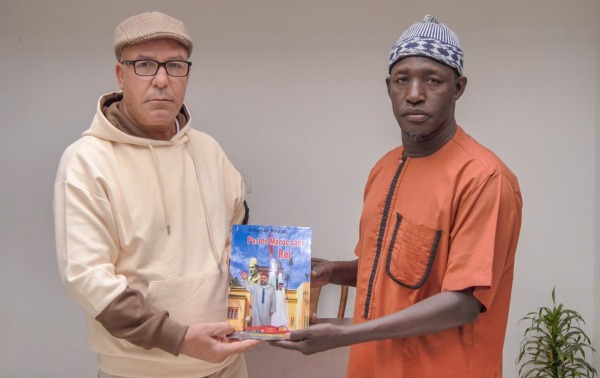
Mr. Mohamed Moqtad presenting a copy of his book to Associate Professor Ensa Touray, History Lecturer, the University of The Gambia
ASSOCIATE PROFESSOR ENSA TOURAY
In your book “No Morocco Without a King”, you do not speak only about the monarchical institution, but about Morocco as a whole: its people, its memory, and the historical bond that unites them with the Throne. Could you offer us a brief historical overview of the evolution of the Moroccan monarchy and explain how this continuity has shaped the identity of the Moroccan people over the centuries?
AUTHOR MOHAMED MOQTAD
I would like to clarify that this work is the result of multiple and extended discussions I had in response to questions posed to me during my time abroad, both by interested Moroccans and foreigners. It does not claim to be a chapter in the history of Morocco, nor does it seek to retell what has already been written; rather, it is the outcome of compiling opinions, ideas, and reflections that highlight some aspects that caught my attention and merit further exploration and discussion.
Numerous studies and research works have addressed the history of Morocco, the Moroccan monarchy, and Moroccan politics, from ancient times up to 2025. These studies vary across historical, political, social, and economic perspectives. Their number is difficult to determine precisely, but it is estimated to be in the hundreds. They cover different periods of Moroccan history, from pre-colonial times, through the colonial era, to independence and the subsequent developments and transformations.
For those seeking accurate information on these works, one can consult major academic libraries or university databases, both in Morocco and abroad, where comprehensive lists of publications in this field are available. Those interested in the ancient and modern history of Morocco will find a selection of notable books written by Moroccan authors, offering diverse and comprehensive insights into Morocco’s historical trajectory from multiple perspectives, including:
– (History of Morocco)” by Abdallah Laroui, considered a foundational reference for Moroccan history from the Islamic era to modern times.
– “Morocco Between Yesterday and Today” by Abderrahman Ben Zidane, which covers multiple aspects of Morocco’s history with a particular focus on social and political transformations.
– “Contemporary History of Morocco” by Abdallah Laroui, providing an in-depth analysis of the modern period of Moroccan history.
– “Morocco: A Study in History and Politics” by Hassan Aourid, which emphasizes significant historical and political developments in the Moroccan state.
The Moroccan monarchy is one of the oldest in Africa, founded in the 8th century by Idris I, a descendant of the Prophet Muhammad. The dynasties that followed—Almoravids, Almohads, Marinids, Saadis—expanded and consolidated the kingdom, strengthening Islam and imperial cities like Fes. Since 1666, the Alaouite dynasty has ruled, stabilizing the country after internal divisions.
During the French and Spanish protectorate (1912–1956), the king maintained a symbolic role. The independence of 1956 strengthened his authority as head of state and guarantor of national unity. Since then, the Moroccan monarchy has evolved through successive constitutional reforms (1962, 1970, 1996, 2011) and remains a central pillar of the country’s politics, religion, and diplomacy.
A PROF. ENSA TOURAY
Why did you choose to open your book with eight introductions instead of just one?
AUTHOR MOHAMED MOQTAD
Because Morocco cannot be confined to a single-entry point. I wanted to guide the reader gradually, helping them understand that the question of the monarchy is simultaneously historical, identity-related, social, political, and symbolic.
A PROF. ENSA TOURAY
You speak of the “dialectic of conflict” in an era of change. What conflicts are you referring to in Morocco today?
AUTHOR MOHAMED MOQTAD
These are less about armed conflicts and more about invisible tensions: between tradition and modernity, between imported discourse and national reality, between social impatience and institutional stability.
A PROF. ENSA TOURAY
You present the monarchy as the lifeblood of Moroccan identity. On what does this claim rest?
AUTHOR MOHAMED MOQTAD
It rests on the long history, collective memory, and daily experiences of Moroccans. The monarchy is not merely a political decoration; it is an organic element of national identity.
A Prof. Ensa Touray
How is the Moroccan monarchy different from other monarchies?
AUTHOR MOHAMED MOQTAD
It is neither a breakaway monarchy nor a frozen one. It has been built through continuity, adaptation, and rootedness in religion, culture, and Africa, which makes it unique.
A PROF. ENSA TOURAY
You emphasize continuity. Why is this a strength?
AUTHOR MOHAMED MOQTAD
Because in an unstable world, continuity provides a framework. It allows change without collapse, reform without chaos, and evolution without loss of bearings.
A PROF. ENSA TOURAY
Is there today a credible alternative to the Moroccan monarchical model?
AUTHOR MOHAMED MOQTAD
No, not in the Moroccan context. Proposed alternatives are often theoretical, imported, or disconnected from the country’s historical and social reality.
A PROF. ENSA TOURAY
What has changed most between yesterday and today’s Morocco?
AUTHOR MOHAMED MOQTAD
The awareness of the Moroccan citizen. Expectations have evolved, the relationship to power has changed, yet the monarchy has remained the balancing point amidst these transformations.
A PROF. ENSA TOURAY
How do you respond to those who accuse the monarchy of hindering democracy?
AUTHOR MOHAMED MOQTAD
I tell them that democracy is not a single model. In Morocco, it follows a specific trajectory in which the monarchy acts as guarantor and arbiter.
A PROF. ENSA TOURAY
Is ‘Being Moroccan’ an identity or responsibility?
AUTHOR MOHAMED MOQTAD
Both. It is an inheritance one receives, but also a responsibility toward the country’s unity, stability, and future.
A PROF. ENSA TOURAY
When you speak of a Moroccan King, what exactly do you mean?
AUTHOR MOHAMED MOQTAD
An embodied institution. The King is not merely a political function; he is a symbol of unity, continuity, and national protection.
A PROF. ENSA TOURAY
How do you distinguish legitimate critique from divisive discourse?
AUTHOR MOHAMED MOQTAD
Critique aims to improve; divisiveness aims to divide. One relies on knowledge and responsibility, the other on provocation and imported conflicts.
A PROF. ENSA TOURAY
Who is your book primarily intended for?
AUTHOR MOHAMED MOQTAD
First and foremost, Moroccans, especially younger generations, but also those who speak about Morocco without always understanding it.
A PROF. ENSA TOURAY
Why does oral culture occupy a central place?
AUTHOR MOHAMED MOQTAD
Because it expresses the deep relationship between the people and the monarchy, often more effectively than legal texts or official speeches.
A PROF. ENSA TOURAY
Do young people still understand this relationship with the King?
AUTHOR MOHAMED MOQTAD
Yes, but differently. Their language has changed, not the need for guidance or awareness of the importance of stability.
A PROF. ENSA TOURAY
In one sentence, what is the central message of “No Morocco Without a King”?
AUTHOR MOHAMED MOQTAD
Morocco is not an accidental construction: it is the fruit of a history in which the monarchy constitutes the heart of its unity, stability, and identity.