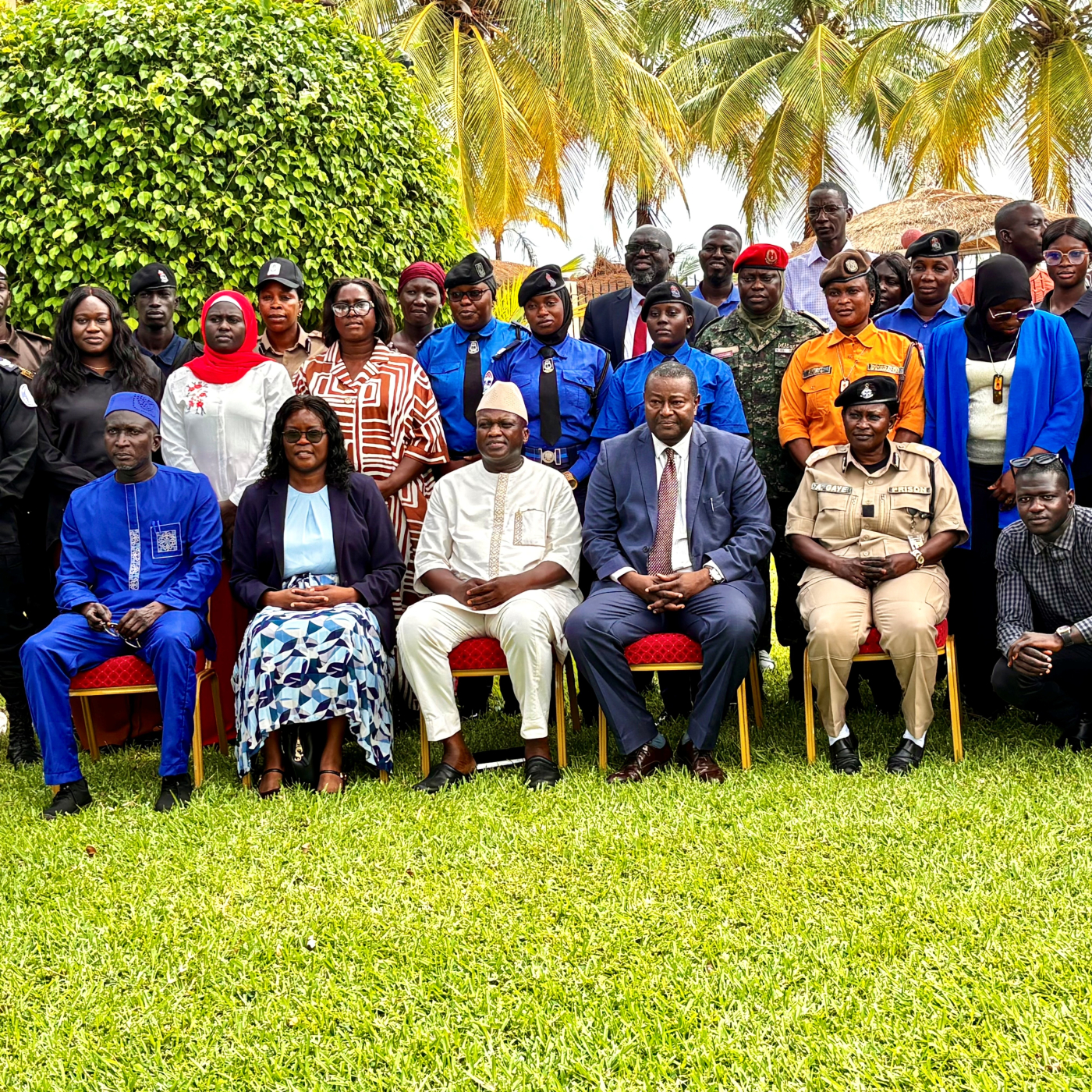
Held at the Ocean Bay Hotel, the initiative seeks to equip security personnel with the practical skills to improve their response to gender-based violence, protect vulnerable groups, bridge gender gaps in policing, and ensure policing practices comply with national and international human rights standards.
At the opening ceremony, Emmanuel D. Joof, chairperson of the National Human Rights Commission, outlined that respect for human rights remains the strongest foundation for lasting national security, arguing that public trust in security institutions cannot be achieved through intimidation but through professionalism, accountability, fairness and respect for human dignity.
“We have to move away from the mentality of ‘us and them” Joof said.
Joof emphasised that a society where people trust its security institutions is a society that is more peaceful, resilient and secure.
The training, he added, is not intended to impose new responsibilities on law enforcement officers, but to strengthen the quality of policing and improve interactions with citizens, particularly survivors of gender-based violence, children, persons with disabilities, migrants, detainees and other vulnerable groups.
Reflecting on The Gambia’s democratic transition, Joof maintained that the establishment of the NHRC followed a national commitment to ensure that the human rights abuses of the past are never repeated.
He said the findings of the Truth, Reconciliation and Reparations Commission (TRRC) unearthed the consequences of institutions exercising power without accountability.
“Never Again’ must be more than a slogan. It should be a national commitment to building institutions that serve people rather than intimidate them, and to placing professionalism and accountability at the centre of public service.”
Joof acknowledged the progress made in the country’s security sector reforms, dialogue and continuous capacity building, describing the NHRC as a partner committed to strengthening, rather than criticising the institutions entrusted with protecting communities.
Deputy Resident Representative of UNDP, Evelyn Edroma, reminded that law enforcement officers represent one of the state’s most visible points of contact with citizens, making every interaction an opportunity either to build or erode public confidence.
She emphasised that rights-based policing extends beyond law enforcement to public service, accountability and the protection of human dignity. According to her, policing must always be lawful, proportionate, non-discriminatory and subject to effective oversight.
Edroma further highlighted the importance of gender-responsive policing, saying women, children and persons with disabilities, migrants and other vulnerable groups experience insecurity differently.
Representing the Office of the National Security Adviser, Chief of Staff Landing Kinteh described the training as a vital step towards strengthening community policing and embedding human rights and gender sensitivity into everyday law enforcement practice.
He reaffirmed the government’s commitment to building a professional, accountable and democratic security sector, positing that national security is not only about maintaining public order but also about ensuring that every Gambian, regardless of gender, age or status, feels safe, respected and protected.