The Gambia Information and Communications Technology Agency (GICTA) has unveiled a prototype Integrated Digital Cabinet Management System (IDCMS), a major step towards transforming cabinet operations and reducing the government’s reliance on manual processes.
The prototype was unveiled on Wednesday, November 25, 2026, following the conclusion of a two-week capacity-building programme on AI-Augmented Software Engineering.
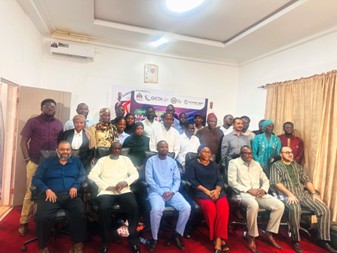
The training, held from November 11 to 25, was funded by the World Bank under the West Africa Regional Digital Integration Program (WARDIP) and brought together 17 participants from GICTA and other Ministries, Departments and Agencies (MDAs).
Speaking at the closing ceremony, GICTA Director General, Prof. Abdou Karim Jallow, said the programme was designed to strengthen government’s internal capacity to develop, maintain and manage its own digital systems.
“This is essential to reduce dependencies on external service providers,” he said.
Prof. Jallow stressed that artificial intelligence should be viewed as an enabling tool rather than a replacement for human expertise.
“AI remains as an enabling tool. We should not think that AI is to replace us, but it is to enable what we do,” he said.
He explained that the IDCMS prototype was the programme’s major practical achievement, noting that cabinet processes currently rely heavily on manual procedures.
The proposed system is expected to automate memorandum submission, agenda management, meeting coordination and decision tracking.
“We envisage that once operational, the system will enhance the efficiency and effectiveness of cabinet proceedings,” he said.
Prof. Jallow estimated that developing a similar system through an international procurement process could cost between US$1 million and US$5 million, while the local initiative was developed for less than US$150,000.
WARDIP Gambia Project Coordinator, Serign Omar Lowe, welcomed the achievement and pledged continued support towards implementation.
He said digitalisation would significantly reduce the time required to retrieve information currently stored in piles of paper documents.
Deputy Chief of Staff at the Office of the President, Momodou L. Dibba, said the system could reduce cabinet meetings, which sometimes last five to seven hours, to two hours or less.
He said this would allow ministers to concentrate more on strategic national issues.
The programme was delivered by Business Automation Limited of Bangladesh, whose representatives emphasised transferring technical knowledge to enable government to independently manage its systems.
Participants received certificates and premium licences for development tools, including Claude Code and Figma.