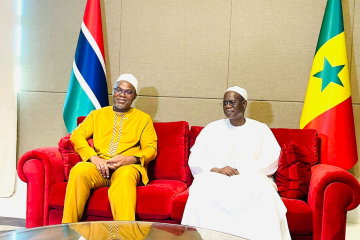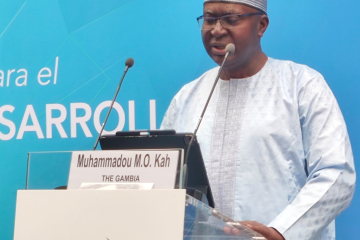
The Gambia has the potential to use trade and investment as key drivers of climate resilience and sustainable economic transformation, Ambassador Professor Muhammadou M.O. Kah has said, calling for stronger international partnerships and increased financing to support the country’s green development ambitions.
Ambassador Kah, who serves as The Gambia’s Ambassador to Switzerland and Permanent Representative to the United Nations Office at Geneva (UNOG), the World Trade Organization (WTO) and other international organisations in Switzerland, said the country had established important policy foundations for climate-resilient growth but needed partnerships and capital to translate its ambitions into tangible results.
“The Gambia may be small, but sound policy and genuine partnership move investment and change trajectories. With partners ready to share the risk, The Gambia will show how a Least Developed Country (LDC) turns trade and investment into climate resilience at scale,” he said.
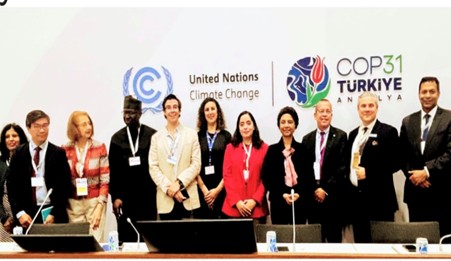
He made these remarks at a high-level side event organised by the United Nations Trade and Development (UNCTAD) and the United Nations Capital Development Fund (UNCDF) during the 31st United Nations Climate Change Conference (COP31), held on November 12, 2026, at the Antalya Expo Centre in Türkiye.
The event, held under the theme Trade, De-risking Investments and Partnerships for Green Industrialisation and Adaptation at Scale, brought together policymakers, international organisations, business representatives and climate stakeholders to explore how trade cooperation could accelerate the transition to clean energy while supporting developing countries.
The conference, which ran from November 9 to 20, focused on strengthening clean energy deployment, developing sustainable supply chains for clean technologies and expanding electrification opportunities.
Speaking on The Gambia’s climate vulnerabilities, Ambassador Kah noted that the country was already experiencing the effects of climate change through coastal erosion, pressure on agricultural land and threats to fisheries.
“As a small, low-lying LDC, we live climate change every day: on our coastline, our farmlands, our fisheries,” he said, adding that government resources alone could not adequately address the growing challenges.
He noted that adaptation needs significantly exceed available adaptation financing, making private investment and international financial partnerships essential to achieving climate commitments.
According to him, trade and investment should not be treated separately from climate policy because they provide opportunities to finance adaptation, strengthen economic diversification and support the transition towards a low-carbon economy.
He said this approach was reflected in The Gambia’s Nationally Determined Contribution (NDC 3.0), covering the 2026–2035 period, which identifies agro-processing, sustainable tourism and low-carbon transport as important areas for green economic development.
In outlining a way forward, Ambassador Kah proposed The Gambia as a pilot country for an UNCTAD-UNCDF strategy-to-financial-close compact, supported by one green zone, one value chain and one guarantee facility.
He also called for a dedicated Least Developed Countries window within the de-risking and project-preparation platforms launched in Sevilla to improve access to investment financing.
He urged international partners to focus on measurable results, arguing that progress should be assessed not only by financial commitments announced but also by funds committed, disbursed and projects delivered.
He further called for progress to be reported at the Doha meeting in 2027 and COP32, which is expected to take place on African soil.
“Our strategic foundations for green, climate-resilient growth are in place. The task now is partnerships and capital, for transformation at scale,” Ambassador Kah said.
His remarks highlighted the importance of mobilising international finance and strengthening trade partnerships to help vulnerable developing countries turn climate commitments into practical development outcomes.