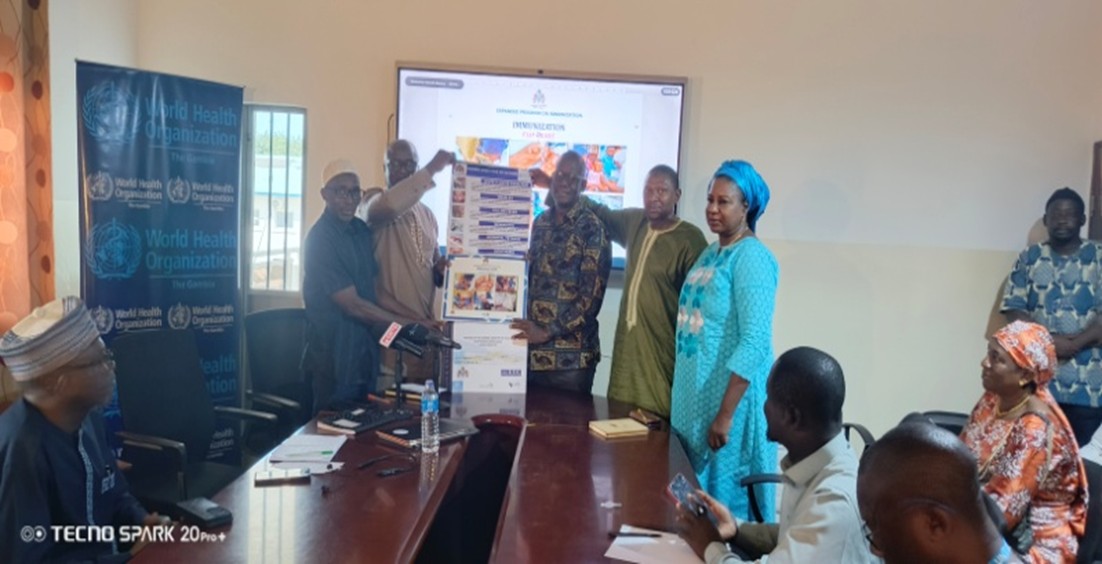
The World Health Organisation (WHO-Gambia Office) on Wednesday handed over a consignment of disease surveillance materials to the Ministry of Health to strengthen the country's disease surveillance, outbreak preparedness and response capacity.
The ceremony was held at the Central Medical Store, Kotu.
The donated items include over 300 surveillance case definition posters, 300 event-based surveillance diphtheria case definition posters and other posters, as well as RI and deep freezers to enhance preparedness and rapid alert generation.
The donation forms part of WHO's ongoing technical and operational support to the Government's efforts to strengthen disease surveillance and routine immunization services.
According to officials, effective surveillance enables countries to detect health threats early, identify transmission pathways, guide targeted interventions, and make evidence-based policy decisions that save lives and prevent outbreaks.
Speaking at the ceremony, Sidat Fofana, Programme Manager, Expanded Programme on Immunization (EPI), said The Gambia is doing very well, especially the EPI, when it comes to disease surveillance.
He recalled that over the years the country has seen emerging threats, especially with the advent of COVID-19, which brought a lot of setbacks in the delivery of vital services.
"There is a need for us to definitely strengthen this very important area so that we are able to manage and control outbreaks of diseases," he said.
Fofana cited the COVID-19 lockdown, which resulted in many children missing their routine zero-dose vaccinations, a situation that also affected many countries.
To address that gap, he said the Ministry is fortunate to have partners like WHO and UNICEF supporting the health sector.
"Our key partners, like WHO and UNICEF, are always there and anytime the need arises," he said.
He commended the agencies for their generosity, expressing hope that the materials will help strengthen the health system to address key surveillance weaknesses.
Lamin Manneh, of the Epidemiology and Disease Control Unit, on behalf of the Programme Coordinator, expressed gratitude to WHO. He underscored the importance of surveillance, particularly community-based case-based surveillance.
Dr. Nathan Nsubuga Bakyaita, WHO Country Representative, said the event was more than the transfer of equipment and materials.
"Today's event symbolizes our collective investment in a stronger, more resilient health system that is capable of preventing, preparing for, detecting, responding to, and recovering from public health emergencies," he said.
He noted that WHO will continue to support national and sub-national capacities for emergency preparedness, disease surveillance and continuity of essential health services.
"The true value of surveillance lies not simply in the collection of data, but in the actions that data inform," he added.
He revealed that last week WHO convened the first Africa Health Data Forum in Nairobi, where leaders emphasised that every death tells a story, and when deaths are not recorded, countries lose valuable information needed to improve public health planning.
He observed that disease threats do not respect national borders, and given significant population movement across the Senegambia corridor, robust surveillance systems are essential.
Dr. Momodou T. Nyassi, Director of Health Services at the Ministry of Health, thanked WHO for its continued partnership and support in immunization, disease surveillance and epidemic preparedness.
He said WHO has supported capacity building, training of health workers on surveillance, case detection and outbreak investigation, and the setting up of specimen collection and transportation systems.
He described the presentation of diphtheria case definition posters as particularly timely, noting that diphtheria is a serious vaccine-preventable disease that can cause severe illness and death, particularly among inadequately immunized populations.