Youth migration continues to pose a significant challenge in The Gambia, with many young people risking dangerous journeys along irregular migration routes in search of better opportunities abroad.
Among them was Edrisa Jallow, a promising young karate athlete whose life before migration was defined by sport, discipline and ambition.
Before leaving The Gambia, Jallow was an active member of the country's karate community. He trained consistently, competed in tournaments and showed considerable potential as an athlete. For him, the dojo was more than a training facility; it was a place where he developed discipline, confidence and a sense of purpose.
However, in 2023, while still a Grade 11 student, he dropped out of school and embarked on the irregular migration journey commonly known as the "back way".
The decision, he said, was largely driven by the financial hardship facing his family and his desire to help improve their living conditions, adding: “If my mum could not provide, I had to,” he recalled.
What began as a search for opportunity soon turned into an ordeal that would last one year and ten months.
During the journey, Jallow said he walked approximately 420 kilometres, accompanied by a fellow traveller who became an important source of support. The experience tested both his physical and emotional endurance.
The situation worsened when he was intercepted in Algeria and later deported to Niger, where he spent three weeks in detention.
It was a turning point that shattered the hopes that had carried him from home.
“That day, I lost all hope of making life better for my family,” he said. “It was so hard for me. It felt like everything had come to an end.”
Jallow had hoped his relatives would be able to raise enough money to help him continue the journey, but the family could only provide limited support to meet his basic needs.
Eventually, the International Organisation for Migration (IOM) facilitated his voluntary return to The Gambia.
Yet what seemed like the end of a dream would become the beginning of a new chapter.
Upon his return, Jallow gradually found his way back to the dojo and to the discipline that had shaped him before migration. Karate, once a part of the life he had left behind, would become central to his recovery and personal transformation.
Returning Home
Although his family welcomed him home with relief and joy, returning was not without challenges.
While some people encouraged him, others viewed him as someone who had travelled abroad but returned empty-handed.
“Some people saw me as a failure because I travelled and didn't achieve what I hoped for,” he said.
Despite the setbacks, Jallow insists he has no regrets.
“I have never regretted taking the journey because I learned lessons that I would never have learned in a classroom.”
The economic difficulties that had influenced his decision to migrate remained largely unchanged after his return.
Through IOM's reintegration programme, however, he received barbering equipment and established a local salon, providing him with a source of income and a foundation on which to rebuild his life.
It was also during this period that he made a life-changing decision: to return to karate.

Finding His Way Back to the Dojo
Jallow has practised Shotokan karate since 2015. He began the sport as a young boy and credits it with steering him away from street violence and negative influences.
After returning home, his mother encouraged him to resume training. His enduring love for the sport strengthened that resolve.
“My passion for karate inspired me to return to the dojo,” he said. “When I walked back into the dojo and saw the tatami, I felt I had returned home.”
According to his coach, Ibrima Gomis, the decision proved crucial in helping him regain structure, focus and confidence.
Gomis, a former Senegal national team athlete who was once ranked among the country's top karate competitors, said the young athlete's return represented far more than a sporting comeback.
“Karate gave him discipline and structure. Coming back to the sport was important because it helped him reconnect with something positive and familiar as he adjusted to life after migration,” Gomis said.
He added that Jallow's experience demonstrates how sport can provide a supportive environment for young people rebuilding their lives following difficult experiences.
Returning to competition, however, was far from easy.
After almost two years away from the dojo, Jallow's fitness levels had declined and aspects of karate competition, particularly kata performance standards, had evolved.
For him, returning to karate meant starting over.
Sensei Pateh Jobe, senior instructor at Waza United Karate Club and Technical Director of the Gambia Karate Federation (GKF), said Jallow had to work exceptionally hard to regain his previous form.
“Before he went on the back way, he had more speed and was more focused. After coming back, his concentration was lower. He had to work twice as hard to get back to where he was,” Jobe explained.
Jobe, who is at the forefront of efforts to strengthen technical standards and professionalism within Gambian karate, said Jallow benefited from an environment that encouraged discipline, consistency and personal growth. That support would soon pay dividends.
From Comeback to Champion
Less than a month after resuming formal training, Jallow entered his first major competition and delivered an impressive performance.
The result, he said, restored his confidence and convinced him that he could still compete at the highest level.
Months later, he participated in an international karate championship hosted in The Gambia, competing against athletes from several countries.
Despite his lengthy absence from competition, his belief never wavered.
“I may have doubts before I compete, but once I step on the tatami, I know I will win,” he said.
He went on to claim victory.
For Jallow, the achievement represented more than sporting success. It was proof that the difficult years spent away from the dojo had not diminished his ability to compete.
“For two years I didn't train. I came back, trained for a few months and secured that trophy for The Gambia,” he said. “That was the moment The Gambia won.”
The triumph marked the beginning of an impressive run of success.
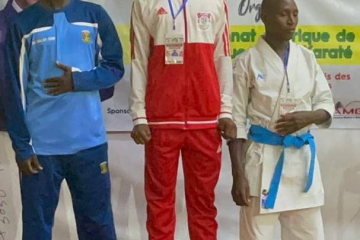
Since returning to karate, Jallow has won numerous domestic competitions and secured three significant international titles, including championships held in The Gambia, Senegal and Guinea.
The victories have played a major role in rebuilding his confidence and helping him move beyond the painful memories of migration.
Challenges Beyond the Tatami
Despite his achievements, significant challenges remain.
Like many Gambian athletes, Jallow often relies on personal resources to cover training expenses, equipment costs and travel to international competitions.
Awa Manneh, a fellow athlete at Waza United Karate Club, believes greater institutional support is required if Gambian karate is to compete consistently on the international stage.
“We don't have sponsors; we are doing it for ourselves,” she said. “People laugh when you say you do karate because they think it's only about fighting. But karate develops discipline and quick thinking. We need government and institutional support to reach the next level.”
Jobe echoed those concerns, stressing the importance of regular exposure to international competition.
“In karate, if you don't have international matches, your ranking cannot improve,” he said. “Despite winning national championships, athletes like Edrisa need support to compete internationally if they are to reach their full potential.”
A Different Journey
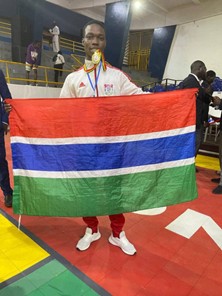
In August 2026, Jallow represented The Gambia at the 6th Union of African Karate Federations (UFAK) Championship in Guinea, competing in the senior category.
He returned home with yet another gold medal.
This journey differed dramatically from the one he had undertaken three years earlier.
This time, he was not travelling through irregular migration routes in search of opportunities abroad.
He was representing his country as a national athlete, carrying the Gambian flag onto the international tatami.
“Right now, I intend for every journey I make to be one I have worked hard for and made legally,” he said.
Three years ago, Jallow left The Gambia hoping migration would help him support his family.
Today, he has found a different path, one built on discipline, perseverance and sporting excellence.
His challenges have not disappeared, and many of the factors that drive young Gambians to migrate remain.
Yet his story stands as a powerful reminder that setbacks do not have to define a person's future.
For Jallow, the road from the back way to the international tatami has become a story not of failure, but of resilience, redemption and triumph. Returning home with a gold medal around his neck, he has proven that sometimes the most important journey is the one that leads back to oneself.