Public debate about the technology contract at Banjul International Airport has largely focused on the passenger fee attached to the arrangement.
While that is understandable, as it directly affects travellers, it can distract from a more important question: what services does the programme support, and which responsibilities remain under the control of Gambian authorities?
The available public record points to three separate issues: a border-processing system, a passenger-processing workflow and a financing mechanism. Although connected, they are not the same thing.
According to the Gambia Immigration Department, arriving passengers must complete disembarkation procedures, present the necessary travel documents and undergo profiling and enrolment through the Integrated Immigration Control System.
The department says the system captures fingerprints, iris scans and passport data-page information. It also refers to kiosks for biometric-passport holders and electronic gates used in the departure process.
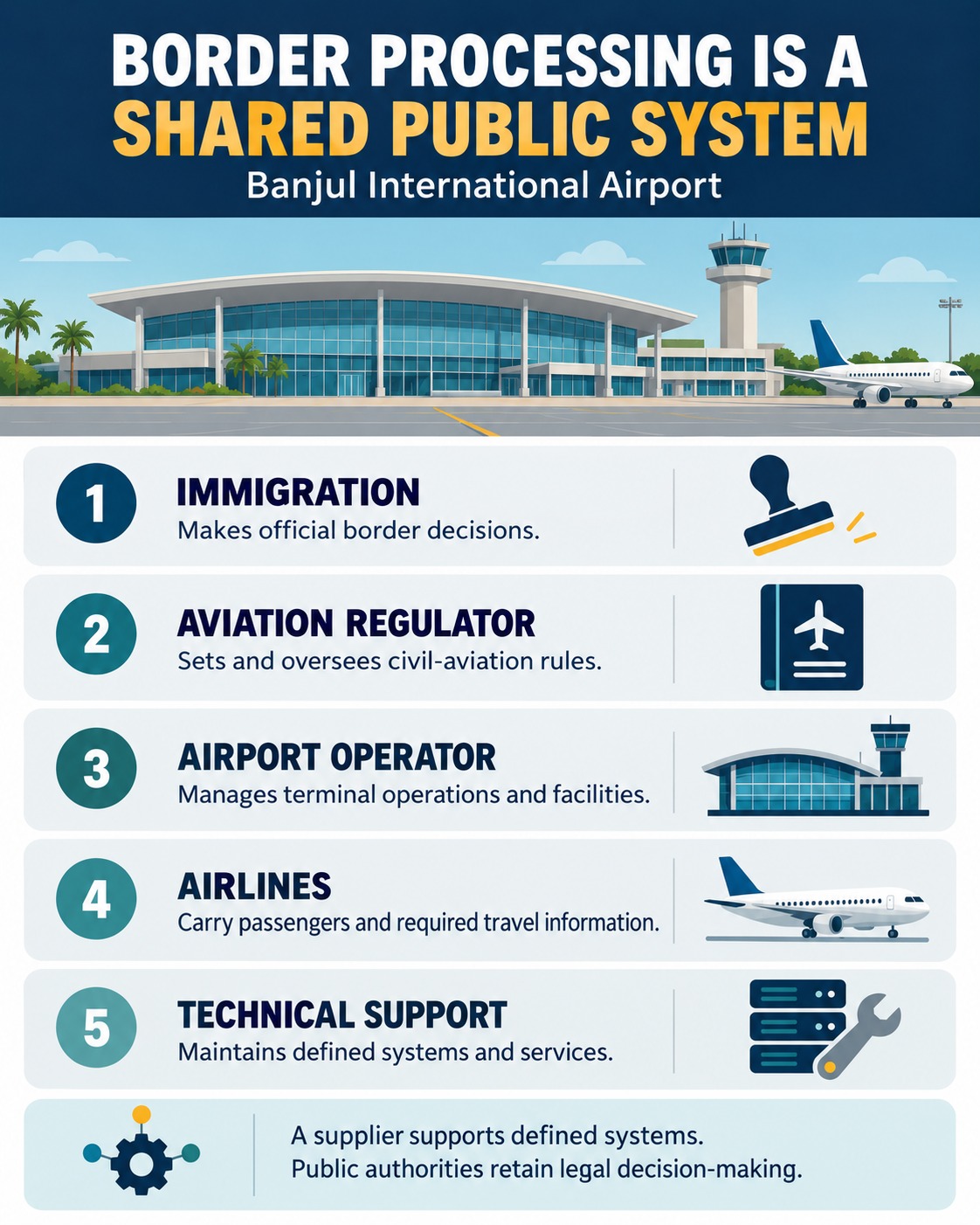
These technologies support immigration procedures by helping to verify identities and process travellers. However, decisions on entry and departure remain the responsibility of authorised Gambian immigration officers.
Technology assists the process but does not replace government authority. Cameras do not decide who enters the country, electronic gates do not make immigration policy and a private contractor does not acquire public powers simply because it supplies or maintains the equipment being used.
Securiport's Role
The 2022 National Audit Office management letter describes a contract for the administration and management of immigration-security services at Banjul International Airport. It also reviewed the security-fee mechanism used to finance the arrangement during the period under audit.
On its services page, Securiport describes a support model that includes system implementation, training, maintenance and technical assistance to government clients.
The company states that governments operate the installed systems and retain ownership of their data and decryption keys.
Based on these public records, Securiport's role was to provide and support technology and related services used in the airport's immigration-security process, while public functions remained with Gambian institutions.
However, the available sources do not provide a current detailed list of all devices, interfaces, operating locations or service obligations.
Responsibilities Remain Separate
Several institutions continue to perform different functions within the airport environment.
Immigration officers make decisions on entry and departure under Gambian law. Aviation authorities oversee airport and aviation matters within their legal mandates. Finance and treasury institutions manage public revenue, while audit bodies examine records and controls.
Airlines also perform their own check-in and security procedures and provide passenger information as required under applicable regulations.
Any technology contractor operates within that structure. Its responsibilities may include supplying equipment, maintaining software, training personnel and meeting agreed service standards. Those obligations are defined by contract.
It should not be assumed that a contractor performs every task associated with a traveller's journey through the airport.
Fee Changes Do Not Automatically Mean Service Changes
A government may change how a fee is collected, alter the account into which it is paid or decide to include it in an airline ticket. Such changes alone do not prove that the supporting technology has stopped operating.
The status of any service can only be confirmed through current government records and official operational reports.
What a Current Service Record Should Show
A useful public update would be a simple and officially approved service map.
Such a document would identify each component, its location, public owner, operating agency, supplier responsibility, implementation date, current status and the date of the most recent inspection or acceptance.
It could include enrolment stations, passport readers, electronic gates, traveller-processing software, government interfaces, training programmes, maintenance arrangements, help-desk services and continuity measures.
It should also clearly indicate whether each component is operational, historical, replaced, unavailable or outside the supplier's scope of responsibility.
This would help avoid two common mistakes.
The first is assuming that every feature described in a supplier's product literature is currently deployed in The Gambia.
The second is assuming that concerns about one collection mechanism automatically mean no operational technology exists.
Both claims require evidence relating to the specific component and the relevant period.
What Remains Unknown
The available sources establish the contract and audit history, the passenger-processing framework and Securiport's stated support model.
However, they do not include the full current contract, any publicly available renewal or termination notice, a current government inventory of equipment or a recent service-acceptance report.
It would therefore be premature to publish a definitive list of all technology currently operating at Banjul International Airport or to state the exact duration of every supplier obligation.
Any authoritative update should come from the responsible Gambian institution and clearly distinguish current operations from the historical period covered by previous audits.
Such an approach would provide the public with a clearer understanding of the system, the responsibilities of public institutions and the limits of the information currently available.
Sources: Gambia Immigration Department; National Audit Office audit records on the Securiport contract; Securiport services and support documentation.