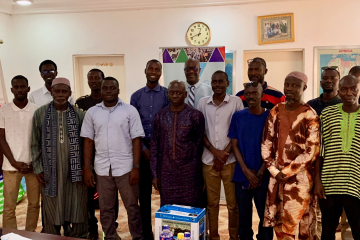
The partnership was reinforced during a two-day national validation workshop on the Maritime Crime Legal Assessment Report, held on 30 July 2026 at the Ocean Bay Hotel in Banjul.
The initiative forms part of the €20 million EU-funded Safe Seas for Africa Programme, which seeks to strengthen maritime legal systems, counter drug and arms trafficking, combat piracy, and improve maritime security across West and Central Africa.
The workshop brought together key national stakeholders to review gaps in The Gambia’s legal framework relating to maritime crimes and identify areas requiring technical assistance to strengthen investigation, prosecution, and enforcement.
The assessment builds on progress made through The Gambia’s 2025 criminal law amendments and is expected to support efforts to ensure that crimes committed at sea can be effectively investigated and prosecuted.
Speaking at the opening, Deputy Head of Mission of the EU Delegation to The Gambia, Raphaël Brigandi, warned that the country’s coastline could be exploited by transnational criminal networks involved in drug trafficking and irregular migration.
“The Gambia’s coastline makes it a tempting route for criminal activity, especially for drugs going to and from Europe and for illegal migration towards the Canary Islands,” he said.
He stressed that strengthening maritime security was a shared responsibility and investments in The Gambia’s maritime capabilities would contribute to mutual economic growth, stability, and security.
Brigandi further noted that maritime operations alone would not be enough to address crimes at sea unless arrests are supported by strong legal and judicial processes.
“You can have the fastest boats and the best-trained crews, but the criminal justice chain needs to hold in court; otherwise, the efforts at sea to arrest criminals are lost down the line,” he added.
For her part, the UNODC Head of Programme Office in The Gambia, Mrs. Coumba Diop, described the workshop as an important milestone in the organisation’s continued support to The Gambia’s criminal justice system.
“This workshop marks another vital milestone in UNODC’s continuing engagement to support The Gambia’s criminal justice system in tackling maritime insecurity,” she said.
She explained that the objective was not only to present and validate the legal assessment report but also to identify and strategically map the technical assistance needed to strengthen the country’s response to maritime crime.
Deputy National Security Adviser Saikou Ceesay, speaking on behalf of the Government of The Gambia, reaffirmed the country’s commitment to strengthening maritime safety and security.
He said the maritime economy remains crucial to The Gambia’s sustainable economic development and stressed that ensuring safe maritime trade is essential to national growth.
“While maritime insecurity continues in many parts of the region, The Gambia is taking active steps through essential operational, institutional, and legal reforms,” he stated.
Ceesay commended UNODC and expressed appreciation to the European Union for its continued support through the previous SWAIMS framework and the current Safe Seas for Africa Programme.
He said the assessment provides a clear roadmap for updating national laws to effectively criminalise, punish, and deter maritime offences.
The EU-UNODC partnership is also providing practical support to Gambian security agencies through joint regional sea patrols, specialised technical training, and the recent delivery of two Rigid Hull Inflatable Boats to the Gambian Navy.
The initiative is expected to strengthen the protection of The Gambia’s territorial waters, support the growth of the country’s blue economy, and enhance efforts to prevent criminal networks from using the country’s coastline and maritime routes for illegal activities.