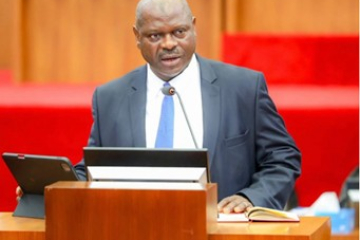
The Permanent Secretary at the Ministry of Health, Lamin Dampha, disclosed this on Thursday 20 August 2026 during the inaugural meeting of the National Technical Working Group on Mental Health and Psychosocial Support held at the Ocean Bay, Cape Point.
Of deep concern to policymakers, PS Dampha stated, “is that more than 89 per cent of this burden comes not from health-care spending, but from lost productivity: absenteeism, presenteeism and premature death.”
Speaking on behalf of the Minister of Health, PS Dampha said the figure is based on a new economic analysis, further reminding that this is a silent economic loss that touches every sector of national life, not health alone.
“For the first time, we now know with evidence, not assumption, the true cost of mental health conditions and suicide to our economy,” he said.
He described the launch of the Technical Working Group as a historic step to formally bring together government, development partners, civil society, professional bodies, and academia to coordinate and accelerate the national response.
“Mental health has too often been the quiet crisis, present in every household, every community and every workplace, yet spoken about the least,” PS Dampha stated.
He noted that for decades, the national response was constrained by an outdated legal framework, a limited specialist workforce, and services concentrated almost entirely in the Greater Banjul Area.
To address this, he recalled that in 2023 and 2024, with support from the World Health Organization, the National Mental Health Programme trained over 200 non-specialists to deliver mental health and psychosocial support services across health facilities and communities using the WHO’s Mental Health Gap Action Programme (mhGAP) guidelines.
The new Technical Working Group is expected to guide policy, improve service delivery, and expand mental health support nationwide.
Building on this, PS Dampha noted that just this past April, the International Organization for Migration, with support of the European Union’s STRONG Project, supported the National Mental Health Programme in training an additional 20 clinicians from across the country in the WHO mhGAP programme.
“In that same period, 30 traditional healers were trained on psychosocial support and collaborative referral pathways. This is the first cohort in a planned programme of 100 traditional and faith-based healers to be trained nationwide.”
This, he said, is significant in view of the fact that in The Gambia, traditional healers remain, for many of ‘our people, the first point of contact when mental distress arises.
He noted that by bringing them formally into a collaborative referral relationship with “our health system, we are not displacing our culture”.
“We are building bridges between traditional and biomedical care in a way that respects our people’s lived realities,” he said.
In 2024, he said, with the support of the United Nations Inter-Agency Task Force on the Prevention and Control of Non-communicable Diseases, the National Mental Health Programme team developed one of only 12 Mental Health Investment Cases produced globally.
“The Gambia is among a very select group of countries worldwide to have completed this rigorous exercise,” he added.
This Investment Case he added, did not stop at diagnosing the problem, but rather it provided with a clear, costed and prioritised set of recommendations.
Through this economic analysis, he said, they concluded, with evidence rather than assumption, that the total economic burden of mental health conditions and suicide on our economy was estimated at D768 million in 2024 alone. This is equivalent to roughly 0.5 per cent of our GDP.
But the Investment Case did not stop at diagnosing the problem. It provided us with a clear, costed and prioritised set of recommendations.
“It shows, for example, that investment in interventions for alcohol use disorder could generate benefits equivalent to 15.8 dalasis for every dalasi invested over seven years.”