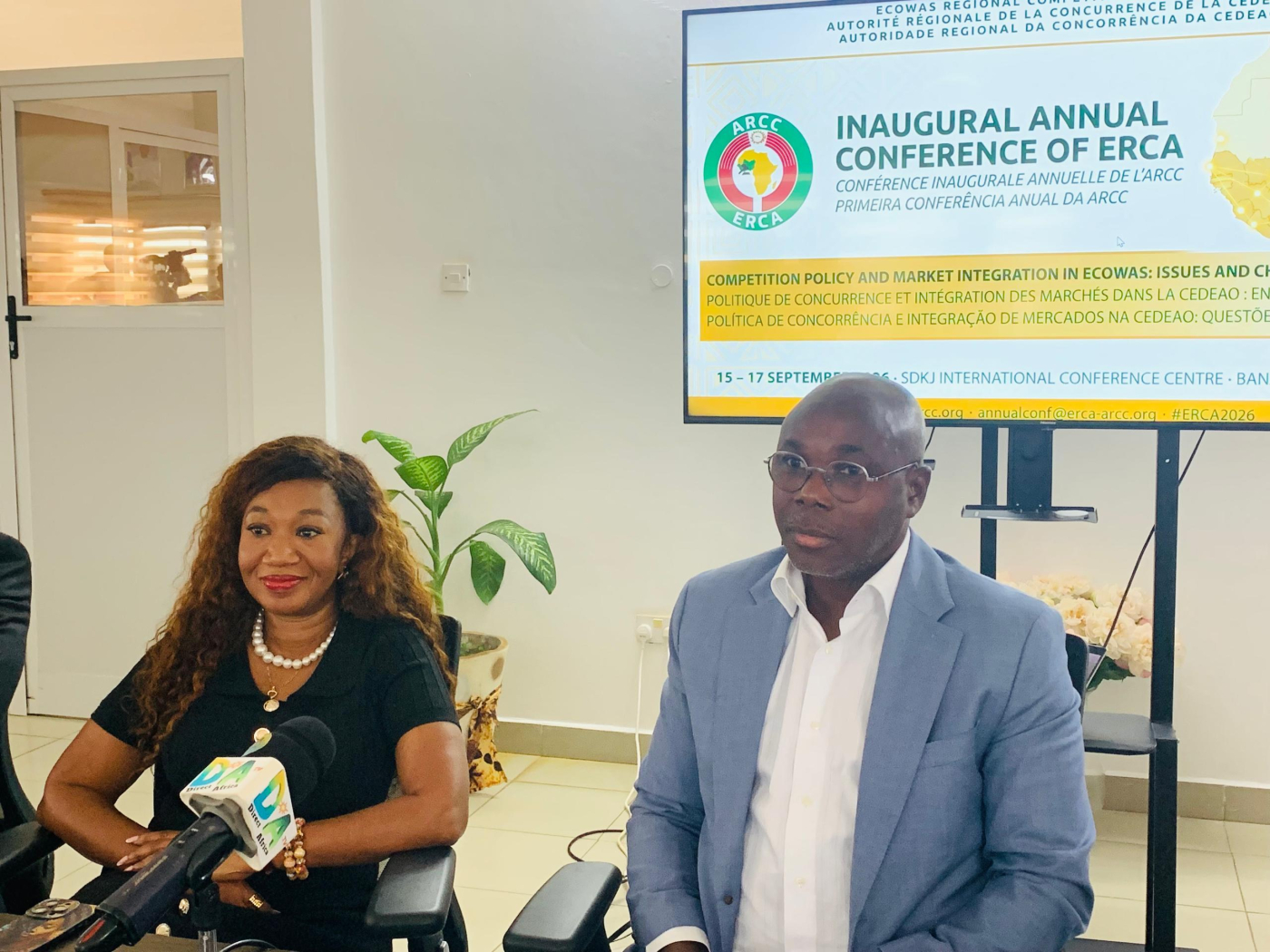
The conference will be hosted by the Ministry of Trade, Regional Integration and Employment from 15 to 17 September 2026. It marks the first major gathering of ERCA since its establishment as the regional body responsible for enforcing competition law across the 15 ECOWAS member states.
Speaking ahead of the event, Simeon Koffi, Executive Director of ERCA, said the conference is designed to share the Authority’s vision and to connect competition policy with the broader goals of the West African market.
The conference will be the first of the regional organisation in charge of competition law enforcement.
“The purpose of having this meeting is to bring together various stakeholders of our regional market and also from other parts of the continent and the world to first of all share ERCA’s vision on competition law enforcement and the link between this assignment, which is to ensure that competition law is properly monitored across our region and see how this mission of ERCA can contribute to the progress of the regional integration of West Africa,” Mr Koffi said.
ERCA expects around 300 participants to attend the Banjul meeting. The list includes market participants, businesses, competition regulators, and experts from other economic sectors.
Researchers, government ministries, legal practitioners, and specialists in competition and consumer protection law are also expected.
Mr Koffi noted that the diversity of participants will allow for rich exchanges on what works and what does not in regulating markets.
“This will be a very important occasion to share experiences because you have various jurisdictions in our member states in charge of competition law enforcement, also in our continent, other parts of Africa and also in the advanced economies in the world,” he said.
Delegates will examine how different countries enforce competition law, how consumer protection is handled, and how regulatory frameworks can be harmonised to support the free movement of goods, services, and investment under the ECOWAS Trade Liberalisation Scheme.
For West Africa, competition law is increasingly seen as a tool to prevent monopolies, curb unfair trade practices, and protect consumers and small businesses.
With the African Continental Free Trade Area, AfCFTA, also expanding, regional authorities say stronger enforcement is needed to ensure that bigger markets do not lead to bigger distortions.
For Gambian businesses, the meeting offers an opportunity to engage directly with regulators and to understand the rules that govern the regional market. For consumers, it signals a growing focus on fair prices, quality, and choice.
“This is basically the objective of having this conference. We expect that all the expected participants will be present to attend,” Mr Koffi said.
With preparations underway, ERCA believes that the inaugural conference could set the foundation for a more competitive, integrated, and consumer-focused West African economy.
Meanwhile, Dr Juliette Anokye, Chair of the ERCA Council, clarified ERCA’s two arms: the Executive Directorate led by Dr Simeon Koffi, and the Council which makes decisions.
Dr Anokye said that since October 2024, the Council has issued about 30 decisions based on the Directorate’s investigations.
She added that consumer welfare is central to every decision, with consumer impact assessed in each case.
Council also considers SMEs in merger reviews to prevent large firms from “bullying” smaller businesses and ensure fair competition, she stated.