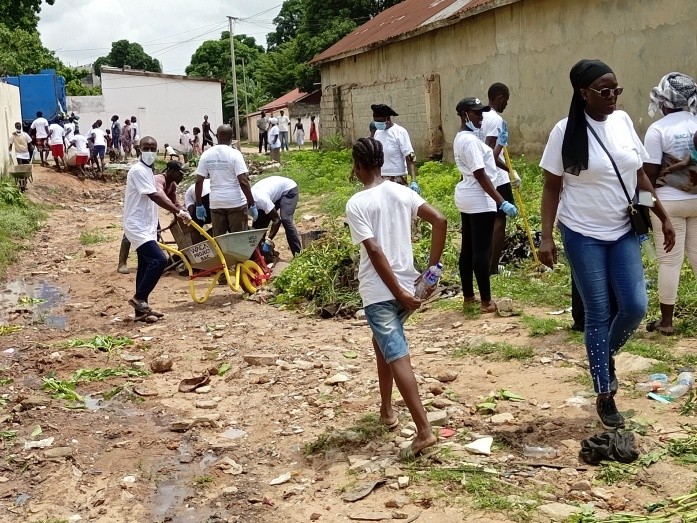
The initiative, led by Lamin Komma, Programme Manager for the Coastal and Marine Environment Programme at the NEA, brought together residents, ward councillors and key stakeholders to remove waste along the Kotu Stream corridor.
Komma explained that the annual event, observed globally on the third Saturday of September, plays a critical role in safeguarding The Gambia's fragile ecosystems.
"The essence is to clean our coastal beaches and other ecosystems that have been littered with different forms of waste," he said.
Unlike previous years, when activities concentrated on the country's 80-kilometre coastline stretching from Barra to Kartong, this year's programme focused on the Kotu Stream, a vital biodiversity hotspot that eventually flows into the Atlantic Ocean.
Komma said the stream was selected because of its ecological and socio-economic significance. Extending from Nema-Kunku to Kotu, the waterway passes through 11 communities spread across nine wards. These communities are particularly vulnerable to seasonal flooding, making effective waste management and environmental protection essential.
He noted that the stream contributes significantly to biodiversity conservation, tourism development and climate resilience, but continues to face growing threats from both solid and liquid waste pollution.
The clean-up exercise was organised as a community-led initiative, with ward councillors coordinating activities within their respective areas.
"We are giving everything back to the community and only coordinating the activity," Komma stated, emphasising the importance of local ownership in environmental conservation efforts.
By focusing on cleaning the stream's banks rather than entering the water itself, organisers hope to reduce pollution levels and protect the wider ecosystem. The NEA believes such interventions will strengthen climate resilience, preserve tourism assets and protect biodiversity for future generations.
The initiative reflects an increasing recognition that environmental stewardship must be driven by communities themselves. The Gambia's participation in International Coastal Clean-Up Day demonstrates the country's commitment to protecting its natural heritage while empowering citizens to take greater responsibility for their environment.
Meanwhile, Musa Bah, Councillor for Latrikunda Yiringanya, commended residents for their strong participation in the exercise, noting that collective action has already transformed an area that was once heavily polluted into a cleaner and healthier environment.
"For years, this place was a breeding ground for mosquitoes because of indiscriminate dumping," Bah said. "Thanks to the West Africa Coastal Areas (WACA) Project, the Council and, most importantly, the community, we have been able to clear the waste and restore our surroundings."
Residents were divided into groups to cover both Latrikunda and neighbouring Kotu as part of the clean-up campaign.
Bah stressed that the exercise was entirely voluntary and driven by a shared determination to address persistent flooding and waste management challenges.
"One individual cannot do it alone," he said. "It takes teamwork and community spirit."
Despite the progress achieved, Bah acknowledged that indiscriminate dumping, particularly during the night, remains a challenge. He called for increased public awareness and behavioural change, stressing that neither the Council nor central government can address the problem without active community involvement.
To discourage further dumping, the community has erected warning signboards and rehabilitated a former dumpsite with support from the Council.
Bah urged residents to sustain their efforts in maintaining a clean environment.
"When we have a clean environment, we are helping ourselves. It is for our own good," he said.
He further encouraged residents across the municipality to embrace voluntary community service regardless of incentives.