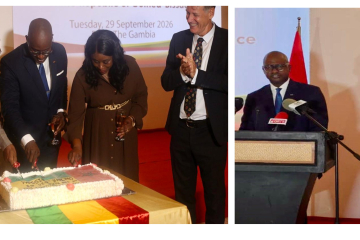
The objective of the program is to provide a strategic platform to review ECOWAP@2025 findings and set ECOWAS priorities for 2026-2027.
It aims to strengthen coordination between ECOWAS institutions, national authorities, and stakeholders, accelerate trade facilitation by reforming ETLS and SIGMAT, enhance governance of business associations, assess cross-border projects like Wellingara-Ba Lumos, and strengthen accountability, competition law, and consumer protection across the region through ERCA Council decisions.
The week-long programme also includes discussions on private sector coordination, trade facilitation, agricultural policy, competition and consumer protection, and the monitoring of cross-border development projects.
The outcomes of the meetings are expected to shape ECOWAS policies and programmes as the bloc advances its Vision 2050 agenda for a more integrated, resilient and prosperous West Africa.
Opening the gathering, ECOWAS Resident Representative to The Gambia Miatta Lily French described the meetings as more than routine technical engagements, saying they reflect the region's collective determination to advance integration through practical cooperation.
“This is more than a series of technical meetings. It is a symbol of the integration agenda we are advancing together,” French said.
She noted that The Gambia's geographical position and strong links with neighbouring countries make it a living example of why regional cooperation, free movement and cross-border trade remain central to the ECOWAS vision.
French added that the convergence of stakeholders from different sectors demonstrates the Commission's commitment to a coherent and results-oriented approach to regional development.
Representing the Government of The Gambia, Interior Minister Abdoulie Sanyang stressed that migration and free movement remain essential pillars of regional integration and economic growth.
“The challenge before us is not to choose between security and mobility, but rather how to ensure that both objectives reinforce one another,” Sanyang said.
He noted that the ECOWAS Protocol on Free Movement has enabled traders, entrepreneurs and workers to move across borders, creating opportunities and strengthening social cohesion. However, he warned that growing threats such as human trafficking, organised crime, cybercrime and arms smuggling require stronger cooperation among member states.
Sanyang called for enhanced information sharing, harmonised border procedures and greater investment in technology to facilitate legitimate travel while improving regional security.
Dr Ibrahim Assane Mayaki, the African Union Special Envoy on Food Systems, urged African leaders to take ownership of their development agenda and place agricultural transformation at the centre of economic policy.
“The only way we can absorb the millions of young people entering the labour market every year is by transforming our agri-food systems,” he said.
He argued that future agricultural policies must move beyond farming alone and embrace a broader food systems approach that connects agriculture with trade, transport, health, environment and industrialisation.
Mayaki also called for stronger domestic resource mobilisation, warning that Africa can no longer rely heavily on traditional development assistance.
Permanent Secretary at the Ministry of Finance Babucarr Jobe, speaking on behalf of the Minister for Finance and Economic Affairs, emphasised the role of the private sector in driving economic transformation.
“Sustainable economic growth and job creation cannot be achieved without a vibrant private sector,” Jobe said.
He noted that entrepreneurs, investors and business associations remain indispensable partners in industrialisation, competitiveness and regional trade.
Participants are expected to validate the ECOWAS agricultural policy review, strengthen trade facilitation measures, assess cross-border development projects and develop recommendations aimed at accelerating regional integration.
ECOWAS Commissioner for Economic Affairs and Agriculture Dr Kalilou Sylla reminded delegates that regional integration remains central to the bloc's vision despite the challenges the sub-region faces.
“Yes, we have some challenges, but we are still fifteen. So we have to continue our work on this, and we need to work together,” he said.
According to Sylla, the meetings are designed to ensure that regional integration delivers practical benefits through increased trade, investment, food security, employment creation, and consumer protection.
He stressed that strengthening free movement, trade cooperation and common market mechanisms remains essential to improving the lives of millions of West Africans.
Momodou Jeng, Director of WALIC, speaking for the Minister for Agriculture, reiterated that agriculture remains central to The Gambia’s economy and food security.
He said progress hinges on harmonised regional policies, shared infrastructure, and coordinated investment to deepen the ECOWAS common market.
Jeng outlined four reform priorities: better input supply systems, stronger food security data, seasonal preparedness, and transparent input governance. He also highlighted key programmes like the National Agricultural Investment Plan 2026-2035 and the Digital Agricultural Transformation Programme, pledging Gambia’s support for a resilient, integrated West African agricultural economy.