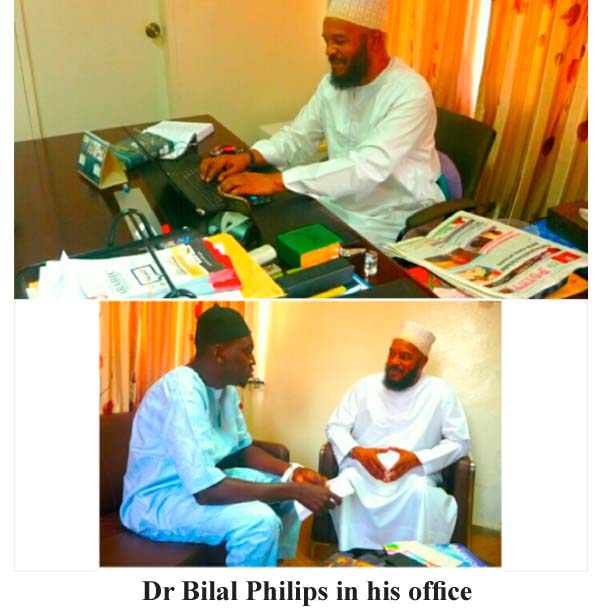
In
an exclusive interview with The Point newspaper, the founder of the Islamic
Online University (IOU), Dr Bilal Philips, has reiterated his commitment to
establishing close partnership with the University of The Gambia. Excerpts of
the interview:
The
Point: First of all, congratulations to you and your staff on your recent
graduation ceremony. How do you feel
graduating yet another batch of students?
Dr
Bilal Philips: Well it’s of course Alhamdulillah, a great blessing from God
that we have managed to achieve what we have achieved in such a short span of
time; it is indicative of Allah’s blessings on it and we hope that it will
continue to grow as it has been in the past. The degree to which the society is
aware of what we are offering determines its growth. Actually, we have not
spent very much on promotion, what we have is what Allah gave us but we hope in
the coming years to come, we will increase our promotional activities so that
more and more people are aware of what we are offering. That should make an
even greater difference for the future expansion of the programmes that we are
offering.
The
Point: Since the inception of the IOU in The Gambia in 2013, more than 1,500
Gambians have benefitted and recently 378 have added to that number. Do you expect to achieve something greater in
just a short period?
Dr
Bilal Philips: Not really. By establishing IOU, are trying to address a need
that we knew was huge so those numbers that you mentioned are great numbers
from an institutional perspective but when you look at those numbers in terms
of the need of the society, this is just a drop in an ocean; we have an ocean
in front of us. So there is a lot of scope and room for expansion of the
programmes and increasing the benefits to the Gambian society to integrate our
graduates from the madrasas into mainstream education for them to play the kind
of role that they should be playing.
The
Point: What are your expansion plans for IOU in The Gambia?
Dr
Bilal Philips: To reach more of the Madrasa students because the ‘Intensive
English Course’ [at IOU] is mainly for such students, and those who have
studied in the conventional schools and did very poorly in their English
(WASSCE). We hope to reach out to them to help them improve their own skills so
that they could retake WASSCE and do better or even if they got through to
upgrade the standard of their English. We expect to expand in those areas also.
The
Point: How is your institution looking to partner with the UTG?
Dr
Bilal Philips: Well, we have already met with the Vice Chancellor of UTG, Dr
Anjum, and we have already identified the areas of cooperation. We are preparing a memorandum of
understanding between the two institutions.
We will be working very closely with UTG; providing the knowledge to
help them put their programmes online as well as to offer some of our courses
through their portal. Also, the IOU as a
university would benefit from the facilities like labs from the UTG. So it is a mutually beneficial arrangement.
The
Point: Why was The Gambia chosen as the global headquarters of the IOU?
Dr
Bilal Philips: The IOU is actually an online university, so technically
speaking it has no headquarters, it is in cyberspace. All of our staff are
scattered around the world, we have been functioning for the last seven years
and never met. We communicate through emails, virtual classrooms and
telecommunication. So the underground headquarters became a necessity to give
us credibility in the eyes of those who feel that a university is not a
university unless you actually have a physical building somewhere as your
headquarters. So we decided to establish
a base and we looked at different locations, The Gambia seemed to be the most
promising, so The Gambia was chosen. It
was also convenient and Allah’s will to select the vice chancellor from The
Gambia in the person of Dr Cherno Barry.
The
Point: What are some of the new initiatives or projects you intend to come up
with?
Dr
Bilal Philips: One of our big projects is providing for the Gambia College
graduates an avenue to complete their undergraduate degrees. Instead of them having to go and do another
four years of study, we are providing a means for them to complete it in two
years. This has already passed through, it has been agreed upon and we are in
the process of launching it. Another one is our partnership with the Ministry
of Basic and Secondary Education to train madrasa graduates as teachers into
the mainstream education.
Also,
we have launched the 100 Scholarships Initiative to help support good students
who cannot afford higher education. Some
of them end up in the Mediterranean because of the lack of opportunity to
continue higher education. So through
this initiative, we reach out to these less privileged students. Next year, we hope to expand it to a
thousand, if possible.
The
Point: Can you tell us how the IOU has bridged barriers in making learning
accessible to all regardless of age, distance or time?
Dr
Bilal Philips: Well, of course in the case age, we have students in their 80s
and as young as pre-teens studying with us, so we have no age barrier. We have students from one end of the spectrum
to the other. In terms of location,
people don’t have to travel all the way to school you can study at the comfort
of your home because it’s online and that’s why 50% of our students are women
for the online programmes. And lastly, our online studies allow you to set your
timetable according to your personal schedule. Whether you are a housewife,
student, professional, etc, you can set a time for yourself that suits your
studies. It has that high degree of
flexibility.
The
Point: Can you explain about your accreditation as an online university?
Dr
Bilal Philips: In terms of our accreditation, we already have a license for
operation from the Ministry of Higher Education by which our degrees are
recognised. We are currently working on
full accreditation for our university as a university of The Gambia. We also have accreditation from Somalia which
is recognised as a country in the UN and that stands as our global
accreditation but we are also looking into having The Gambia to be our main
accrediting body because of the status of The Gambia in Africa.
The
Point: Most Gambians have a problem of internet connectivity, especially those
in rural areas. What framework do you have in place for students encountering
such problems?
Dr
Bilal Philips: We are currently working on a solution with an I.T company to
make PC Tablets accessible to these students wherein study materials can be
uploaded so that all they will need to do is just to charge their tablets and
study. Another option is the hard drives
where semester work will be uploaded.
They only need to go online to do their tests. We also have free access
to internet for all our students here in the center. And we want to enter into arrangement with
the government to provide access to our students in their e-learning hubs
countrywide.
The
Point: What are some of the challenges you are facing?
Dr
Bilal Philips: One of the main challenges we face is the frequent power
outage. Another setback would be the
slow pace at which the accreditation process is taking. And more importantly,
many people think of us as being an ‘Islamic university’ but in reality as of
2014, we expanded into major areas like psychology, business administration,
Information Technology, Islamic banking, etc.
The
Point: As an institution contributing to the development of The Gambia, how
would you like the new government to support you in your quest to continue in
the capacity building of Gambians?
Dr
Bilal Philips: That’s a good point. I
would like them to help facilitate and speed up our accreditation process. I would also want them to get sufficient
finance to implement the madrasa bridge programme across the country. Also, the goal of universal education for all
can be achieved through us because for every UTG student, bachelor’s degree
costs approximately $4000 whereas eight students can be enrolled at IOU on the
same amount because we charge approximately only $500 for a whole degree
programme. We could have more students
enrolled at IOU at a much less cost.
Therefore, the government can utilise this opportunity at IOU. Also, we encourage charitable organisations
and individuals to provide scholarships in order to get more Gambians to have
access to higher education.
The
Point: What’s your advice to the new graduating students?
Dr
Bilal Philips: My general advice is for them to be focused on the real goals of
their education. They should not only
focus on the material benefits but also in terms of the societal benefits so
that they can play greater impact and play important role in the Islamic future
and civilisation of The Gambia.
The
Point: As I conclude, I would like to
ask a general question and that is: what do you think are some of the societal
challenges of the Muslim Ummah today?
Dr
Bilal Philips: The most serious challenge we face today is getting back to
Islam. We call ourselves Muslims, we go for Hajj, fast and pray etc but then
our Islam is still compartmentalised. We
only have it in one corner of our life and the major part of our life doesn’t
involve Islam. Islam should be in everything. So the main problem is
reintegrating Islam in all of the aspects of our lives. We have become
splintered. Why can’t we have that ‘one Muslim nation’ as it was in the past? The only way to do this is to bring Islam
back to our lives practically not just verbally and to live it.
The
Point: In April 2016, the Dabiq Magazine run by the notorious Terrorist group
of Islamic State of Iraq and Syria (ISIS) listed your name together with other
renowned Muslim scholars threatening to kill you for denouncing them. As a
Canadian citizen, has your government offered you protection from these threats
and are you worried about life?
Dr
Bilal Philips: Firstly, yes in the Dabiq Magazine, my name was listed along
with a number of other renowned Islamic scholars because, according to them, it
is a religious obligation to kill us for speaking out against their extremist
views and operations which totally contradicts the true teachings of Islam. When I was in Canada last year I was informed
that my name had been put on the list but I was not offered any protection this
is probably because Muslim lives don’t really matter in the Western
countries. On the contrary, Salman Rushdie,
author of the ‘Satanic Verses’ which ridiculed and talked on horrible things
about Islam and the prophet, the British government has spent tens of thousands
of pound sterling to protect him because he was saying things which defamed
Islam and denigrated the Prophet (SAW), cursing his wives. Such a person is protected in the West but
for Muslims, no; they are in fact happy if they [Muslims] are eliminated.
The
Point: What do you have to say to all your entire staff together with the vice
chancellor, Dr Cherno Barry, who has been working tirelessly to ensure that
there is landmark convocation annually?
Dr
Bilal Philips: I commend them for their efforts as this is the 3rd graduation I
have attended since we began in 2013 and Alhamdulillah it’s progressively
getting better and better. I heartily
thank all of those who have been engaged and involved in the process. God willing, we hope to see even greater
successful events in the future. I will
be given a series of lectures on Ayatulkursy at Minaa Mosque, and a couple of
other lectures as well at the Supreme Islamic Council.
The
Point: What are your last words to the general public?
Dr
Bilal Philips: We need to work together as Allah has given us opportunity to
more freely express ourselves to work for the Islamic goals as a Muslim
society.