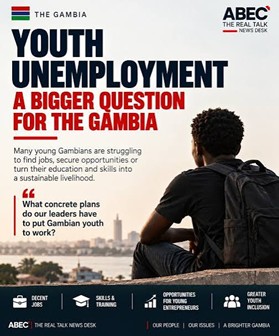
More than 60% of Gambians are under the age of 25 – an immense resource and an equally enormous development challenge.
According to The Gambia Labour Force Survey 2025, 41.3% of youth are not in education, employment and training.
Among those who have jobs, 84.5% are employed in the informal sector (The Gambia Bureau of Statistics, 2025).
The Gambia ranks 125th out of 183 countries on the 2023 Global Youth Development Index, up from 139th two years earlier (Commonwealth, 2024), but lags near the bottom (170th out of 193) on the United Nations Development Programme’s (2025) Human Development Index, underscoring the scale of the development challenges facing the country’s youthful population.
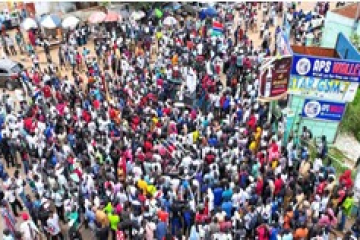
Challenges in education were brought into public view in October when University of The Gambia students protested against conditions at the Faraba campus, including inadequate transportation, limited access to food and water and unreliable Internet connectivity.
The government has introduced policies and programmes intended to expand opportunities for young people.
The National Youth Policy 2019-2028 sets out a framework for youth development, including investments in education, skills, employment, and participation in decision making (Ministry of Youth and Sports, 2020).
The National Employment Policy 2022-2026 also proposes measures to improve young people’s access to internships, vocational training, and productive resources, including credit and business support (Ministry of Trade, Industry, Regional Integration and Employment, 2022).
More recently, the government and the World Bank have supported investments in technical and vocational education and training (TVET) through the Resilience, Inclusion, Skills and Equity project, including U.S. $13 million to establish two TVET centres of excellence in agribusiness and fisheries (Ecofin Agency, 2026).

The Afrobarometer Round 10 survey (2024) offers some insights into the situation of Gambian youth.
Findings show that young people are more educated than their elders, but also more likely to be unemployed.
Job creation would be their top priority for additional investment to help young people, though given a choice, most youth would become entrepreneurs.
Unemployment ranks among the country’s most important problems, according to young respondents, though more voice concerns about health, the increasing cost of living, and crime and security.
On all of these priority issues, only small minorities see their government as performing adequately.
Evaluations of economic and personal living conditions are overwhelmingly negative, and most youth see their country as moving in “the wrong direction”.
A growing majority of youth say they have contemplated emigration in search of better opportunities.
Source: Afro Barometer