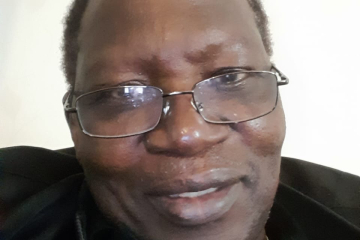
Fatoumatta: There are lives that do not simply pass through history but confront it, reshape it, and redeem it. The life of Mr. Saul Mbenga belongs to that rare category. In the long and painful chronicle of Gambia’s struggle against authoritarianism, his name stands among the early architects of resistance, a man who refused to surrender his conscience to fear. In the immortal words of Professor Wole Soyinka, “The man dies in all who keep silent in the face of tyranny.” Saul Mbenga refused to die. He spoke. He resisted. He fought.
Like hundreds of thousands of Gambians and Pan-Africanists worldwide, Mr. Mbenga joined the diaspora struggle when dissent was dangerous. To understand his influence, recall the hazardous context: He was among the first exiled patriots to challenge dictatorship when it was neither fashionable nor safe. Before social media, with the state controlling the airwaves and fear pervasive, he fought on the digital frontlines through the Gambia-L Listserv, the Mighty Gambia Post, and other early platforms. His words were weapons, his convictions unshakable, his courage contagious.
As coordinator of the Movement for the Restoration of Democracy (MRD) in the United States, he mobilized Gambians across states and continents. He organized marches in the freezing winters of New York and the scorching summers of Washington, D.C., securing police permits, printing placards, and rallying citizens to confront the kleptocratic rule of Yahya Jammeh. He was not a spectator of history; he was a combatant in the civic arena.
In an era when tribalism threatened to fracture the nation, Saul Mbenga stood as a detribalized Gambian—loyal to justice, not identity; to principle, not parochialism. Influenced by Kwame Nkrumah, his activism grew from the Pan-African belief that the liberation of one African is bound to all. As his activism broadened, he fought injustice wherever he found it: in Gambian politics, in diaspora communities, and within the African Mosque in the Bronx, where he mediated, organized, and uplifted.
For more than two decades, Mr. Mbenga was a constant presence in the struggle for democracy — not because he sought recognition, but because he believed that citizenship is a moral duty. He never held public office, never demanded reward, never claimed entitlement. Yet his fingerprints are on every chapter of the democratic awakening that eventually toppled the dictatorship.
He supported the survivors of the April 10–11 student massacre, offering moral and financial assistance when the world looked away. He stood with the oppressed, defended the voiceless, and confronted the powerful. Telling the story of Gambia’s democratic rebirth without inscribing his name would be an act of historical amnesia.
A man of principle and unbreakable spirit. For over twenty‑five years, I worked alongside him in various organizations and causes. I witnessed his brilliance, tenacity, and unwavering loyalty to principle. Even when paths diverged, his sincerity was clear. He could have chosen comfort, silence, or safety, but he chose The Gambia.
His journey was intertwined with other giants of the diaspora struggle, Mr. Ousainou Mbenga, Maila Touray, Yankuba Jammeh, Momar Senghor, Cherno Gaye, Jamila Allston, Amie Noho, Late Junkung Dibba, Demba Sanyang, and the indefatigable activists across Europe and Scandinavia. Together, they formed a constellation of resistance, a brotherhood and sisterhood of conscience. They were not perfect, but they were present, courageous, and necessary.
The resilience of Saul Mbenga and his comrades is a testament to the human spirit’s refusal to bow to tyranny. Their sacrifices illuminate the path from dictatorship to democracy. It is time, long overdue, to honor him formally, publicly, and permanently. His life demonstrates, once again, the wisdom of James Mill, who wrote that “it is not the life that matters but the courage you bring into it.” Mr. Mbenga brought courage enough for a nation. He was a virtuous gentleman, a paragon of civic virtue, a man of gravitas who gave everything so that The Gambia might one day be free.
Today, he is honored. Tomorrow, he must be remembered. And forever, his sacrifices and those of his comrades must remain part of the nation’s memory.
A Tribute to a Pioneer of the Gambian Diaspora Struggle. A Pan‑Africanist and detribalized Gambian