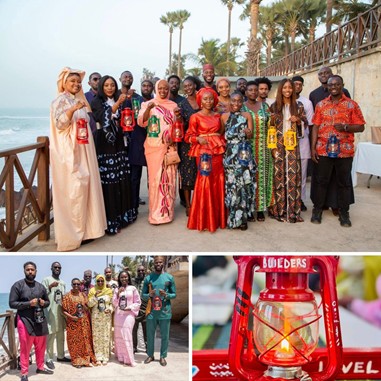
Last week I was on the phone with a young entrepreneur I have known since our early years in our beloved Brikama Sataybaa. He is someone I consider more like a brother than anything else. Over time, as life often does, our paths took us into the world of business, and like many Gambians navigating that journey, we occasionally exchange ideas, frustrations, and the small victories that come with trying to build something meaningful. On this particular call, his voice carried a noticeable excitement.
''Nko..,have you heard about the new association of entrepreneurs?" he asked. I had not. "They call themselves The Builders," he said. My first reaction was genuine excitement. The very idea sounded promising. In a country where young people are often searching for pathways into enterprise and innovation, the emergence of a collective of entrepreneurs sounded like precisely the kind of initiative that could energise the business landscape. I wished them well even before I knew much about it.
Soon afterwards he forwarded me their media broadcasts and their social media accounts. I then listened to a podcast interview with one of the founders, Dr. Ismaila Badjie, who was my batchmate at "Gambia High'' and someone I have a great deal of respect for — on Dialect Space, hosted by the thoughtful and articulate Ebrima Sonko. The conversation was engaging. The ambition was admirable. The language of building the country through entrepreneurship is one I instinctively support. At that stage, I was sincerely pleased that such an initiative existed. Then came the moment in the discussion where Dr. Badjie explained how intentional they are about exclusivity when it comes to how one becomes a member. According to the explanation given publicly, membership requires nomination by one of the founding members. The group themselves consist of thirty-five founders who effectively act as the gatekeepers of entry. The reasoning offered was that the association wanted to avoid growing too quickly.
At first glance, that may sound reasonable. Organisations often grow gradually in order to maintain cohesion. But it was precisely at that moment that my curiosity was triggered. So, I decided to look more closely at the founding members, their family backgrounds, their professional connections, and the networks they belong to. The exercise was not particularly difficult. In a country as small and socially interconnected as The Gambia, patterns reveal themselves quickly. What emerged was not a random cross-section of Gambian entrepreneurship. Rather, it appeared to be a remarkably familiar constellation of individuals mostly drawn from what many Gambians jokingly, and sometimes not so jokingly, refer to as the "Kairaba Avenue network." For those unfamiliar with the phrase, it is the shorthand many ordinary Gambians use to describe a relatively tight social ecosystem of families, friends, and long-standing connections who occupy a visible portion of the country's professional, business and political space.
There is nothing inherently wrong with networks. Every society has them. I myself belong to exclusive private members' clubs at Oxford and Cambridge, as well as the Westminster Africa Business Association and others. Businesspeople everywhere rely on relationships. But when a network presents itself as a national platform for leading entrepreneurs and professionals of the highest calibre, questions naturally arise about representation. Is this truly a broad coalition of the country's under-50 business and professional community? Or is it simply a well-connected circle organising itself under a more ambitious label?
At this point, a little intellectual honesty is required. After all, a modest entrepreneur like the founder of Rahma Gambia Ltd clearly does not deserve to be anywhere near such a distinguished table. What could a small company with far fewer than 30 employees possibly contribute among such accomplished figures? Some may assume that observations like these are motivated by a sense of exclusion. Those who know me know I have never measured my challenging but proud journey in business by proximity to social circles or private clubs. My work has always taken me far beyond the comfortable networks that often define our public life.The issue therefore is not who belongs to any particular association, but whether such associations truly reflect the diversity of the entrepreneurial community they claim to represent.
Would someone who built a business or professional career outside the Kairaba Avenue network, from communities far removed from the country's traditional centres of privilege, realistically have a pathway into this association, regardless of their success? From the structure described publicly, the answer appears to be only if one of the insiders decides to open the door. The German sociologist Max Weber described this phenomenon more than a century ago as "social closure." In simple terms, it refers to the tendency of groups to protect access to resources, status, and opportunities by controlling who gets admitted into their circles. The mechanism does not require malice. Often it happens quietly, almost unconsciously. Friends nominate friends. Families recommend familiar names. Networks reproduce themselves. And before long, a structure emerges that looks inclusive from the outside but remains socially narrow in practice. This is why representation matters. When an organisation presents itself as the voice of a generation of entrepreneurs, it carries an implicit claim: that it speaks, in some meaningful way, for the diversity of that entrepreneurial community.
Yet if the pipeline into the organisation runs primarily through the same social corridor, the same Kairaba Avenue networks, the same long-standing family connections, then the claim becomes difficult to sustain. There is another aspect worth reflecting on. The association has reportedly taken non-members along during engagements with the President. At first glance, this appears commendably inclusive. It signals openness and collaboration. But it also raises a subtle question. When individuals who are not members of the organisation accompany its leadership to high-level meetings, how are they presented? As equal participants? As symbolic guests? Or simply as evidence that the association is broader than its actual membership suggests? Representation can sometimes be curated. In political economy, this is known as performative inclusivity. The appearance of diversity is used to reinforce the legitimacy of a narrower structure. Again, none of this necessarily implies bad intentions. It is entirely possible that the founders of The Builders genuinely believe they are creating something beneficial for the country. Many of them are capable and well-educated individuals with sincere ambitions. But intentions alone do not define institutions. Structures do. And the structure described so far resembles less a national entrepreneurial or professional platform and more a self-selecting network of elites organising themselves collectively. If that is the case, then honesty would serve everyone better.
There is nothing wrong with a group of well-connected professionals forming an association to collaborate, share ideas, and pursue opportunities. Such networks exist everywhere in the world. But they are usually called what they are: A network, A club, An elite consortium.
What they are not typically called is the representative body of an entire generation of entrepreneurs and professionals. The Gambian business community is far broader and more diverse than any single network can capture. It includes young poultry and cattle farmers in Sambouya village, an online delivery platform founder in Tallinding that connects local restaurants and customers, farmers building agribusiness ventures in Basse, and countless small and medium enterprises operating far from the social orbit of Kairaba Avenue. They are builders too.
Perhaps the most constructive way forward for this new association is not to defend its exclusivity but to clarify its identity. If it wishes to remain a tight network of well-connected professionals, there is nothing inherently wrong with that. But if it claims to represent the entrepreneurial energy of a nation's youth, then the doors must be wider, the criteria more transparent, and the networks less predictable. Until then, the rest of the country may continue to look at The Builders and quietly conclude that the name is only half accurate.
They are indeed building something. The question is whether they are building bridges for the country's entrepreneurs and professionals or simply reinforcing the walls of the Kairaba Avenue Network.
AlaSan Ceesay is a Cambridge-educated entrepreneur and founder of Rahma Gambia Ltd.