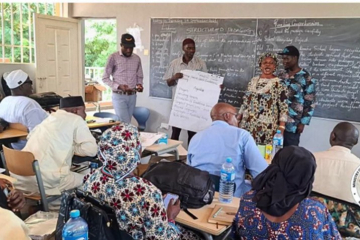
Held at the Senegambia Beach Hotel, the session brought together government officials, civil society organisations, development partners, and disability rights advocates to review and validate a framework designed to ensure that the rights guaranteed under the law translate into tangible improvements in the lives of persons with disabilities across The Gambia.
At the event, Emmanuel Daniel Joof, chairperson of the NHRC described the forum as ‘a significant milestone’ in the country’s human rights journey, highlighting that the true value of the Persons with Disabilities Act lies not in its enactment, but in its effective implementation, monitoring, and measurable impact.
“The Act provides strong legal protections, but laws alone do not change lives. The real measure of progress is whether these provisions become lived realities for persons with disabilities in healthcare, education, employment, accessibility, and social protection.”
Joof recalled that The Gambia ratified the United Nations Convention on the Rights of Persons with Disabilities (UNCRPD) in 2015, reaffirming its commitment to promote, protect, and ensure the full and equal enjoyment of human rights for persons with disabilities.
The domestication of the Convention through the 2021 Act, he noted, was a landmark achievement, but one that now demands robust accountability mechanisms.
Within this context, he noted that the establishment of the National Advisory Council on Persons with Disabilities under Section 8 of the Act was described as central to driving implementation.
The Council, he added, is mandated to monitor programmes, facilities, and policies affecting persons with disabilities, and to support evaluation and compliance with national and international obligations.
“To effectively discharge this mandate, the Council needs clear indicators, practical tools, and a structured monitoring approach,” he added, pointing out that this necessity informed the development of the draft monitoring framework through a collaborative process.
Musu Kuta Komma, Country Director of ChildFund The Gambia, underscored the importance of the framework in promoting accountability, inclusion, and justice.
She emphasised that while laws establish rights, it is monitoring and accountability that turn legal promises into everyday realities.
“This framework gives meaning to the Act by ensuring that rights are realised in schools, health facilities, workplaces, public spaces, and communities,” she stated, adding that it strengthens evidence-based advocacy, enables early identification of gaps and discrimination, and promotes transparent reporting to relevant ministries and the National Assembly.
From the perspective of Persons with Disabilities, Muhammed Krubally, Chairperson of the National Advisory Council, hailed the validation as a historic moment.
He said Persons With Disabilities have for too long faced exclusion, discrimination, and denial of equal opportunities.
Citing the Universal Declaration of Human Rights and the UNCRPD, Krubally reaffirmed that the rights of persons with disabilities are non-negotiable, highlighting key principles enshrined in both the Convention and the Persons with Disabilities Act, including non-discrimination, accessibility, equality of opportunity, full participation, and respect for human dignity.
He called on all stakeholders to translate these principles into action, noting the monitoring framework provides a pathway for ensuring that no institution or sector escapes scrutiny when it comes to disability rights.
The forum concluded with stakeholders validating the framework and reaffirming their collective commitment to advancing the rights, inclusion, and dignity of persons with disabilities in The Gambia.