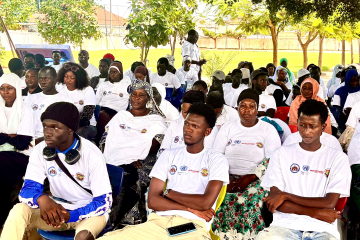
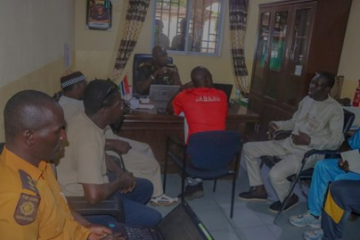
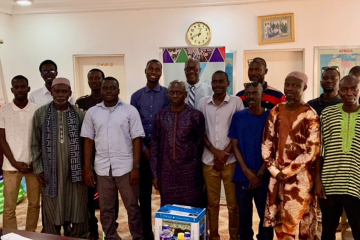
During the session, Camara highlighted the various capacity-building initiatives undertaken under the projects. These included data analytics training led by the ICRAF team, participation of University of The Gambia students, and targeted training for staff from NARI and the Soil and Water Management Unit. “We conducted the Land Generation Surveillance Survey (LPSF), training 35 participants in data collection techniques,” Camara noted, adding that 20 technicians were also trained on fertiliser emission trials to enhance research outcomes.
Camara further emphasised the establishment of sustainable business models for NARI and Soil and Water Management laboratories, ensuring that the facilities can generate revenue independently while supporting agricultural research. Other capacity-building efforts included soil science research by university students, technical training on soil stability evaluation, tropical soil fertilisation, and laboratory safety courses for 41 participants.
The financial performance of the projects was also shared, with an overall budget of D1.34 million and approximately 63% execution. Key achievements highlighted included the installation of the NARI spectral lab, completion of soil surveys across four agricultural regions, processing and scanning of soil samples, two cycles of field trials, and sponsorship of three university students’ theses.
Despite the progress, challenges remain. Camara cited delays in constructing the Soil and Water Management lab, slow donor response times, and constraints in accommodating partner institution activities. Lessons learned included the importance of early internal consultation during project preparation and the need for a dedicated local project line to support international collaborations.