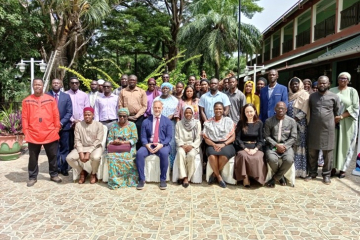
The committee was inaugurated on Wednesday at the MoHERST Conference Room, bringing together representatives from the Ministry of Health, Edward Francis Small Teaching Hospital (EFSTH), the Gambia Nursing and Midwifery Council, the University of The Gambia, the University of Education, and other key stakeholders in the health and education sectors.
Presiding over the inauguration, the Minister for Higher Education, Research, Science and Technology, Professor Pierre Gomez, described the initiative as a significant step toward building a resilient and sustainable healthcare system capable of meeting the country’s growing health demands.
He commended members of the committee for committing their expertise to an initiative designed to confront longstanding challenges facing the nursing profession.
Professor Gomez noted that The Gambia continues to grapple with an inadequate number of nurses to serve its growing population, uneven distribution of health personnel, limited training opportunities, poor retention of skilled professionals, and insufficient pathways for specialised nursing education.
He stressed that overcoming these challenges requires a coordinated national response involving government institutions, training establishments, professional regulatory bodies and healthcare providers.
“The committee is not merely an advisory body; you are the architects of our future nursing workforce,” the minister told members, adding that their work would have a lasting impact on healthcare delivery and patient outcomes across the country.
According to him, the proposed project will provide a strategic framework for strengthening nursing education, expanding training capacity, improving regulation and enhancing healthcare delivery nationwide.
Professor Gomez further explained that the proposal will serve as a key instrument for mobilising resources and attracting investment into the country’s health sector. He said it would be aligned with the National Health Policy, the National Health Sector Strategic Plan, MoHERST’s strategic priorities and the Gambia National Qualifications Framework.
He tasked the committee with producing an evidence-based proposal that addresses every stage of the nursing profession, including education and curriculum development, clinical training, deployment, regulation, retention and continuous professional development.
The minister also urged members to ensure that the experiences of frontline nurses and healthcare workers, particularly those serving in rural communities, are reflected in the final document so that it responds to the realities of healthcare delivery across the country.
He expressed confidence that the committee would produce a proposal that meets international standards while supporting the development of a skilled nursing workforce capable of responding to both national healthcare priorities and emerging global demands.
Professor Gomez reaffirmed the government’s commitment to investing in human capital development, saying strengthening the health workforce remains central to improving healthcare services and achieving sustainable national development.
Once completed, the Nursing Capacity Development Project Proposal is expected to guide future investments in nursing education and workforce development while laying the foundation for a stronger, more responsive and sustainable healthcare system in The Gambia.