In an era of rising misinformation as The Gambia heads to the December 5 presidential election, voters are being urged to verify election-related information before sharing it.
The call comes as social media and messaging platforms become major sources of political information, especially for those easily carried away. For many, seeing the same claim repeatedly on WhatsApp or Facebook is enough to believe it is true.
However, election officials, fact-checkers, civic educators and journalists warn that familiarity, popularity and an official-looking appearance do not make information true.
The Independent Electoral Commission’s Voter Education and Training Officer, Demba Jallow, said misinformation about electoral requirements and other aspects of the electoral process remains a major concern.
The IEC, he said, is working to provide timely and credible information to reduce the space for false claims.
“We are prepared, and we do what is required of us to make sure that we give the public credible and timely information,” Jallow said.
He urged voters to “delay and verify” whenever they encounter information whose accuracy is in doubt.
“Don’t be quick to react. First delay,” he advised, urging people to check where information was published and compare it with information from the IEC. The Commission, he added, uses its website and social media platforms to provide updates and responds to false information through press releases, press conferences and stakeholder engagements.
He noted that the IEC is conducting continuous voter education through communities, radio, television and social media, with its regional offices used to reach voters across the country.
But the challenge is not only the availability of official information — it is also whether people know how to recognise and verify it.
Abdoulie Jobe, a voter who regularly uses social media, said he relies heavily on Facebook and WhatsApp but does not automatically trust information simply because it is widely circulated.
“If it is something important, especially if it claims to come from the IEC, I try to check their official pages or see whether reliable news platforms are reporting the same thing,” he said.
Jobe, however, admitted he had previously shared information that later turned out to be misleading after assuming it was genuine because many people posted it.
“I felt embarrassed because I had already forwarded it to other people, so now I try to verify things before sharing them,” he said.
For Fanta Ceesay, an elderly voter who relies mainly on WhatsApp and radio, trust is closely linked to the person sharing the information.
“If it comes from someone I know and trust, I am more likely to believe it,” she said, adding that she feels more confident when many people in a WhatsApp group share the same information. She said she prefers to hear important election information on the radio, particularly in a language she understands well.
Awa Camara, a first-time voter, described a similar dependence on people around her.
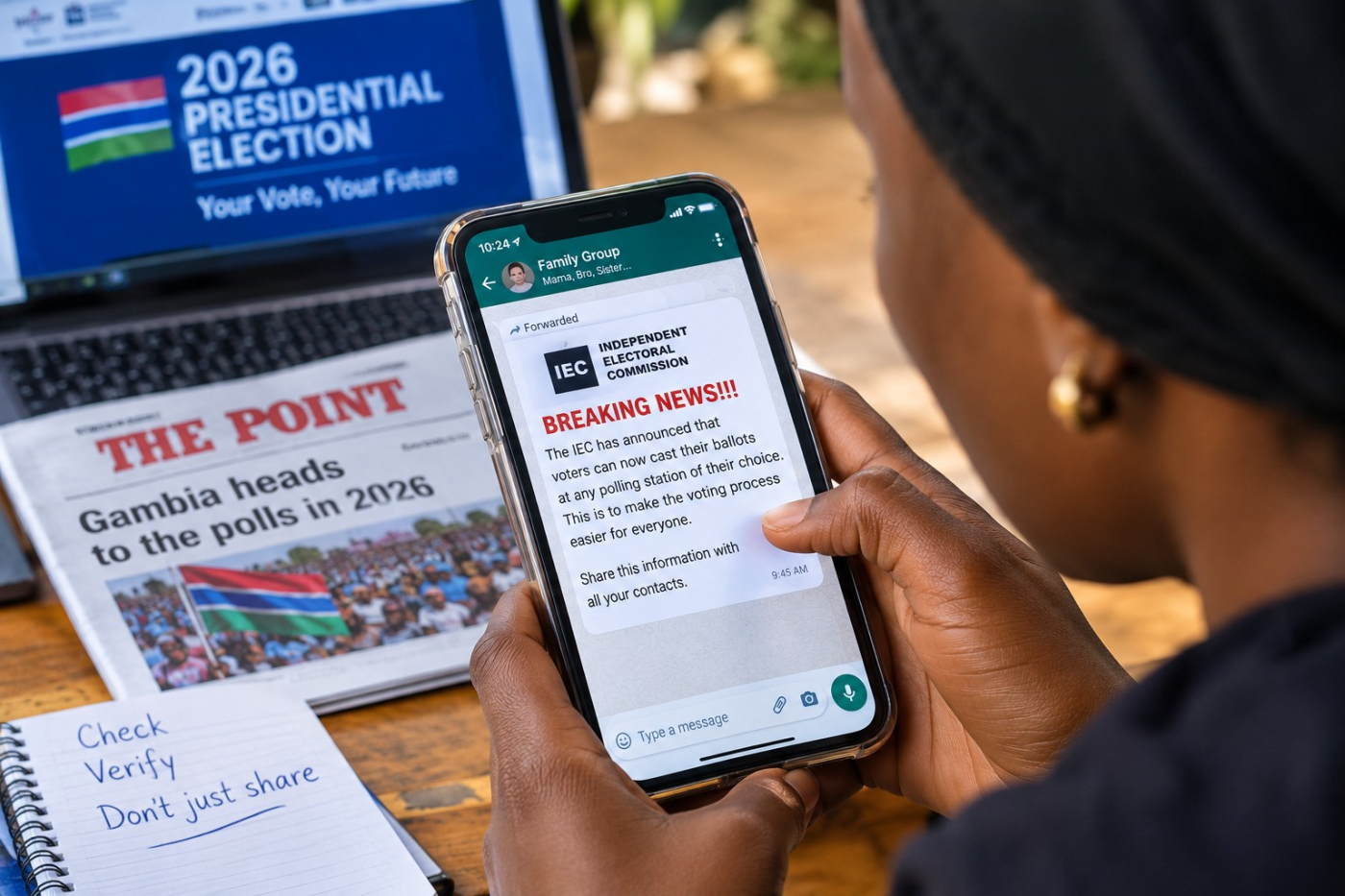
“If I see that many people are sharing the same thing, I also assume it might be true,” she said. She added that she does not always know how to determine whether a message carrying the IEC’s name or logo is genuinely from the Commission.
The concerns raised by voters reflect a wider challenge identified by fact-checkers.
Omar Saibo Camara, Executive Director of Fact-Check Gambia, said election misinformation can take several forms, including fabricated or misattributed statements, fake results, recycled information, hate speech, ethnic framing, gendered disinformation and manipulated content.
He said false information often succeeds because it targets people’s emotions.
“The biggest red flag is when your emotions become higher than your critical thinking,” Camara said.
He advised people to be particularly cautious when a message has no clear source, uses alarming or emotional language, demands immediate sharing, or presents old photographs and videos as current events.
“If it cannot be confirmed, say ‘unverified’ rather than guessing or sharing it,” he said. Camara also warned that the 2026 election could bring new challenges involving artificial intelligence and manipulated videos and images.
The issue extends beyond voters and social media users. Journalists can also become part of the problem when they report viral claims without first establishing their veracity.
Isatou Keita, journalist and President of The Gambia Press Union (GPU), said the pressure to provide breaking news during elections can tempt journalists to mistake popularity for accuracy.
“A false claim can go viral within minutes, and because journalists are also monitoring social media for breaking news, there is a temptation to report what is trending. The danger comes when popularity is mistaken for truth,” she said.
Keita said journalists should establish the original source of information rather than relying on screenshots, reposts or second-hand accounts. She also urged reporters to verify photographs and videos by establishing when and where they were produced.
Her advice was simple: “Accuracy over speed.”
“Being first and being wrong can cause more damage than being five or ten minutes late and being correct,” she said. She warned journalists against making false claims the centrepiece of their reporting.
“Lead with the truth, not the false claim,” she said, arguing that journalists should explain misinformation without repeatedly amplifying it.
Mohammed Kanuteh, Regional Civic Education Officer for the National Council for Civic Education (NCCE) in the North Bank and Lower River Regions, said access to reliable information is central to informed political participation.
He urged citizens to approach institutions directly when they are uncertain about election-related information, particularly the IEC and other relevant civic bodies.
Kanuteh identified women and young people as groups requiring particular attention, saying gaps in civic knowledge can affect their participation in the political process. He also called for greater use of social media platforms and influencers to reach people who no longer rely primarily on traditional media.
For voters like Ceesay and Camara, the challenge is not necessarily a lack of interest in elections.
As the December polls approach, the message from experts is consistent: a forwarded message is not proof, a familiar sender is not proof, and thousands of shares are not proof. The first step, they say, is to stop — then verify.