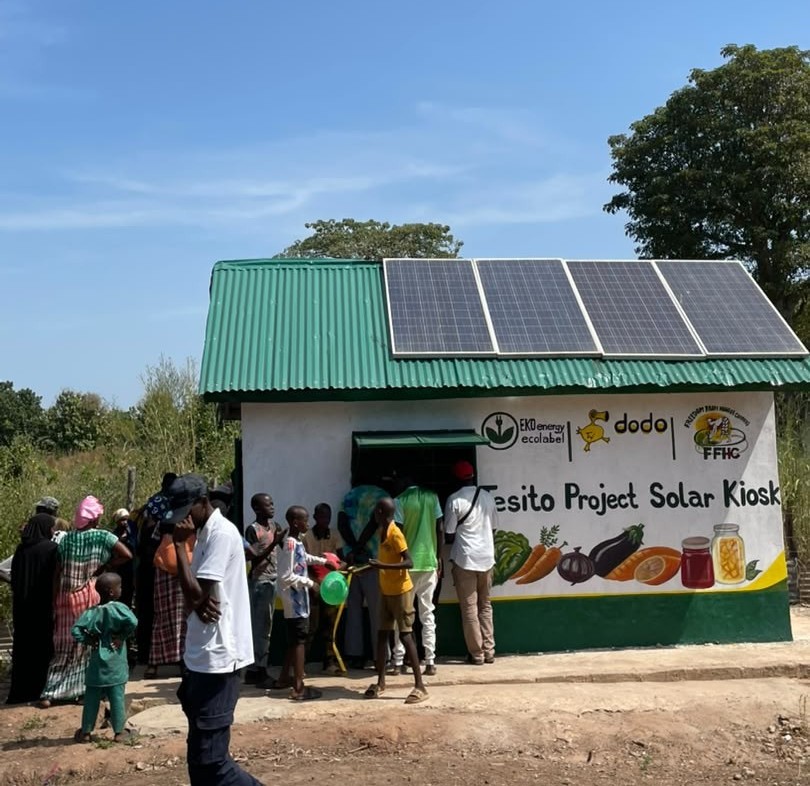
Women vegetable farmers in Dumbuto and Jiffarong have received a major boost with the inauguration of a new solar-powered kiosk designed to reduce post-harvest losses, improve food preservation and improve market access to sell their produce.
The facility, established under the FFHC ‘Tesito’ Project, is expected to strengthen livelihoods within the two communities.
For years, women vegetable farmers in Dumbuto and Jiffarong have faced significant post-harvest losses, with large quantities of vegetables going to waste due to limited storage, processing and marketing opportunities. The challenge has discouraged some women from cultivating crops such as tomatoes and peppers, resulting in reduced production and lower incomes.
The newly inaugurated solar-powered kiosk is expected to change that situation. Equipped with air-conditioning, refrigerators and blenders, the facility will enable farmers to store, preserve and process agricultural produce, selling them with higher profit, while adding value and minimizing waste.
The FFHC Tesito Project is funded by Ministry for Foreign Affairs of Finland through Dodo, a Finnish environmental NGO. The solar kiosk itself was financed by EKOenergy, a non-profit ecolabel for renewable energy that raises funds to support renewable energy projects benefiting local communities.
At the inauguration ceremony, FFHC agricultural extension worker Momodou Lamin Nyabally described the facility as a timely intervention that addresses a longstanding challenge faced by women farmers.
He noted that persistent post-harvest losses had forced some women to stop cultivating certain vegetables because of the difficulties involved in preserving and marketing their produce.
FFHC Director Alpha Khan said he had long looked forward to seeing the project become a reality. Although modest in size, he expressed confidence that the facility would make a significant contribution towards reducing post-harvest losses, increasing incomes and supporting women's economic empowerment.
Community member Yahya Sanyang also welcomed the initiative, describing it as an important contribution to the development of Dumbuto and the surrounding communities.
Speaking on behalf of the women farmers, Teremading Darboe expressed gratitude to the project's partners, saying they had waited a long time for support that could help address the losses experienced after harvesting their vegetables.
She said the facility would provide women with new opportunities to preserve their produce, add value to it and improve household incomes.
Representatives of the NGO Affairs Agency, the village Alkalo and the contractor also praised the initiative, describing it as a positive step towards community development and sustainable agriculture.
For the women of Dumbuto and Jiffarong, the solar-powered kiosk represents more than just a building. It symbolises renewed hope for reducing waste, preserving valuable harvests and creating better economic opportunities.
Situated in an accessible roadside location, the facility is expected to provide a convenient outlet for women to sell processed and fresh agricultural products, helping them secure greater returns from their hard work and strengthen their livelihoods.