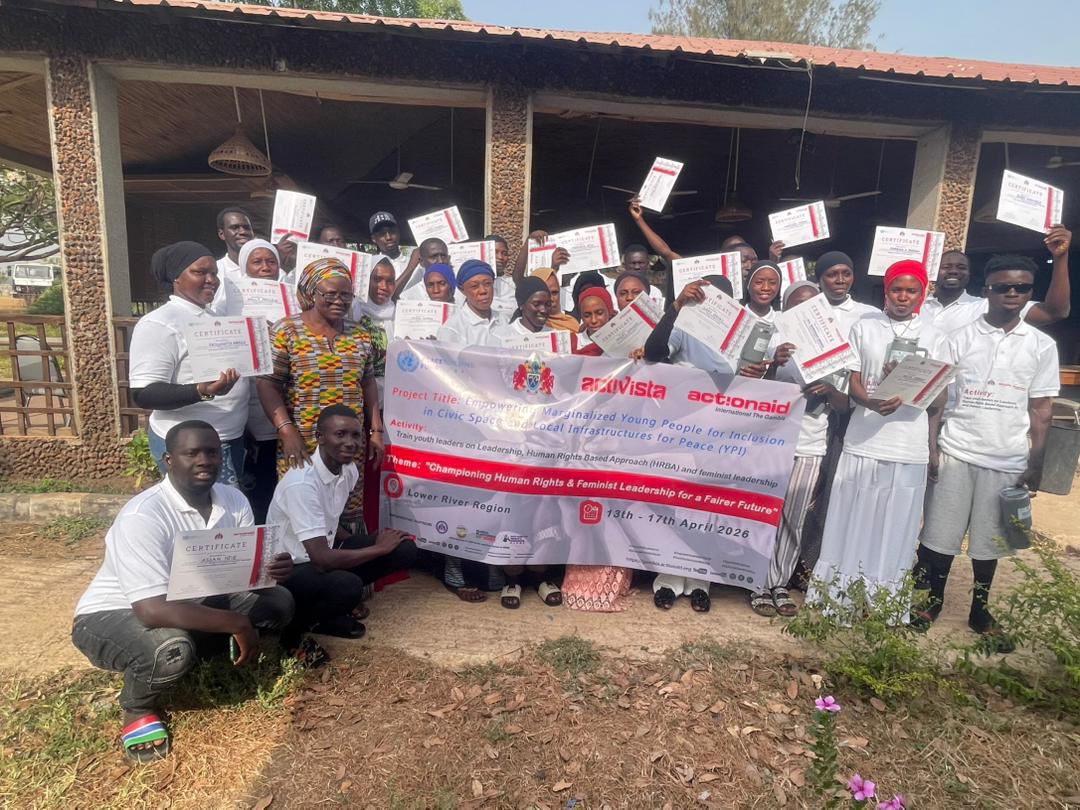
The six-day training, whichwas held at Tendaba Camp, brought together 30 youth leaders across the Lower River Region. The initiative seeks to strengthen leadership skills among participants using principles such as empathy, inclusivity and collective decision-making.
Through a diverse session, group works and interactive sessions, participants explored how to apply Human Rights-Based Approaches and feminist leadership in their communities and daily engagements. The training also focused on encouraging youth-led advocacy and participation in governance and development processes.
At the closing, Bridget Tabou Correa, Project Manager, said the initiative is meant to empower young people to take an active role in society. “We want the youth to participate, to learn, and go out there and manifest whatever information they have gotten.” she said.
She added that understanding rights must go hand-in-hand with responsibility, urging participants to apply what they have learned.
She also stressed the importance of inclusion, particularly the need to ensure women are fully involved in leadership and decision-making processes. “We want you to treat women equally and also to carry them along,” she said.
Programme Officer Saikou Darboe also emphasised the importance of sharing knowledge beyond the training room. “Report back to your people, but also share the knowledge,” he told participants, noting that the true value of the training lies in how it is used within communities.
He warned against failing to retain and apply the lessons learned, saying the impact will only be seen ‘if participants’ are able to pass on the knowledge and influence change.
“If your habit is not changed, your life is not changed, that means we have not made an impact,” he said.
Fabakary Sanneh, Regional Youth and Sports Coordinator for Lower River Region, described the training as intensive but important.
Sanneh noted that the training is never easy, but expressed optimism that it would change something among participants.
He thus encouragedparticipants to continue learning and reflecting even after the programme.
Sirra Ceesay, a participant from Jarra Central, described the six-day interface as demanding, but rewarding.
She sounded optimistic that the experience gained from the session has already enhanced their understanding of leadership and community engagement. However, the training marks another step intheir broader efforts to help promote youth inclusion and strengthen community leadership, with a focus on ensuring that no one is left behind.