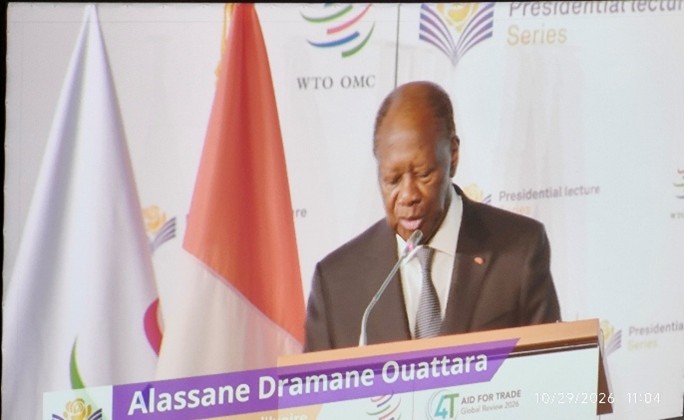
Côte d’Ivoire President Allassane Ouattara has highlighted that international trade remains a powerful driver of growth, as it expands markets, diversifies exports, facilitates the diffusion of technology, enhances business competitiveness, and integrates economies into global value chains.
President Ouattara made these remarks at the presidential lecture of the 20th anniversary of the Aid for Trade programme which also marked as the 10th Global Review of Aid for Trade held on Thursday 29 October 2026 at the World Trade Organization (WTO) headquarters in Geneva, Switzerland.
The occasion was marked with small firms, global rules, a dialogue with the International Trade Centre (ITC) and WTO on standards, regulation and trade facilitation.
The Aid for Trade Global programme signifies strategic partnership as a catalyst for trade development across the globe. The Aid for Trade initiative was launched at the 5th WTO Ministerial Conference in Hongkong in 2005 to help developing economies benefit from market access opportunities offered by the multilateral trading system.
President Ouattara says investment contributes to infrastructure development, modernization of productive systems and innovation, and the creation of sustainable jobs. Together, these two pillars can accelerate development trajectory, he stated.
He however outlined that the benefits are neither automatic nor evenly distributed, emphasizing that an economy that mainly exports raw materials while importing high value-added manufactured goods risks remaining trapped in a position of dependency.
President Ouattara outlined that attracting foreign investment is not an end in itself, that its contribution to development depends on its ability to create jobs, facilitate technology transfer, develop local skills, maximize the opportunities offered by free trade, and build lasting linkages with domestic enterprises.
He emphasized that it is therefore essential to align trade and investment policies with industrial, agricultural, and technological strategies. The aim, he said, is to build economies that are not only able to participate in international trade but also to derive greater value from it and become more resilient to external shocks.
Ouattara noted that globalization aims to make trade more inclusive, diversify value chains, and enable more countries to participate in global economic opportunities.
For developing countries, he said, re-globalization represents an opportunity to move beyond their traditional specialization in primary commodity exports and secure a greater role in innovation, processing, manufacturing, and marketing activities.
“This requires improving infrastructure, developing skills, facilitating access to finance, and promoting technology transfer. It also calls for coherent public policies, strengthened international cooperation, and trade rules that enable the most vulnerable countries to better seize the opportunities offered by the global economy,” he said.
“Re-globalization should allow us to move from an integration model based primarily on the export of raw materials to one founded on value creation, competitiveness, and productive transformation.”
Further, Ouattara revealed that between 2012 and 2025, his country recorded sustained economic growth averaging approximately 7 per cent, despite several external shocks, including the impact of the COVID-19 pandemic.
This performance, he said, exceeded the average for sub-Saharan Africa (3.3 per cent) and the global economy (3.2 per cent) over the same period. It was accompanied by significant growth in trade, gradual market diversification, and strengthened productive capacity.
These results stem in particular from improvements in the business environment, stronger governance, a sound macroeconomic framework, and sustainable debt management, he said.
“Côte d’Ivoire occupies a major position in global cocoa and cashew nut markets. However, our ambition is no longer limited to producing and exporting these commodities. Our goal is to increase their processing within our country, thereby retaining a larger share of value added, creating jobs, particularly for young people, and diversifying our economy,” he explained.
In the cocoa sector, he said progress has been significant, adding that the processing rate for the 2024-2025 season is estimated at 41 per cent. He added that the large number of grinding facilities now enables local production of cocoa liquor, butter, and powder for international markets and the food-processing industry.
The next step, he said, is to move further towards finished products, particularly chocolate and processed food products, which offer additional opportunities for value creation and employment.