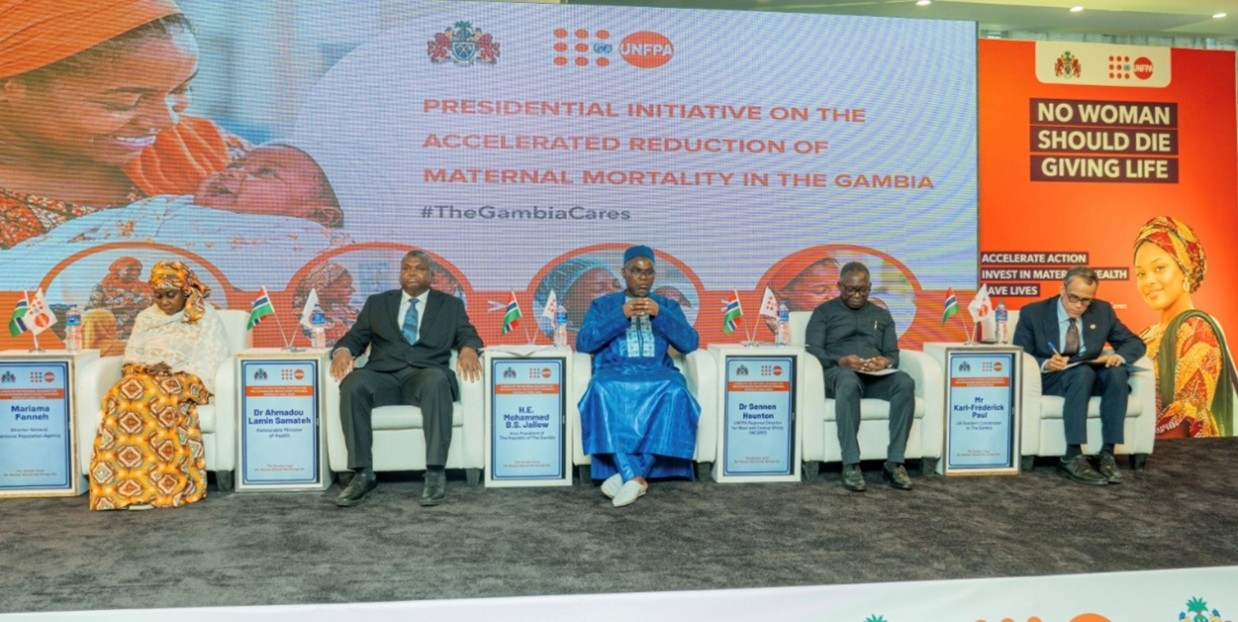
The Gambia has launched a Presidential Initiative for the Accelerated Reduction of Maternal Mortality, alongside a national roadmap aimed at strengthening healthcare services, increasing domestic investment and addressing the social and economic factors contributing to preventable maternal deaths.
The initiative was officially launched on Tuesday at the Sir Dawda Kairaba Jawara International Conference Centre in Bijilo, under the leadership of Vice President Mohammed B.S. Jallow, who represented President Adama Barrow.
The initiative, developed in collaboration with the United Nations Population Fund (UNFPA) and other partners, seeks to strengthen political commitment, improve access to quality maternal healthcare and coordinate action across government institutions, development partners, communities and the private sector.
Speaking at the launch, Vice President Jallow described the initiative as a landmark commitment to protecting the lives and rights of women and girls.
He said the initiative was more than the unveiling of a strategic document, describing it as a declaration of national resolve that no woman should lose her life while giving birth.
According to the Vice President, The Gambia has made progress in reducing maternal mortality, with figures from the 2013 and 2019–2020 Demographic and Health Surveys indicating a decline from approximately 400 to 289 deaths per 100,000 live births.
However, he stressed that more work remained to be done to prevent avoidable deaths and improve maternal health outcomes.
Jallow said maternal mortality was not simply a clinical problem confined to hospitals but a broader issue involving social justice, human rights and governance.
He identified inadequate healthcare infrastructure, limited investment in reproductive health services, gender inequality, harmful social practices and climate-related challenges among the factors contributing to maternal deaths.
The Vice President highlighted government investments in primary healthcare, reproductive health services, skilled birth attendance and emergency obstetric and newborn care.
He also cited the expansion of health insurance coverage, improvements in health infrastructure and efforts to recruit midwives and strengthen rural healthcare services.
He emphasised that women should not be denied access to essential healthcare because they could not afford it.
UN Resident Coordinator Karl Frederick Paul said maternal survival was a fundamental indicator of a country’s social and economic development and its ability to build sustainable human capital.
He explained that maternal deaths and severe complications during childbirth had far-reaching consequences for families, affecting household productivity and the health, education and future opportunities of surviving children.
Paul said the United Nations system was working collectively to address maternal mortality through improved emergency obstetric and newborn care, clinical training, midwifery recruitment, adolescent education, nutrition, food security and women’s empowerment.
He also called for stronger involvement from local councils, governors, traditional leaders and religious authorities in promoting maternal health accountability.
UNFPA Regional Director for West and Central Africa, Dr Sennen Hounton, stressed that preventing maternal deaths required more than medical treatment.
He said women needed skilled midwives, reliable emergency transport, functioning blood banks, equipped operating theatres and uninterrupted electricity to receive life-saving care.
He added that communities and governments must work together to ensure that women could reach healthcare facilities on time and receive quality treatment upon arrival.
Hounton noted that most maternal deaths were preventable with the right interventions and adequate investment.